Walk down any well-designed school athletic hallway and you will notice that the strongest programs do more than hang a paper schedule on the bulletin board. A sports schedule poster is a designed visual asset — one that carries school colors, the team mascot, and a typographic identity that turns a list of game dates into a communication piece that parents save, alumni share, and students stop to look at. When designed well and displayed intentionally, a sports schedule poster does something a plain text list never can: it makes the season feel real before the first whistle blows.
For athletic directors, coaches, and school communications staff managing multiple programs simultaneously, the challenge is not understanding why schedule posters matter — it is knowing exactly what to include, how to design for every display context, and how to connect seasonal graphics to the kind of team recognition that outlasts any single game.
What Makes a Sports Schedule Poster Worth Displaying
Not every schedule graphic earns a spot on a hallway wall or a lobby screen. The ones that do earn that placement share a common set of design qualities that separate a finished communication piece from a printout.
Visual hierarchy that communicates at a glance. The school name or logo, the sport and team level, and the season year are the three anchoring elements every viewer needs to orient themselves. Opponents and game dates fill in below that. A viewer who sees the poster for three seconds should walk away knowing what sport it is and when the next home game falls.
Brand consistency with every other athletic communication. A football schedule poster that uses different school colors than the basketball poster erodes the cumulative impression of a well-run program. The same hex codes, the same mascot treatment, and the same typographic logic across every sport’s schedule graphic creates a unified athletic identity — one that students and community members recognize immediately.
Information density matched to the display format. A full-season schedule on a social media Story can list fifteen games in a legible vertical scroll. The same content on a lobby screen needs to be trimmed to the next five games, sized for hallway reading distance. A printed gymnasium poster can hold the full season at 18"×24" with room for sponsor recognition. Format determines density — not the other way around.
Sports graphics for school game day visuals and schedule posters exist on a continuum: the branding system that works for a game day graphic is the same one that makes a season schedule poster immediately recognizable as part of the same program.
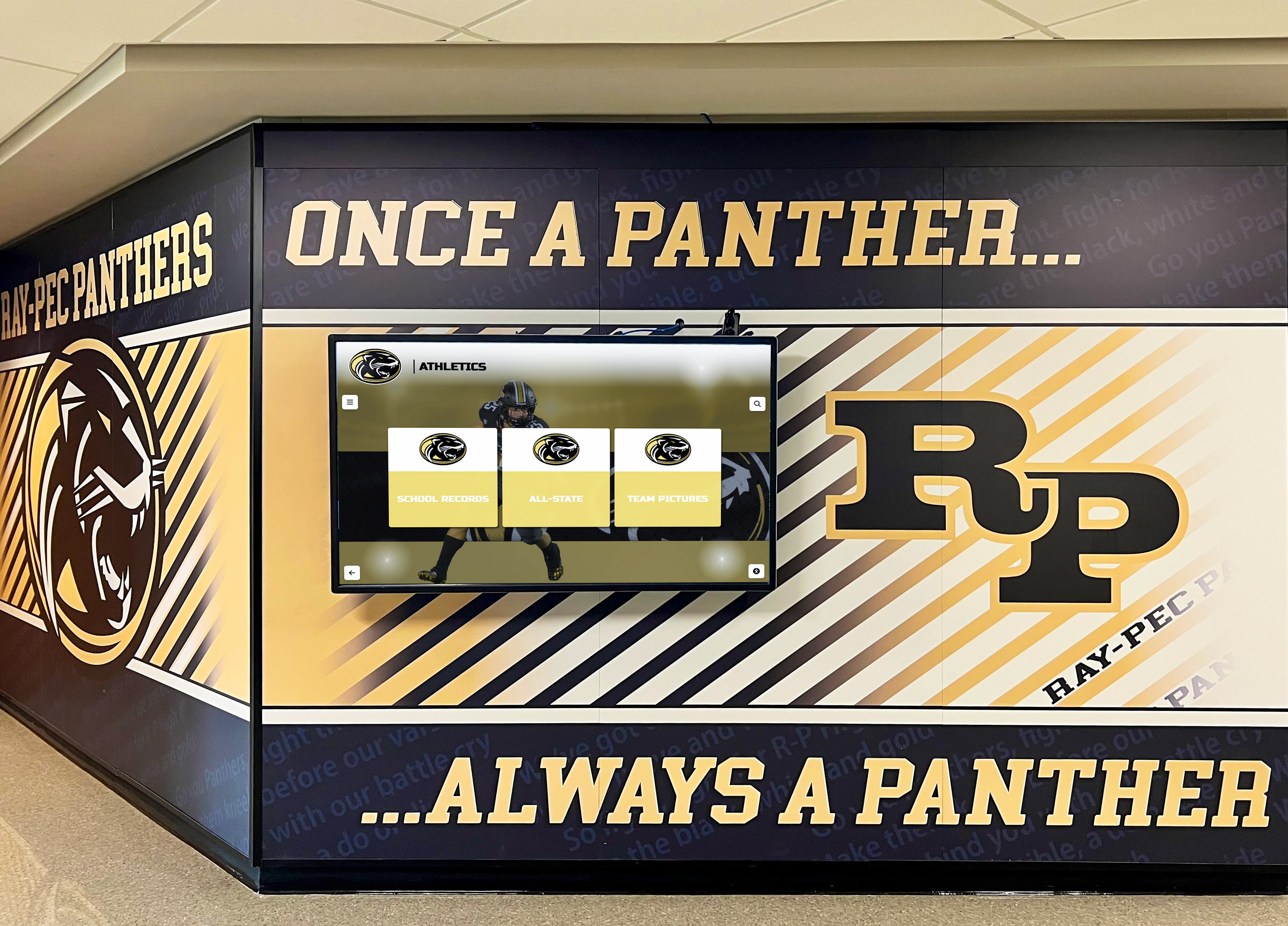
A consistent visual identity — school colors, mascot treatment, typography — links a sports schedule poster to every other graphic the athletic program produces, from hallway murals to digital lobby displays
Types of Sports Schedule Posters for School Athletics
A complete school athletic schedule poster system covers four distinct moments in the program communication calendar. Each type serves a different purpose and calls for different design decisions.
1. Season Preview Poster
The season preview poster is the flagship piece — published at the start of each sport’s season, it announces the full schedule with every game, opponent, date, time, and home/away status. This is the most information-dense format and typically the most widely shared: parents screenshot it, alumni post it, and local media reference it.
Required fields for a season preview poster:
- School logo and mascot graphic
- Sport name and team level (Varsity / JV / Freshman)
- Season year
- Complete game list with date, time, opponent, and home/away designation
- Conference or regional affiliation if applicable
- Head coach name
Best display dimensions:
- Printed poster: 18"×24" or 24"×36" at 300 DPI
- Instagram Story: 1080×1920px
- Lobby portrait screen: 1080×1920px
Season preview posters benefit from a strong visual frame — the school mascot as a commanding background graphic, the team colors as the dominant palette, and the game list organized in a clean, scannable column layout. The opening home game should be easy to find; consider a typographic accent (bold treatment, color highlight, or an icon) to make the home opener stand out.
2. Single-Game Announcement Poster
For rivalry games, senior nights, homecoming matchups, and playoff contests, a dedicated single-game announcement poster earns its own print run and social media push. This format trades the full schedule view for visual impact — a large opponent name, a bold date treatment, and visual energy that earns engagement.
Single-game announcement posters are also the format best suited for lobby digital signage rotation. Readable from hallway distance, communicating one clear message, and designed to stop foot traffic — these posters translate directly to a 1920×1080px landscape screen without redesign.
For senior nights specifically, a single-game poster with senior names or silhouettes added below the game details creates a piece the school can post digitally and physically — connecting the game announcement to the athlete recognition moment that will define the evening. Senior night posters for soccer programs demonstrate how single-game formats extend naturally into recognition displays.
3. Weekly or Rolling Schedule Poster
Once the season is underway, weekly rolling schedule posters keep the community oriented without requiring them to locate and re-read the full season preview. A weekly poster covers the next five to ten days of competition — formatted for quick mobile reading and lobby screen display.
Weekly rolling schedule graphics are the highest-frequency format in the schedule poster cycle. Schools running templates that reduce production to a data-entry task — swap dates, swap opponents, publish — maintain consistent communication without a significant time investment each week.
Team poster ideas for eye-catching athlete displays explore how the visual principles behind team poster design apply directly to rolling schedule graphics — the same emphasis on brand consistency and athlete recognition carries across both formats.
4. Playoff and Tournament Bracket Poster
Playoff schedule posters occupy a special category. A bracket format replaces the linear game list, the stakes are higher, and the visual treatment typically calls for elevated energy — bolder typography, more prominent mascot placement, and visual language that signals “this is different from the regular season.”
For programs that advance deep into playoff competition, a playoff bracket poster becomes a document worth archiving. Schools that reach state finals, district championships, or regional tournaments have a visual record in that bracket poster that feeds directly into hall-of-fame documentation and athletic archive systems.
Fall sports playoff schedule highlights and recognition guides detail how schools connect playoff graphics to formal recognition programs — treating the playoff bracket poster as both a communication tool and a historical document. Similarly, playoff schedule highlights for fall sports recognition demonstrate how schools build on playoff season graphics to create lasting team recognition displays.
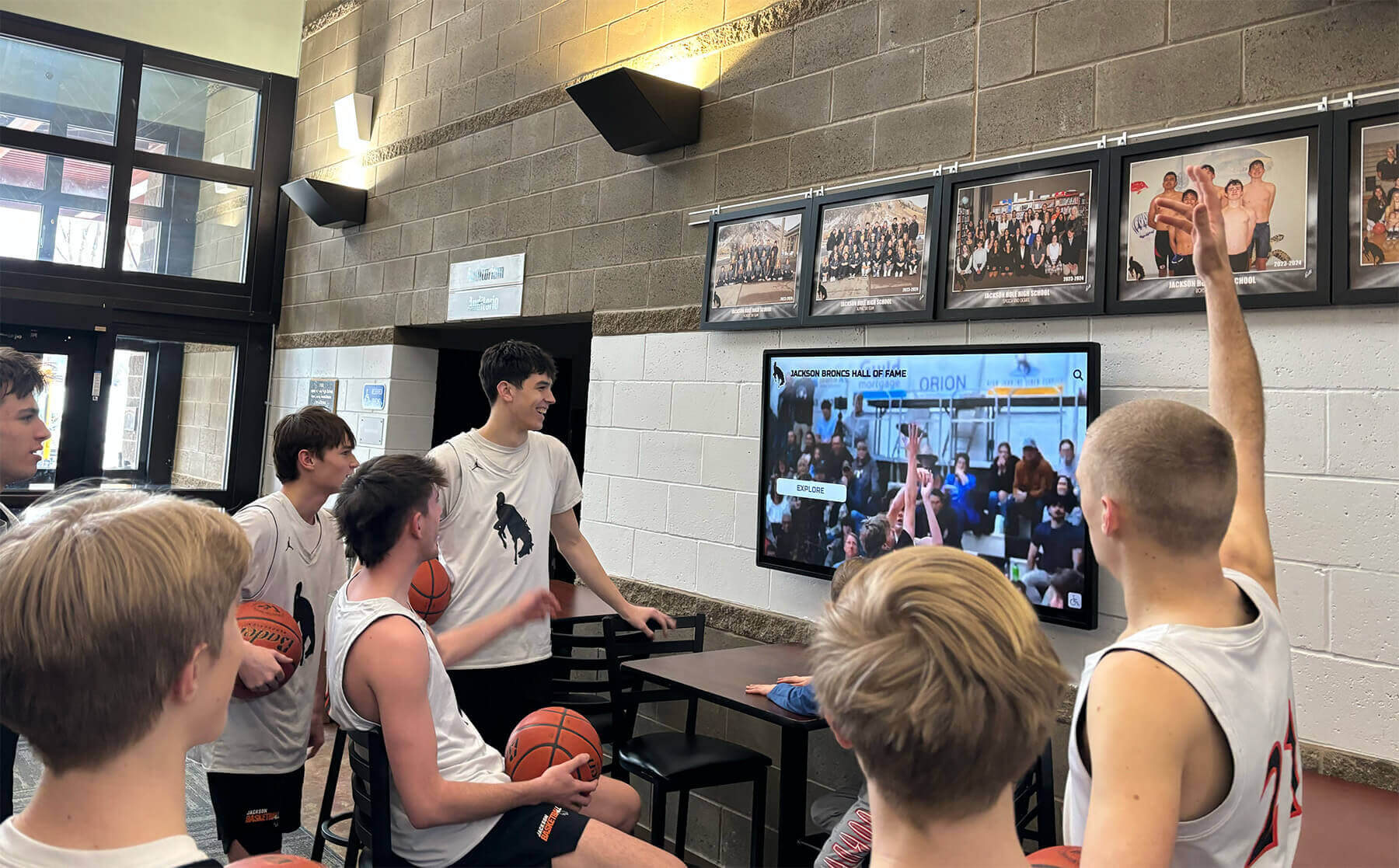
Lobby screens that display game highlights and schedule graphics run on the same visual system developed for printed sports schedule posters — consistent branding across every surface creates a unified athletic communications environment
Visual Checklist: What Every Sports Schedule Poster Needs
Use this checklist before publishing or printing any sports schedule poster. It covers both design quality and information completeness.
Information Completeness:
- School name or logo present (every format, no exceptions)
- Sport and team level clearly stated (“Varsity Girls Volleyball,” not just “Volleyball”)
- Season year included — critical for archiving and future reference
- Every game has a full date (month and day), time (12-hour with AM/PM), opponent name, and home/away designation
- Venue or location name for away games
- Coach name included for season preview formats
Design Quality:
- School colors applied from official hex codes (not approximations)
- School logo appears unmodified — no stretching, recoloring, or effects
- Mascot graphic present, sized appropriately for the format type
- Single typeface family used throughout (bold weight for key data, regular for supporting info)
- Text is legible at the primary viewing distance for the intended display context
- Background-to-text contrast ratio is high enough for all lighting conditions
Format and Dimensions:
- Canvas dimensions match the target platform (print at 300 DPI, digital at native display resolution)
- For lobby screens: minimum 48pt font for opponent names and game dates
- For print: no smaller than 10pt for any text field
- Source file saved and named with sport, season, and version number
Recognition and Archiving:
- Sponsor credit included if required
- File saved to the athletic department’s season archive folder
- Playoff or championship versions flagged for permanent recognition records
Design Elements That Separate Strong Schedule Posters From Forgettable Ones
Mascot Placement Logic
The mascot graphic belongs on every sports schedule poster — but its role changes by format type. On information-dense season preview posters, the mascot works best as a large background element at reduced opacity (15–25%) behind the game rows. The mascot establishes identity without competing with the schedule data.
On single-game announcement posters and playoff brackets, give the mascot full visual presence as a dominant element. At the peak-stakes moments in the season calendar, the mascot should feel commanding — not a watermark.
Maintaining the same mascot version, orientation, and sizing logic across every sport’s schedule poster set creates the cumulative visual effect of institutional strength. A basketball schedule poster and a baseball schedule poster that both use the same mascot treatment read as part of the same program, even when viewed months apart.
Typography Built for Multiple Sizes
Schedule poster typography needs to work at two extremes simultaneously: large enough for the primary game dates and opponent names to read clearly from hallway distance, and compact enough for the full-season game list to fit without requiring tiny print.
A condensed bold sans-serif for primary data (opponent names, game dates) combined with a regular or medium weight for secondary information (time, location, home/away) gives the layout the visual hierarchy it needs without requiring multiple typefaces.
Typography hierarchy for a season preview schedule poster:
- Sport name and season year — largest element, establishes context
- Opponent names — second largest, the variable that changes game to game
- Game dates and times — clearly readable
- Location and home/away designation — smallest, minimum 10pt for print, 24pt for lobby screens
Color Strategy for School Athletics
School athletic schedule posters should use primary and secondary school colors as the foundation — not as accent elements. The poster that reads most clearly as a school communication piece is the one that commits fully to the school palette rather than diluting it with neutral grays and generic backgrounds.
One reliable color structure: the school’s primary color as the dominant background, the secondary color for the sport name and season header, and white for the game list rows. This creates strong contrast, clear visual separation between the header and the game data, and immediate brand recognition from any distance.
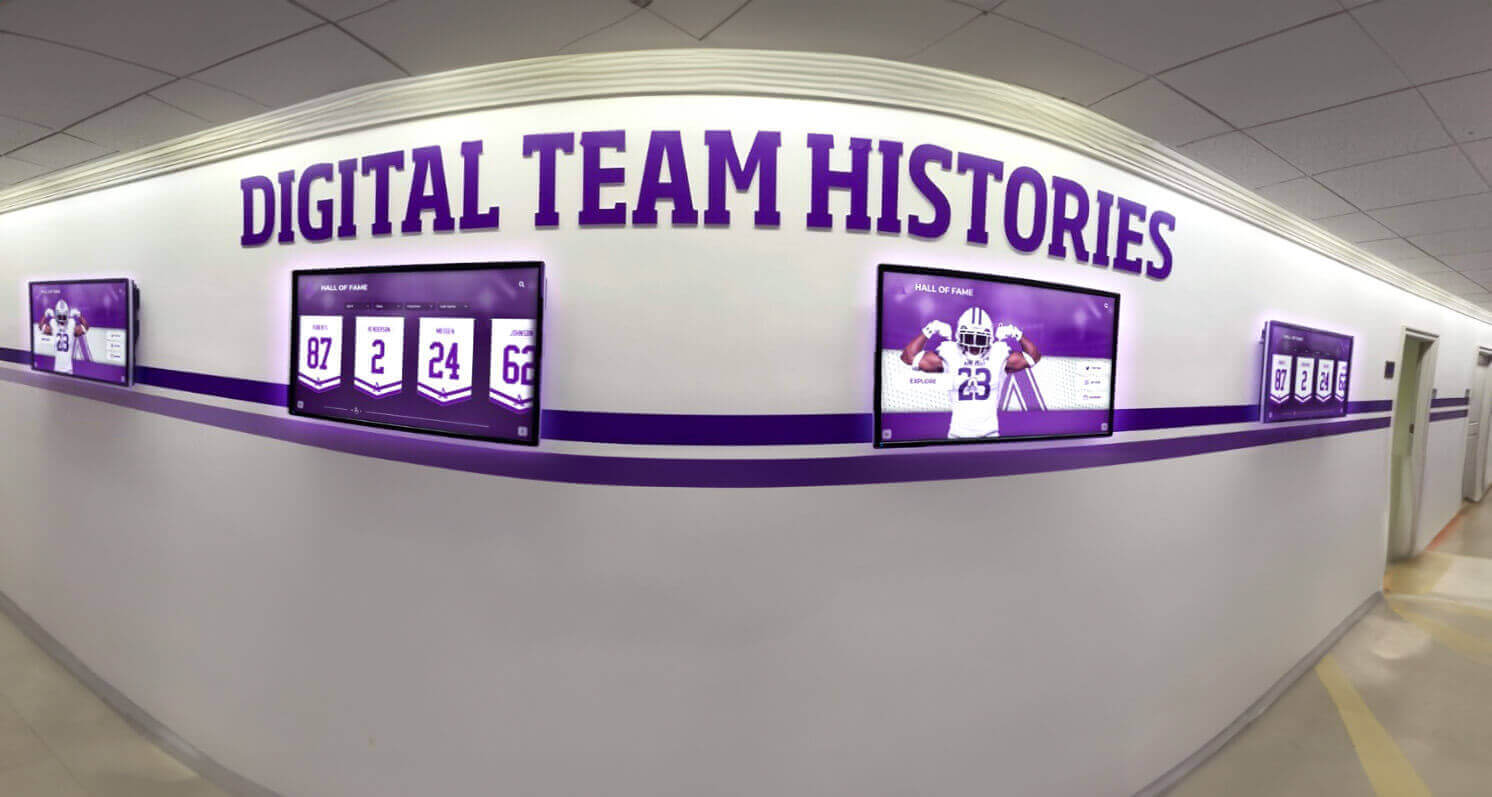
Digital corridor displays running team history content use the same color logic, mascot treatment, and typographic approach as printed sports schedule posters — a unified visual system across every athletic communications surface
Displaying Sports Schedule Posters Beyond Social Media
Most schools default to social media as the only distribution channel for sports schedule graphics — but the schedule poster that earns the most community engagement is the one that appears across multiple surfaces simultaneously.
Lobby and Corridor Digital Screens
Schools running digital display systems in lobbies, main entrances, and athletic corridors have a natural home for rotating schedule poster content. The design principles that make a social media schedule poster legible also apply to lobby screen content — but lobby screens add one consideration social media doesn’t have: viewing distance.
For corridor display, design schedule posters at a minimum 48pt font for opponent names and game dates. Limit each screen to the next five upcoming games — content that tries to show an entire season on one screen is readable at a desk, not from twelve feet away in a moving hallway.
Schools with touchscreen walls of fame or digital trophy case systems can add rotating schedule graphics to the same content playlist without additional hardware. The schedule poster becomes part of the recognition environment — current competition appearing alongside historical achievement.
Printed Gymnasium and Athletic Office Posters
Print distribution of season schedule posters gives parents and community members a physical reference they return to throughout the season. An 18"×24" or 24"×36" season preview poster mounted in the main gym entrance, the athletic office, and the school cafeteria reaches an audience that may not follow the school’s social media accounts.
Championship banner ideas and recognition banner design for schools demonstrate how the same design discipline behind sports schedule posters applies to large-format athletic recognition installations — the visual system scales from a 24"×36" schedule poster to a 4’×8’ championship banner.
For schools that want printed posters without outsourcing design work, AI-powered school graphics platforms can generate print-ready schedule poster layouts from game data, applying school colors and logos automatically. The same tool that produces a social media Stories graphic exports a print-ready version at the correct dimensions and resolution.
Sponsor Recognition on Schedule Posters
Many school athletic programs fund tournament registration, travel, and equipment through community sponsors. A sports schedule poster that includes a sponsor recognition section converts a seasonal communication piece into a tangible return on investment for program sponsors — giving businesses visible, season-long exposure without requiring ongoing production costs.
Sponsor placement best practices for schedule posters:
- Sponsor logo in the footer zone, clearly separated from the game list
- No more than two to three sponsor logos per poster to preserve readability
- Consistent placement across all sports — sponsors know where their logo appears without checking each new poster
Connecting sponsor recognition to the schedule poster workflow is also a bridge to longer-term recognition programs. Schools building donor recognition walls and sponsor displays use the same visual discipline as schedule poster design — consistent brand treatment, clear hierarchy, and recognition that feels institutional rather than transactional.
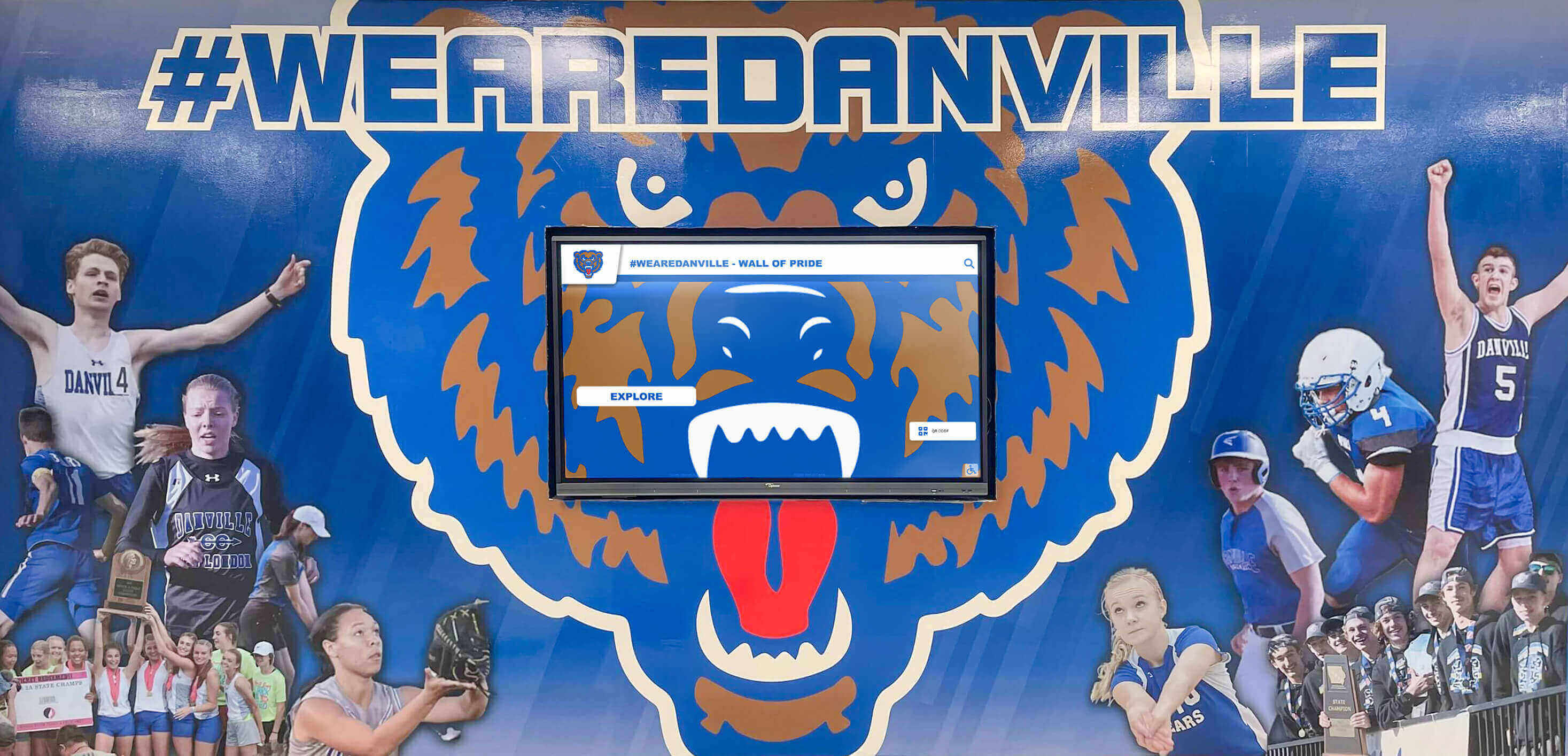
Athletic hallway murals with integrated digital screens create recognition environments where seasonal content like schedule posters coexists with permanent program history — the same visual language links both
From Schedule Poster to Permanent Team Recognition
Sports schedule posters are created to communicate upcoming competition — but they also document the season as it unfolds. A program that archives every season’s schedule poster has a visual record of every opponent faced, the full scope of the season’s competition, and the year the program made a playoff run or set an attendance record.
That archive has long-term value well beyond its immediate communication purpose.
Building a Season-by-Season Athletic Archive
When a program prepares for a hall-of-fame induction, a coach retirement celebration, or a ten-year program anniversary, season-by-season schedule posters provide visual and data documentation that text records alone don’t fully capture. The 2018 football schedule poster shows who was on the schedule the year the program won its first regional title. The 2022 basketball schedule poster documents the season a player broke the all-time scoring record.
All-time records and sports recognition guides demonstrate how athletic programs connect individual performance records to the broader season context — a context that a well-archived sports schedule poster provides at a glance.
Feeding Year-End Recognition Programs
Coaches and athletic directors preparing end-of-season awards programs — MVP, Most Improved, Best Scholar-Athlete — benefit from having the season’s complete game documentation at hand. A systematic archive of schedule posters and game-day graphics creates a visual record that supports award selection beyond what memory alone can provide.
Schools that hold athletic banquets use this archived material as content for recognition slideshow presentations. Sports banquet awards ideas and creative recognition categories explore how banquet recognition programs draw on season-long documentation — the schedule poster is part of that documentation chain.
Team recognition awards with meaningful categories for sports teams extend this further: the same season record that supports individual award selection can power team-wide recognition frameworks that acknowledge team culture, effort, and growth alongside competitive achievement.
Connecting to Hall-of-Fame and Digital Recognition Systems
Rocket Alumni Solutions builds touchscreen halls of fame, digital trophy cases, and interactive record boards that incorporate season-by-season athletic documentation into permanent recognition displays. A playoff bracket poster from a championship year becomes part of the team’s historical record in the touchscreen archive. A roster from the season a coaching record was broken is browsable by returning alumni and current students alike.
Yearbook and team documentation for pre-game unity and team culture reflects the same principle from a different angle: the visual and documentary record built season by season supports not just formal recognition programs but the ongoing culture of the athletic program itself — the sense that what happens this season will be remembered.
When sports schedule posters are produced consistently with the same visual system — same branding, same formatting, same archive discipline — they feed directly into the searchable, browsable digital recognition infrastructure that a hall-of-fame system organizes for years after the season ends. Rocket Graphics will connect seasonal athletic graphics to those touchscreen recognition displays. Get notified when it opens.
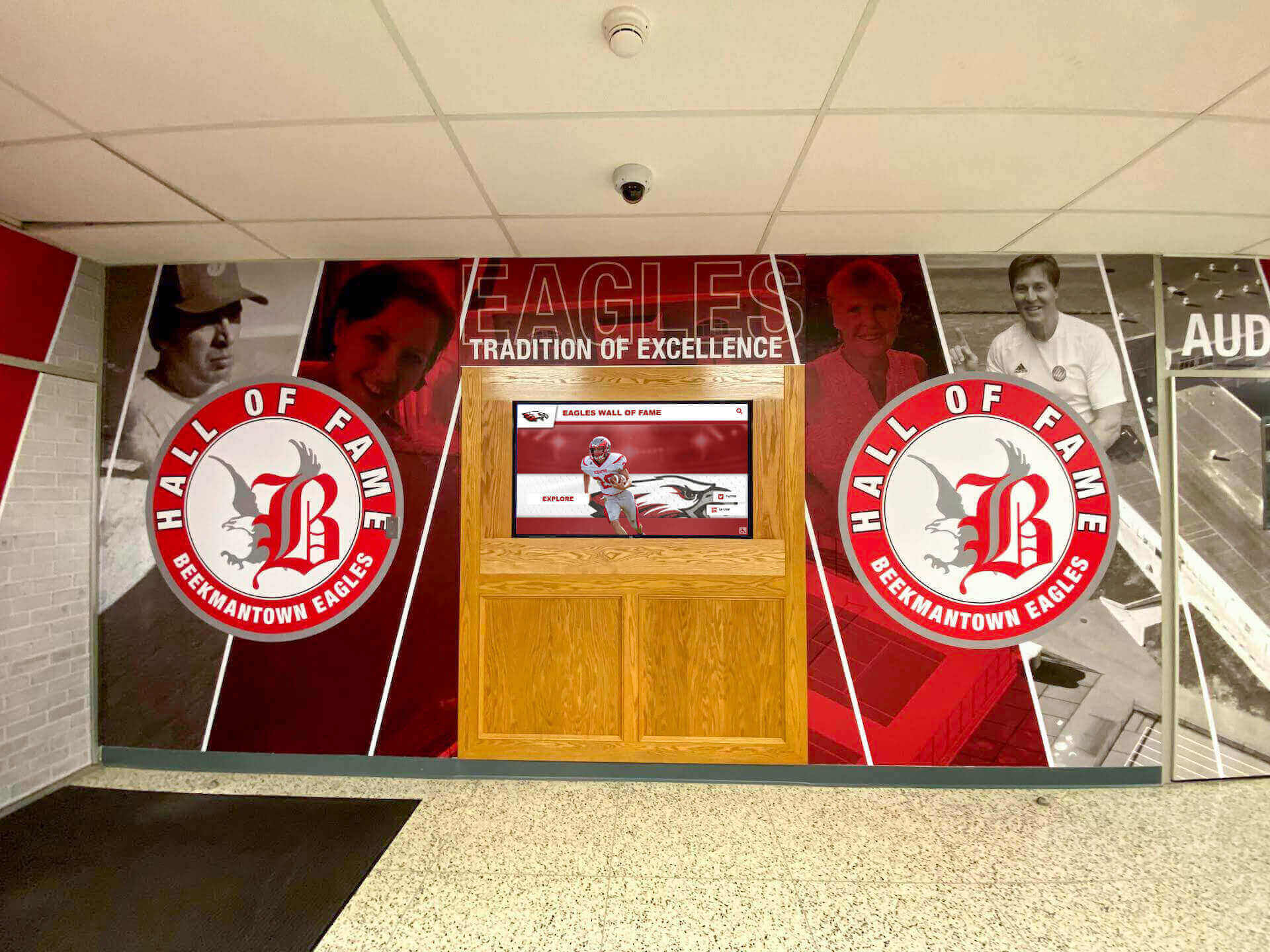
A lobby hall of fame display represents years of accumulated athletic documentation — from season schedule posters to championship records — building toward a visual history that tells the program's full story to every student, parent, and alumni who walks through the door
Creating Sports Schedule Posters With AI Tools
Producing consistent, on-brand schedule posters for ten or twelve varsity sports over an eight-month school year requires either significant design staff time or a template system that reduces each graphic to a data-entry task. AI-powered graphics platforms built for schools accomplish the latter.
Rocket Graphics — a free AI platform built for K-12 athletic departments — generates sports schedule posters from text input, applying school colors and logos automatically. An athletic director or coach enters the game dates, opponent names, and times; the platform produces a ready-to-publish schedule poster in the right dimensions for print, social media, and lobby screens. The same workflow applies to game-day posts, player spotlights, and score updates — all consistent with the school’s visual identity and all feeding the same season archive.
For athletic departments evaluating graphics tools, the most practical test is workflow speed: how many clicks does it take to go from a finalized game schedule to a published social media graphic and a print-ready PDF? AI tools that reduce that workflow to under two minutes per sport make consistent schedule poster production achievable without a dedicated design staff member.
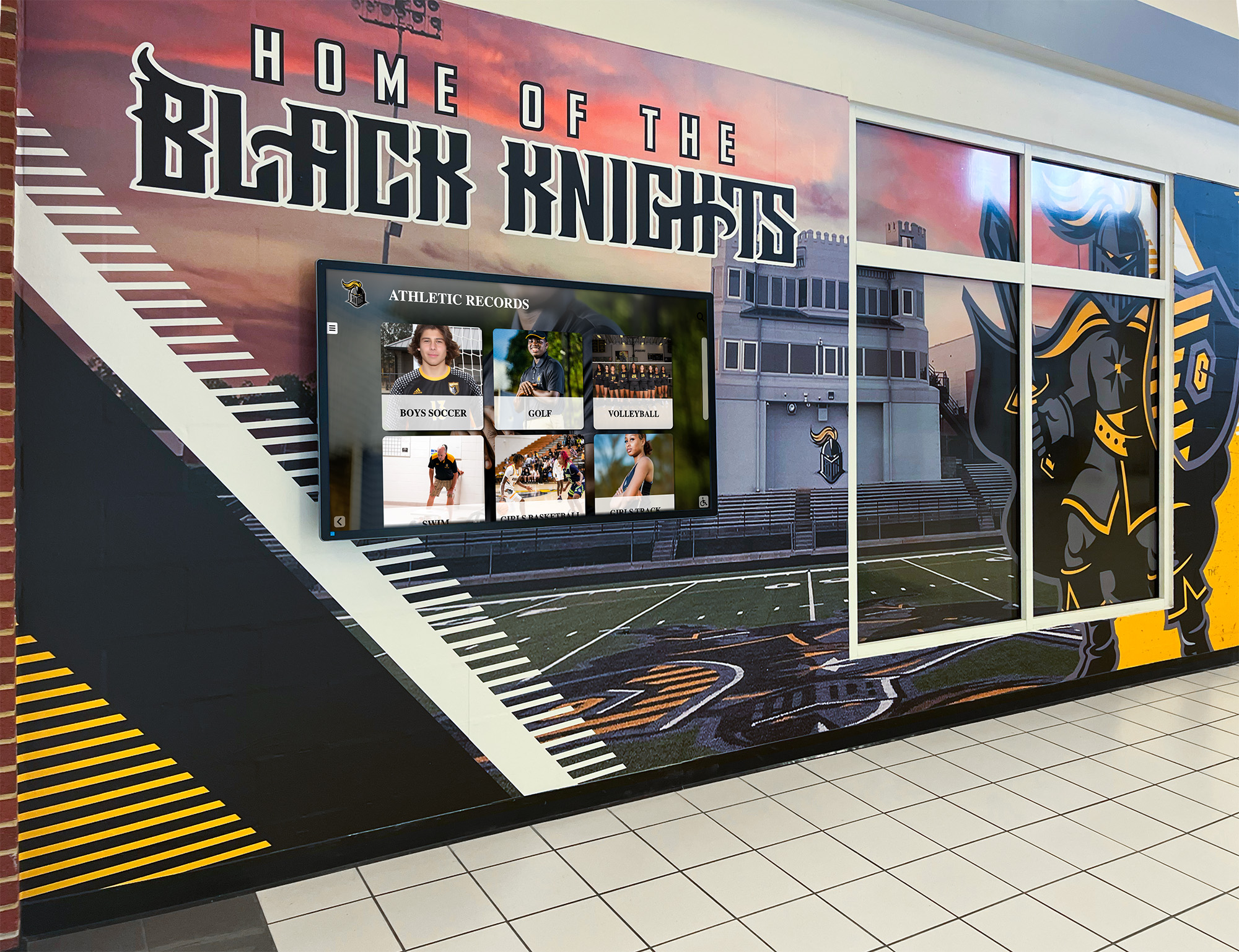
Digital athletic records displays and hallway murals are built from the same visual foundation as sports schedule posters — consistent school colors, mascot treatment, and typographic standards create recognition environments that connect current seasons to program legacy
Frequently Asked Questions About Sports Schedule Posters
What should be on a sports schedule poster?
Every sports schedule poster needs the school logo, sport and team level, season year, and for each game: the full date, start time, opponent name, and home/away designation. Location or venue name adds context. Optional additions include conference designation, ticket or livestream information, running season record, and sponsor recognition in the footer. On single-game announcement posters, the opponent name, date, time, and location should dominate the visual hierarchy.
What size should a sports schedule poster be for print?
For hallway and gymnasium display, 18"×24" is the most practical print size — readable from twelve feet away and printable on standard large-format printers. For a more prominent presence (athletic office lobby, cafeteria wall), 24"×36" gives room for a full season game list with legible text. All print schedule posters should be built at 300 DPI. For digital lobby screens, design at 1920×1080px (landscape) or 1080×1920px (portrait).
How do you make a sports schedule poster look professional without a designer?
Use a pre-built template with school colors and logo locked in. Apply a single bold sans-serif typeface rather than mixing fonts. Use documented hex color codes, not approximations. Place the mascot as a watermark background element on information-dense formats, and as a full-presence graphic on single-game posters. AI-powered school graphics platforms generate schedule posters from game data automatically, applying school branding without requiring design experience.
Can sports schedule posters be displayed on school lobby screens?
Yes — design at 1920×1080px with a minimum 48pt font for opponent names and game dates. Limit each screen to five upcoming games for hallway readability. Schools with existing touchscreen halls of fame or digital trophy case displays can add rotating schedule poster content to the same playlist without additional hardware.
How should schools archive sports schedule posters at the end of the season?
Save the final source file and a high-resolution export for every season, organized by sport and year. Flag playoff and championship season posters for the permanent athletic archive — these have long-term value for hall-of-fame research, anniversary programs, and coach recognition events. Schools using digital hall-of-fame and touchscreen recognition systems can upload archived schedule posters to make season documentation browsable by students and returning alumni.
Connect Your Schedule Graphics to Lasting Athletic Recognition
Rocket Alumni Solutions helps school athletic departments build the recognition infrastructure that makes every season matter — from branded sports schedule posters and game day graphics to touchscreen halls of fame, digital record boards, and recognition displays that connect current competition to program history.
Get notified when Rocket Graphics opens