Sports marketing examples for schools span everything from game day social graphics to corridor banner installations to sponsor acknowledgment boards — and schools that treat athletics communications as a coordinated system, rather than a collection of one-off posts, build stronger programs, more reliable sponsor relationships, and deeper community engagement year over year. This guide breaks down the most effective examples by category, with practical checklists and implementation guidance for athletic directors, communications staff, and facilities teams.
What Is Sports Marketing in a School Context?
School sports marketing is the set of communications, promotions, and recognition activities that build awareness, community, and support for a school’s athletic program. It is distinct from traditional commercial sports marketing in one critical way: the primary audiences — students, parents, alumni, local businesses, and community members — are motivated by identity and pride, not ticket sales or broadcast revenue.
Effective school sports marketing serves four audiences simultaneously:
| Audience | Primary Motivation | What Sports Marketing Delivers |
|---|---|---|
| Current athletes | Recognition, motivation | Spotlight graphics, record displays, award acknowledgment |
| Students and parents | Community connection | Game announcements, score updates, event promotion |
| Local sponsors | Visibility, brand association | Sponsor acknowledgment graphics, banner displays |
| Alumni | Pride, legacy connection | Hall of fame content, historical recognition, reunion events |
Understanding which audience you’re serving with each communication makes every sports marketing decision easier — and ensures that sponsor recognition never crowds out athlete recognition, and that game day promotion doesn’t edge out year-round achievement content.
7 Sports Marketing Examples Schools Use Effectively
The following seven categories cover the full range of school athletic marketing, from the highest-frequency daily communications to the permanent recognition infrastructure that serves alumni for decades.
1. Game Day Promotion Graphics
Game day graphics are the highest-frequency sports marketing output in any school athletic program. Pre-game announcements, live score updates, and final-result posts create a communication rhythm that builds fan engagement over a season.
An effective game day promotion system includes:
- Pre-game announcement (date, time, opponent, venue)
- Starting lineup or key player spotlight
- Halftime or score update
- Final score with win/loss indicator
- Post-game player recognition
Schools running multiple sports simultaneously — fall typically includes football, soccer, volleyball, and cross country — need a template-based system so game day content can be produced in minutes per game, not hours.
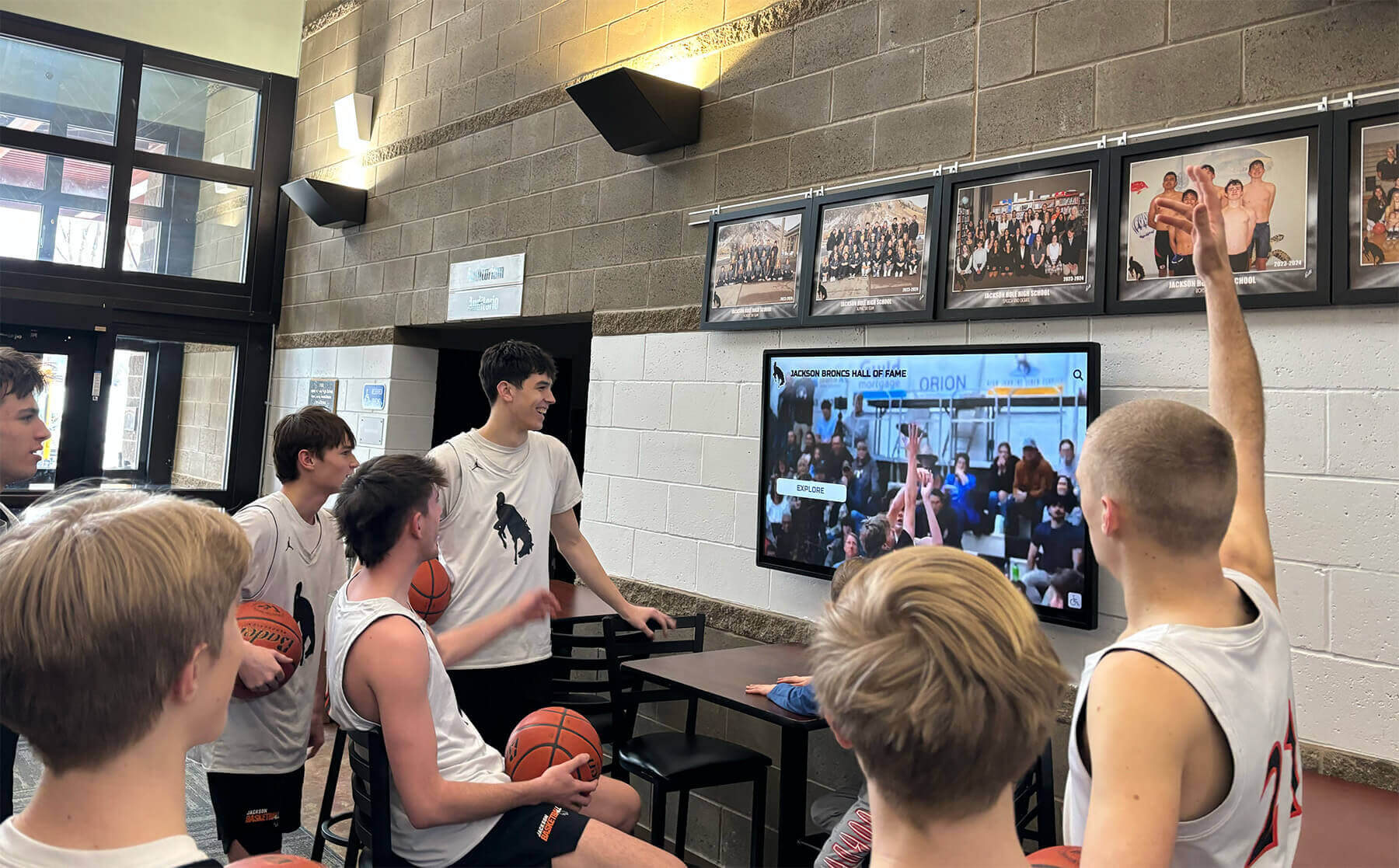
Game day promotion reaches fans on multiple surfaces — social media, lobby screens, and hallway displays all deliver the same message when built from a unified template system
2. Sponsor Recognition Displays
Sponsor acknowledgment is one of the most visible and commercially sensitive school sports marketing categories. Local businesses that sponsor athletic programs expect acknowledgment that is visible, consistent, and policy-compliant under state athletic association rules.
The most effective sponsor recognition formats used by school athletic programs:
- Corridor banner displays — “Presented by [Business Name]” banners at gym entrances and athletic hallways
- Digital signage rotations — Sponsor logo and message cycling in lobby and corridor screen playlists
- Game day graphic acknowledgment zones — Fixed sponsor logo position at the bottom of game day social posts
- Scoreboard or PA sponsorship — Verbal acknowledgment integrated into game-day operations
Policy compliance requires that school identity (logo, mascot, school name) dominates every surface where student athletes appear alongside sponsor branding. A fixed sponsor zone, consistently placed, protects both the school and the sponsor relationship.
3. Digital Athlete Spotlight Programs
Athlete spotlight programs give individual student athletes recognition beyond box scores. They also serve as the most sustainable engagement driver in school sports marketing — families, friends, and teammates share recognition posts at far higher rates than game promotion content.
Effective athlete spotlight formats include:
- Player of the game / week
- Senior athlete recognition
- Academic achievement + athletics combination
- New school record announcement
- All-conference or all-state selection
Player profile templates for athletic archives establish the structured fields that make athlete spotlights useful both for the immediate social post and for long-term hall-of-fame and archive documentation — building a recognition asset that compounds over years.
4. Signing Day Campaigns
Signing day — when senior athletes commit to college programs — is the highest-reach individual sports marketing moment of the school year. Well-executed signing day campaigns generate significant community engagement and reflect positively on the athletic program’s development outcomes.
Athletic signing day ceremonies that create memorable moments for student athletes combine event design, photography, and digital communications into a recognition package that reaches alumni, current families, and prospective students simultaneously.
A complete signing day campaign includes:
- Announcement graphic (athlete, sport, college destination, jersey or school colors)
- Event photography at the ceremony
- Follow-up social spotlight with achievement summary
- Lobby display or corridor banner recognizing the signing class
- End-of-year archive entry with the full signing class documented
National college signing day digital showcase strategies demonstrate how schools are extending signing day recognition from a single ceremony moment to a multi-week visibility campaign across social platforms and physical display environments.
5. Award Ceremony and Recognition Event Promotion
End-of-season award ceremonies are a significant school sports marketing opportunity that most programs underutilize. A well-promoted ceremony — with event graphics, digital signage during the event, and post-event recognition content — extends the marketing value of the program’s achievements beyond the small audience in the gym.
Award ceremony sports marketing components:
- Pre-event announcement graphics for social and corridor display
- Award category announcements used as countdown content
- Event slideshow cycling athlete photos and season highlights
- Post-ceremony award winner recognition posts
- Medal and trophy display options that extend ceremony recognition into permanent physical installations
6. Athletic Lobby and Corridor Displays
Physical display environments — lobby screens, corridor murals, trophy cases, banner installations — are the permanent sports marketing infrastructure that reaches every visitor, recruit, and alumni member who walks through the building. Unlike social media posts that disappear from feeds within hours, corridor displays work continuously.
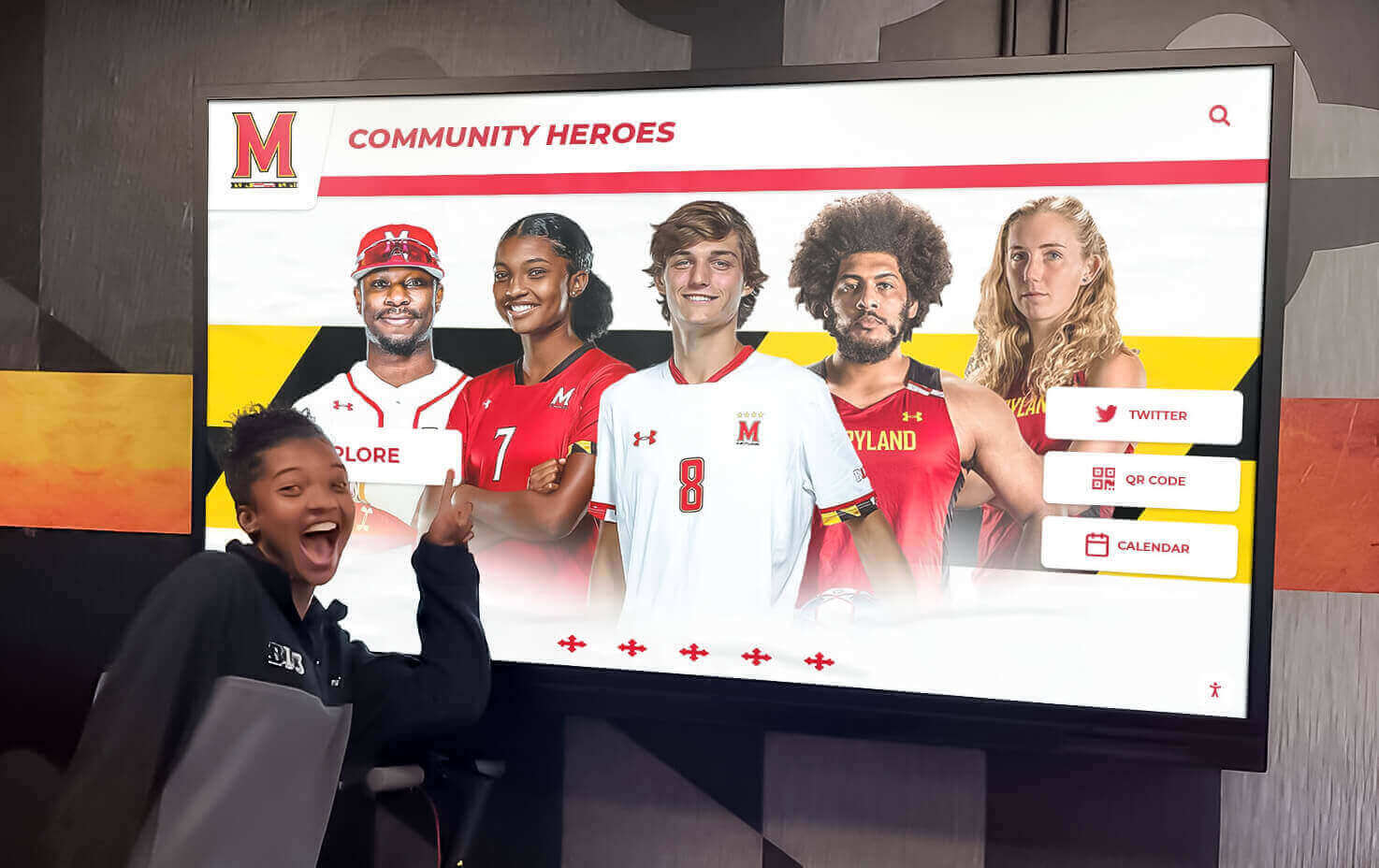
Corridor recognition displays work as always-on sports marketing — serving recruits, alumni, and current students equally with no ongoing production effort per impression
Interactive touchscreen displays that retain users through responsive design represent the current standard for athletic lobby installations — they allow visitors to explore the full program history without requiring staff facilitation, and they update without physical reprinting.
7. Alumni Engagement Campaigns
Alumni are among the highest-value audiences in school sports marketing — they give, they recruit, and they amplify the program’s reputation in ways current families can’t. Reconnecting alumni to current program success through targeted recognition campaigns creates the relationships that support capital campaigns, facility upgrades, and booster club growth.
Alumni event ideas that strengthen the network consistently demonstrate that recognition — specifically, visible acknowledgment that the program remembers and values alumni contributions — drives attendance, giving, and word-of-mouth more reliably than event programming alone.
Game Day Promotion: The Foundation of School Sports Marketing
Game day promotion is where school sports marketing starts for most programs, because it has the clearest production cadence and the most immediate feedback from engagement metrics.
The production challenge isn’t creativity — it’s volume. A school athletic department running eight sports simultaneously may need to produce 15 to 25 game day graphics in a single week during peak season. Without a template-based system, that volume requires either dedicated staff hours that most programs don’t have, or inconsistent quality that undermines the program’s visual identity.
A sustainable game day promotion workflow:
- Build a master template set at the start of the season — game day pre-game, score update, final result, and player of the game — with school logo, colors, and mascot locked in each template
- Assign template access to sport-specific staff or student volunteers who know each team’s schedule
- Establish a publication calendar with default posting times (pre-game 2 hours before tip-off, final result within 30 minutes of the final whistle)
- Archive every exported graphic in a season folder organized by sport and date
Schools that build this workflow in the fall — when football and fall sports demand creates urgency — maintain it through winter and spring with far less resistance than programs that try to build systems mid-season under pressure.
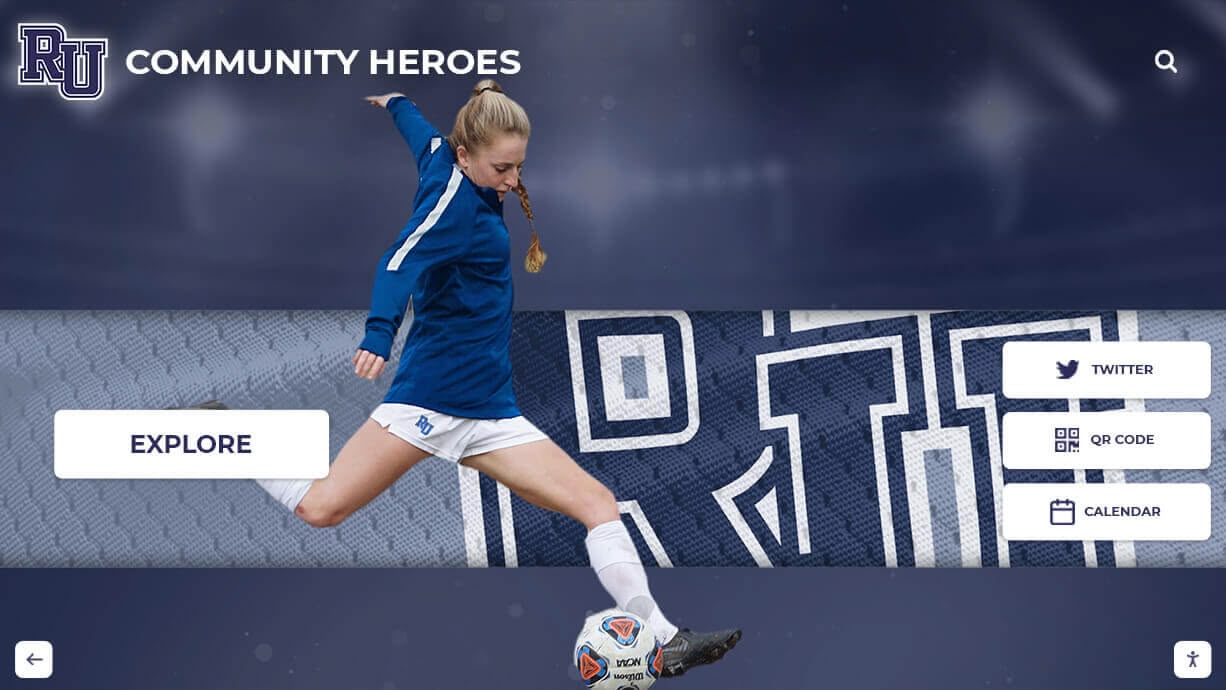
Action imagery combined with community recognition programs creates sports marketing content with both game day energy and lasting recognition value
Sponsor Recognition Examples for School Athletics
Sponsor recognition is where school sports marketing intersects with fundraising, compliance, and community relations — all at once. Programs that handle sponsor acknowledgment well create sustainable revenue relationships; programs that handle it poorly create compliance risk and lose sponsors to competitors.
Effective Sponsor Acknowledgment Formats
The following formats consistently deliver value to sponsors while staying within NFHS and state athletic association guidelines:
Corridor banner installations: “Presenting Sponsor” or “Community Partner” banners at gym entrances, athletic hallways, and lobby areas. Fabric or vinyl banners at consistent dimensions give sponsors visible brand presence in high-traffic, high-dwell-time spaces.
Digital signage slots: A sponsor’s logo and brief message occupying a fixed time slot in the lobby screen content rotation. For schools with multiple sponsors at different tiers, digital signage allows tiered visibility without proportional printing costs.
Game day graphic acknowledgment zones: A fixed sponsor logo zone at the bottom of game day social posts, labeled “Presented by [Business Name],” gives sponsors social media impressions across every post in a game day communications set.
Event title sponsorship graphics: Season finale events — championship banquets, award ceremonies, senior nights — with a named presenting sponsor represented in all event graphics, printed programs, and corridor signage for that event.
What Sponsors Actually Want From School Athletic Partnerships
According to a 2023 survey by the National Federation of State High School Associations, local business sponsors of high school athletic programs rank community visibility and brand association with student achievement above quantified ad impressions as their primary motivations. This means that acknowledgment language and placement matter more than raw audience numbers.
Sponsors value:
- Consistent placement (the same position in every relevant graphic)
- Clear visual separation from athlete imagery (protecting the program from policy violations while protecting the sponsor from negative association)
- Year-round visibility, not just during high-stakes events
- Documentation they can use in their own marketing (a screenshot of a game day post showing their logo in context)
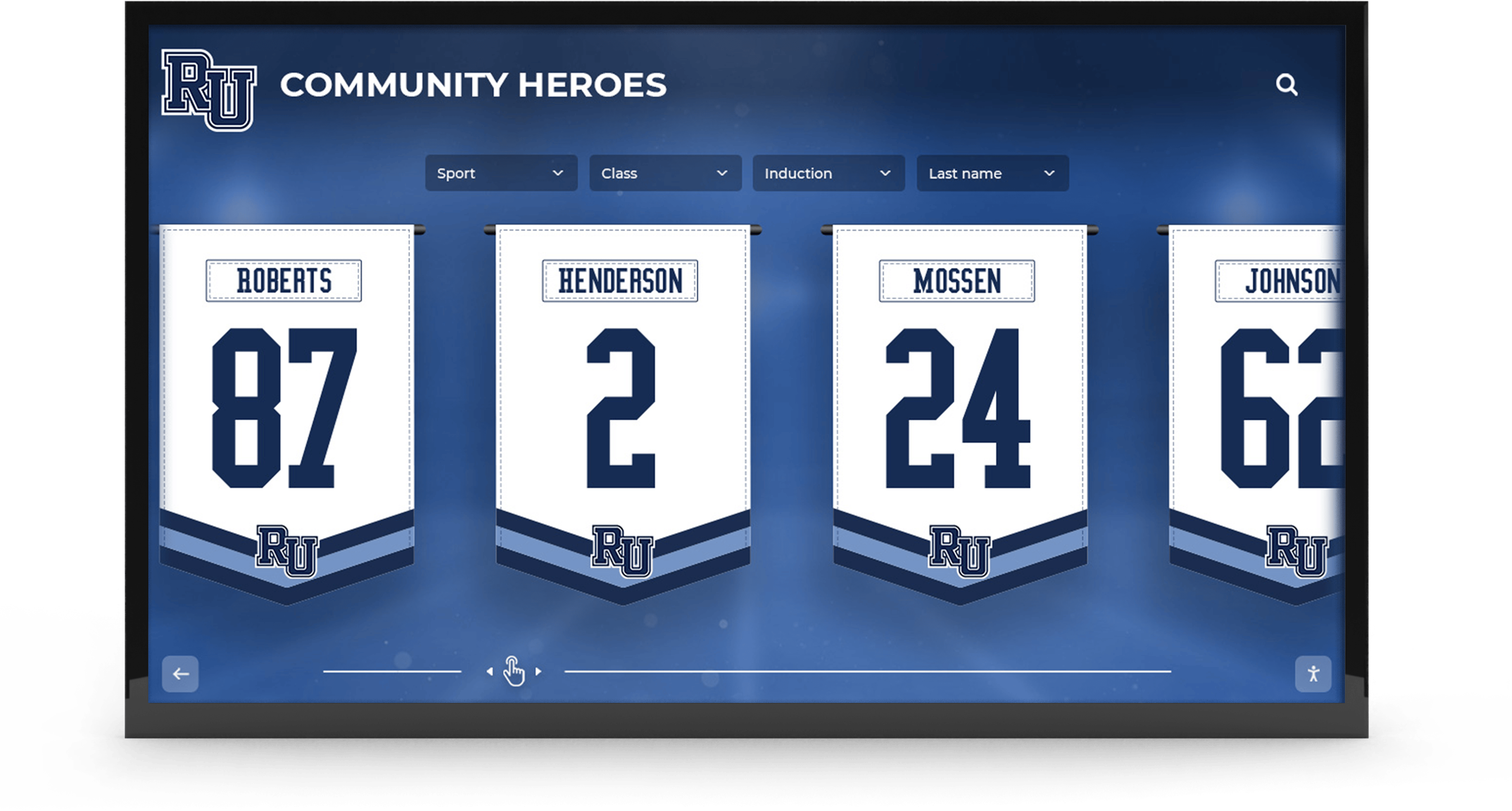
Corridor digital banner displays function simultaneously as athlete recognition and institutional sports marketing — the same installation that celebrates athletes creates the high-dwell-time visibility sponsors value
Digital Displays as Sports Marketing Infrastructure
Digital display systems — lobby screens, corridor touchscreens, and integrated hallway screen networks — are the most versatile sports marketing infrastructure a school can invest in. Unlike printed banners or static murals, digital displays update in minutes, rotate through multiple content types, and serve different audiences at different times of day.
What School Digital Sports Marketing Displays Can Run
A well-configured digital display system in an athletic facility supports all of the following content types simultaneously in a managed rotation:
| Content Type | Update Frequency | Audience Served |
|---|---|---|
| Current season scores and results | Daily / same-day | Current students and families |
| Athlete spotlights (player of week/game) | Weekly | Current students, recruits |
| Sponsor acknowledgment slides | Continuous rotation | Sponsors, community visitors |
| Upcoming game schedule | Weekly | Students, parents, community |
| Hall of fame profiles and records | Evergreen | Alumni, recruits, visitors |
| Signing day recognition | Per event | Entire community |
| Award season highlights | Seasonal | Students, parents, alumni |
Building directory and touchscreen wayfinding installations share infrastructure with athletic recognition displays in many school facilities — a lobby touchscreen can serve both athletic recognition and general visitor wayfinding from the same hardware, improving cost-per-function significantly.
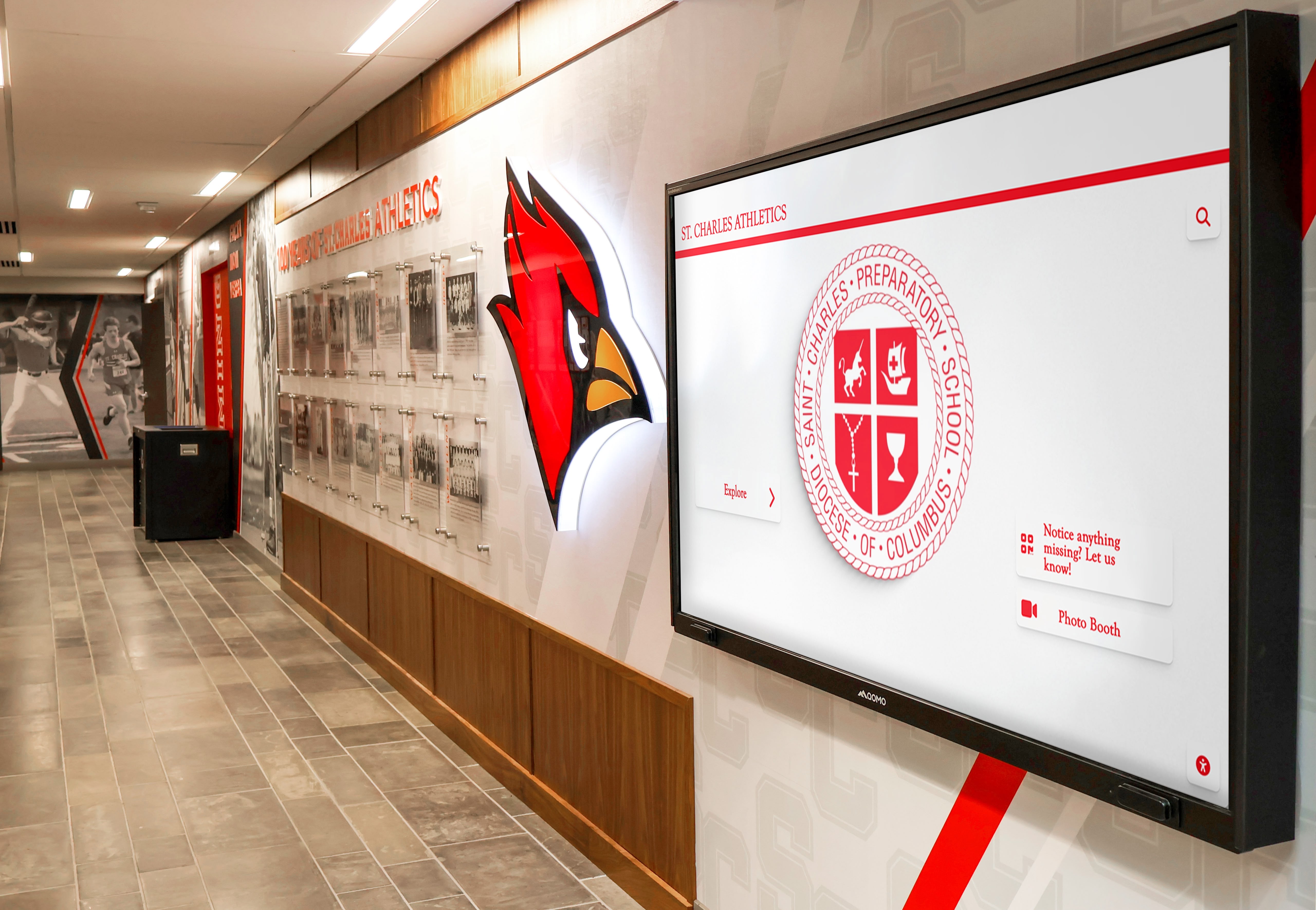
Hallway digital displays with consistent mascot branding and school colors create daily sports marketing impressions for students, staff, and visitors — without any per-impression production effort
Connecting Digital Displays to Social Media Production
The most efficient sports marketing workflows connect digital display content to social media production, so the same graphic serves both channels from a single production effort.
A 1920×1080px game day graphic designed for landscape lobby screens is also the correct dimensions for a Twitter/X post and a Facebook post. A 1080×1080px athlete spotlight designed for Instagram feed posts scales directly to hallway portrait screen content. When the template system is built with both channels in mind, a single production event — populating the template with the game or athlete data — produces content for both social media and physical displays simultaneously.
This workflow is where AI-powered school graphics tools provide their highest-leverage benefit. Rather than managing separate production tracks for social media and physical displays, an AI platform that handles brand application, dimension export, and content delivery across both channels eliminates the duplication that consumes staff time in programs managing both channels manually.
Social Media Sports Marketing for Schools: What Works
Social media is where school sports marketing is most visible to the widest audience — but it’s also where the gap between programs that have a system and programs that don’t is most apparent.
Content Categories That Drive Consistent Engagement
School athletic social media accounts that maintain consistent engagement across full seasons typically run a mix of these content categories:
Recognition content — athlete spotlights, award announcements, record achievements — consistently generates the highest shares and saves, because families and athletes share recognition posts to their own networks. A player of the week post may reach 500% of the school’s social following through shares.
Game-day countdown content — pre-game announcements, schedule graphics, opponent matchup posts — drives event attendance and builds weekly engagement habits among fans who check the account for game updates.
Community connection content — alumni milestones, sponsor acknowledgment, booster club announcements — keeps the broader community engaged during off-season periods and between high-profile events.
Behind-the-scenes and culture content — practice moments, team activities, coaching staff spotlights — builds the parasocial relationship between fans and program that drives long-term community investment.
Season archives and retrospectives — end-of-season stats roundups, career milestone acknowledgments, graduating senior highlights — gives the season’s content a coherent conclusion and creates engagement at low-traffic calendar moments.
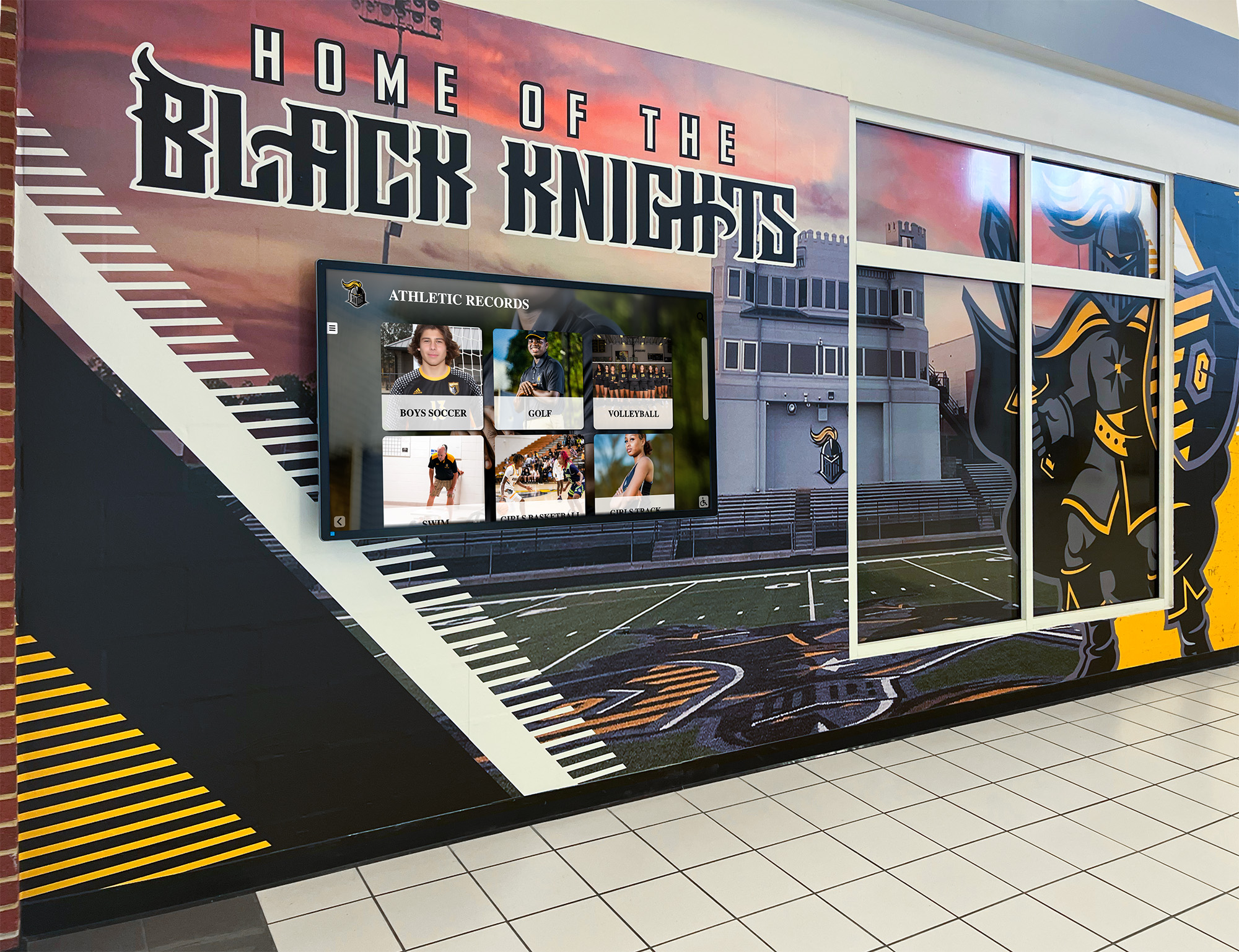
Physical recognition environments — murals, corridor displays, record boards — create the authentic content backdrop that makes school sports marketing social posts credible and distinctive
Platform-Specific Guidance for School Athletic Accounts
Different platforms serve different audience segments in school sports marketing:
Instagram — primary platform for student-facing content. Visual-first. Stories for game day real-time updates; feed posts for athlete recognition and program milestones.
Facebook — reaches parent and alumni demographics most effectively. Event promotion and longer-form program updates perform well. Community group sharing extends reach beyond page followers.
Twitter/X — real-time score updates and result posts, particularly effective for fans who can’t attend games. Score graphics and brief result posts at game’s end.
Email/newsletter — the most reliable channel for reaching parents and alumni who don’t follow social accounts. Weekly or biweekly athletic department updates with links to social content amplify every post to audiences that would otherwise miss it.
Frequently Asked Questions About Sports Marketing for Schools
What are good sports marketing examples for high schools?
Effective school sports marketing examples include game day graphic templates, athlete spotlight programs, sponsor acknowledgment displays, signing day campaigns, award ceremony promotion, athletic lobby displays, and alumni engagement campaigns. The most sustainable programs use template systems that cover all categories from a single unified visual identity, so every communication reinforces the same program brand regardless of which staff member produced it.
How do schools recognize athletic sponsors in their marketing?
Schools recognize athletic sponsors through corridor banners labeled “Presenting Sponsor,” fixed sponsor zones in game day social graphics, digital signage rotation slots, and named event sponsorships in ceremony graphics and printed programs. Effective recognition keeps school identity visually dominant and places sponsor branding in a consistent, clearly separated zone to comply with state athletic association policy.
What digital tools do schools use for sports marketing?
Schools use AI-powered graphics platforms for branded game day posts and athlete spotlights, digital signage software for lobby and corridor screen rotations, touchscreen hall of fame systems for interactive program history, and email newsletter platforms for reaching alumni and parents. Each tool addresses a different audience segment and content type, and they work best when connected by a shared visual identity system.
How do you build a school sports marketing plan?
Identify the four key audiences (current athletes, students and parents, sponsors, alumni), build a template set for each major content category, assign production responsibilities by sport or content type, establish a posting calendar with default cadences, and archive every produced graphic by season and sport. A plan built at the start of the fall season covers the full academic year without requiring mid-season system changes under pressure.
How can schools use digital displays for sports marketing?
School digital displays — lobby screens, corridor touchscreens, and hallway screen networks — run current scores, athlete spotlights, sponsor acknowledgment slides, schedules, and hall of fame content continuously. Design templates at 1920×1080px to serve both lobby screens and social media from a single production event. Schools with touchscreen display infrastructure can update content across the full physical display system as quickly as posting to social media.
Connect Your Sports Marketing to Permanent Athletic Recognition
Rocket Alumni Solutions builds touchscreen halls of fame, digital record boards, corridor recognition displays, and AI-powered graphics platforms that bring every element of school sports marketing — game day promotion, sponsor recognition, athlete spotlights, and alumni archives — into a unified recognition environment visible to students, families, recruits, and alumni year-round.
Get notified when Rocket Graphics opens