The walls of a school gymnasium hold more institutional memory than any trophy case or program booklet. A single wall — painted with the right combination of team colors, mascot imagery, championship years, and record-holder names — can communicate decades of athletic tradition to a visiting recruit in thirty seconds flat. The best school gym artwork doesn’t just fill empty wall space. It tells a complete story: who competed here, what they achieved, and why the program is worth continuing.
For athletic directors and facilities teams planning a gym renovation or recognition upgrade, the range of design options now spans far beyond a painted mascot and a row of hanging banners. This guide covers the categories of gym artwork that have the most impact for recognition and tradition-building, the design principles that make each category effective, and the point at which static artwork reaches its limits and digital recognition systems extend the story further.
What Makes School Gym Artwork Different from Ordinary Wall Décor
School gym artwork carries recognition obligations that standard commercial or institutional wall art doesn’t. A painted mural in a hotel lobby exists to create atmosphere. A painted mural in a school gymnasium exists to honor athletes, acknowledge champions, and anchor an athletic program’s identity across generations of students.
That recognition obligation changes every design decision. Color choices aren’t aesthetic preferences — they’re school brand standards. Athlete names aren’t decorative text — they’re institutional records. A mascot treatment isn’t clip art — it’s a symbol that current students will wear and former students will recognize thirty years from now.
School lobby designs that welcome visitors and showcase community pride illustrate how the entryway and gym together frame a school’s identity for everyone who steps through the door. Gym artwork is the athletic chapter of that institutional story.
8 Types of School Gym Artwork That Tell Athletic Stories
1. Championship Banner Displays
Championship banners are the oldest and most universal form of school gym artwork. A row of banners — district, regional, state, national — hanging from the gymnasium rafters communicates program history at a glance. The visual density of a full championship banner series is itself a statement: a wall of twenty banners spanning forty years reads as a tradition, not a lucky season.
What makes championship banner displays effective:
- Consistent dimensions across the full series (visual coherence beats individual design)
- Four-digit year as the primary visual element — readable from center court
- Sport and championship level on every banner (not all programs earn the same classification)
- Official school colors in exact brand specifications — color drift across banner vendors creates visible inconsistency that accumulates over decades
Championship banner templates for schools and sports teams offer a useful starting point for standardizing a series.
2. Athletic Hall of Fame Murals
Hall of fame murals move beyond year-by-year titles to recognize individual athletes whose careers defined the program. These are the most ambitious form of school gym artwork in terms of scope — they need to accommodate a growing roster of inductees, balance photography with biographical text, and remain readable from across a gymnasium floor.
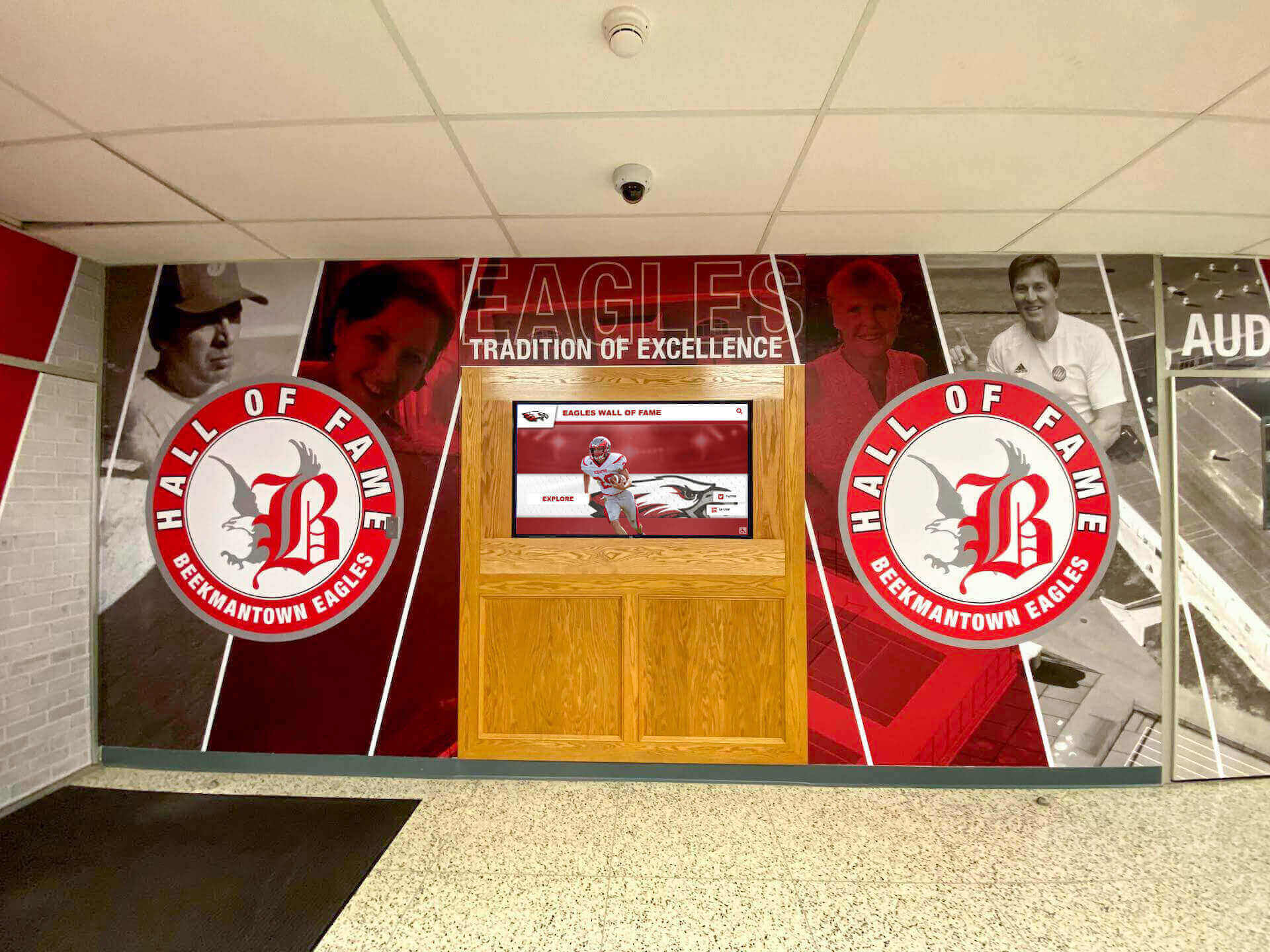
A hall of fame mural format that uses athletic shields to organize individual recognition — each shield communicates athlete identity at lobby viewing distance while rewarding closer reading with career detail
Design elements that make hall of fame murals work:
- Modular panel system that allows new inductees without redesigning the full installation
- Name and sport in large type readable at 10+ feet
- Career summary, years, and achievement in secondary type readable at arm’s length
- Consistent photographic treatment (same framing, same editing style) across all inductees
- School mascot and color system as a unifying visual framework rather than individual panel themes
Recognizing championship teams through digital and physical displays explores how the hall of fame format applies across team sports as well as individual athletes.
3. Athletic Record Boards
Record boards are a distinct category of school gym artwork: less about visual expression, more about institutional data. A well-designed record board communicates the program’s benchmark performances — single-season scoring records, career statistics, team win streaks — in a format that current athletes can reference as targets.
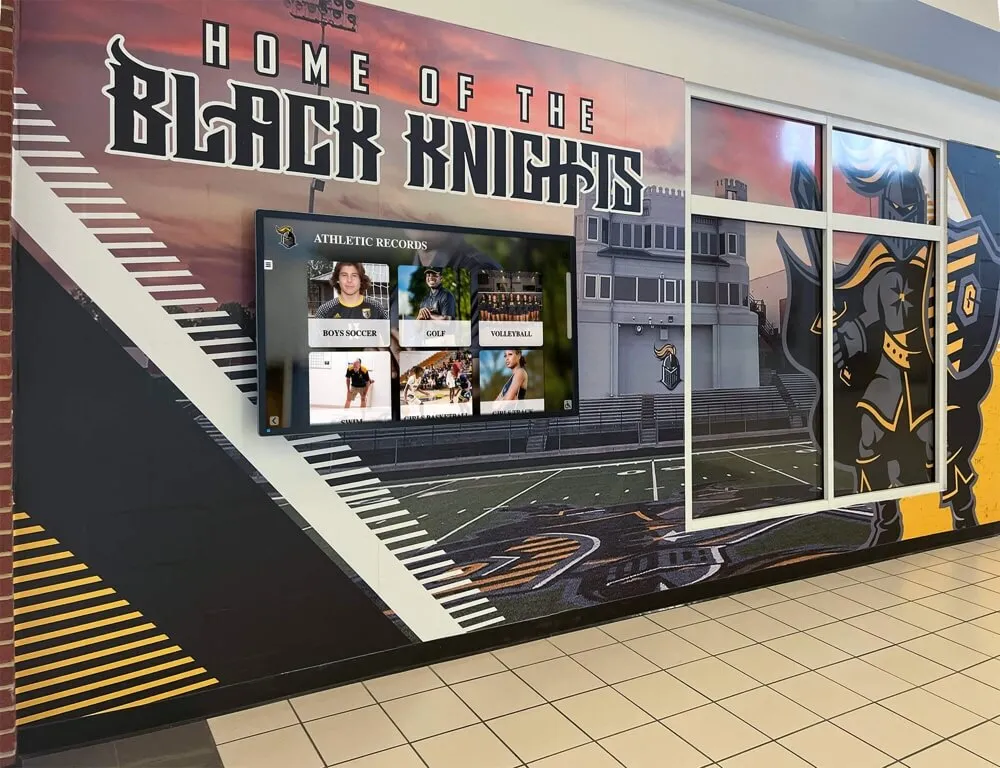
Combining a painted mural with a digital records display allows a gym to maintain its traditional visual identity while keeping records current without reprinting physical panels
Record board design principles:
- Sport-by-sport organization rather than mixed alphabetical lists
- Record holder name, year, and mark as the minimum data points per entry
- Update mechanism — physical record boards require reprinting or overlay panels when records fall; digital record boards update without physical replacement
- Prominent placement within the gym so current athletes pass the board daily, not only on competition nights
4. Team History Timeline Displays
Timeline displays organize a program’s history chronologically rather than by individual. They’re particularly effective for schools with long athletic traditions — a timeline that runs from the program’s founding through the present creates a sense of continuity that individual trophy cases and banner series don’t capture.
What to include in a team history timeline:
- Program founding year and original team name or classification
- First championship or milestone win
- Coaching tenures with record summaries
- Facility changes and renovation dates that mark eras
- State or national recognition events
- Championship years plotted as milestones on the timeline
Showcasing AAU and travel teams through recognition displays demonstrates how even non-traditional school programs benefit from the historical organization that timeline displays provide.
5. Trophy Wall and Case Installations
Physical trophies are some of the most legible recognition objects in a gymnasium — they’re immediately understood by any visitor as representing a specific achievement. But unorganized trophy cases that accumulate trophies across decades without context lose their recognition value. Trophies sitting in a dimly lit case without labels communicate nothing about who won them, what sport, or what year.
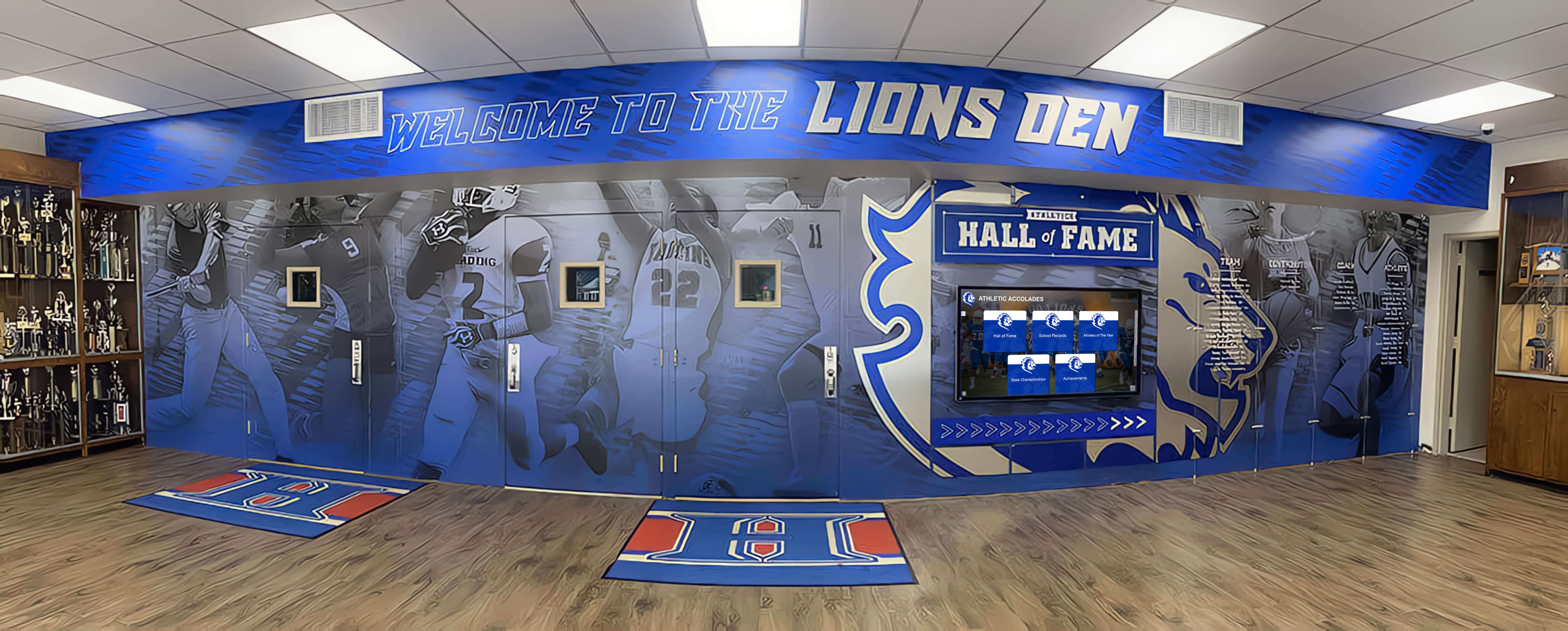
An organized trophy case environment with mural backing — the visual context the mural provides elevates the recognition value of each individual trophy by connecting it to the program's broader identity
Trophy wall design improvements:
- Illuminated case displays that make trophies visible under gymnasium lighting
- Clear labels: sport, year, classification, and any individual award recipients
- Chronological or sport-based organization rather than size-based arrangement
- Painted or vinyl mural backing behind the case that extends the school’s visual identity into the display environment
- Dedicated lighting that makes the case a destination rather than background architecture
6. Sport-Specific Mascot and Identity Murals
Mascot murals are the most recognizable category of school gym artwork — the image most people picture when they think of gymnasium walls. A well-executed mascot mural communicates school identity instantly and creates the visual backdrop against which every competition and practice takes place.
Effective mascot mural approaches:
- Full-wall treatment that uses the mascot as a field of action rather than a small centered logo
- Integration with school colors across the entire gym wall, not just the mascot itself
- Combination of mascot imagery with typography — school name, motto, or tradition phrase
- Sport-specific versions that adapt the mascot to the gymnasium’s primary sport
School main office and hallway décor that shows pride from first impression illustrates how mascot identity that begins at the school entrance carries naturally into the gym interior.
7. Retired Number and Jersey Displays
Retired number displays occupy a specific and highly legible recognition format in school gym artwork. A large number, the player’s name, and the years they wore the jersey communicate the program’s highest individual honor in a visual format that reads from anywhere in the building.
Retired number display formats:
- Physical jersey framing (most traditional — original game-worn jersey in a display case with plaque)
- Large-format number panels mounted high on gymnasium walls alongside championship banners
- Painted number treatments integrated into the gym mural system
- Digital jersey display boards that include career statistics alongside the number
Gym lobby touchscreen displays for digital trophy showcases explore how retired number recognition extends naturally into interactive digital environments where a visitor can pull up a player’s complete career statistics alongside their number.
8. Interactive Digital Recognition Displays
Interactive digital displays represent the newest category of school gym artwork — and the one with the highest capacity for recognition. Where a painted mural is fixed at the moment of installation, a digital display updates annually to add new inductees, new champions, and new record holders without physical replacement.
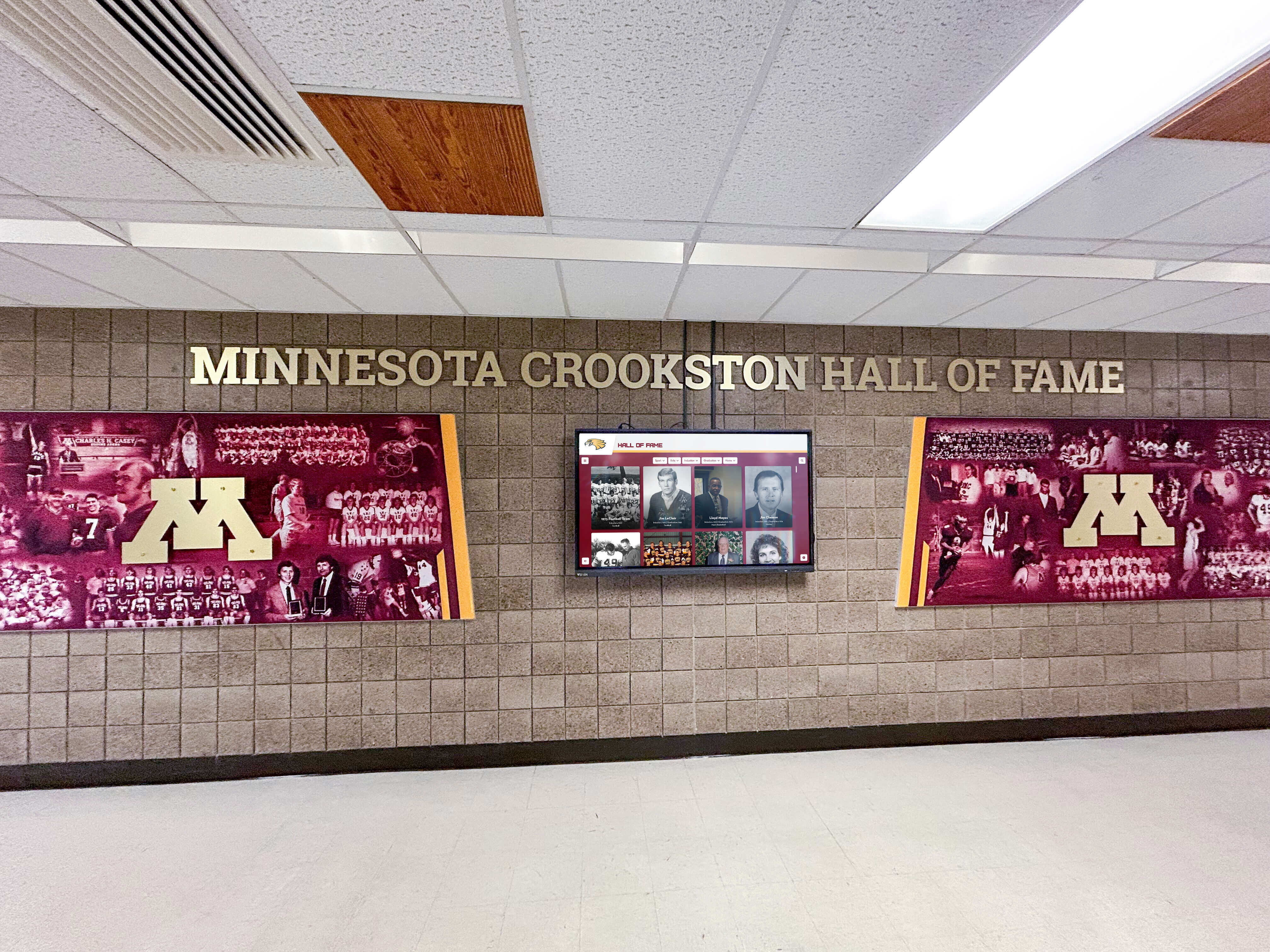
A hall of fame environment that combines painted murals for permanent visual identity with a digital screen for current and searchable recognition — the physical and digital layers serve complementary functions
What digital recognition displays add to traditional gym artwork:
- Full athlete biography, statistics, and career photos beyond what physical space allows
- Searchable database that lets visitors find any inductee by name, year, or sport
- Video highlights and archived footage embedded alongside recognition records
- Annual updates that add new inductees without reprinting or repainting
- Multiple sport coverage in a single unified system
Academic and scholar recognition through school display systems shows how the same digital recognition infrastructure that serves athletic halls of fame extends to academic achievement displays — a natural expansion for schools recognizing multiple programs on the same walls.
Design Principles for Effective School Gym Artwork
Across all eight categories, the same design principles determine whether gym artwork achieves its recognition purpose or simply fills wall space.
Readability at gymnasium distances. Text that cannot be read from center court has failed its primary function. Apply 1 inch of letter height per 10 feet of viewing distance as a starting rule: a name displayed 25 feet from center court needs letters at minimum 2.5 inches tall.
School brand consistency. Official hex codes for school colors should govern every artwork project — not approximations based on vendor color charts. Color drift between banner print runs, mural paint batches, and digital display settings creates visible inconsistency when all displays exist in the same environment simultaneously.
Modular architecture for growing recognition. Any artwork system that doesn’t accommodate future inductees forces a full redesign within a decade. Design for expansion from the first installation: modular panels, reservable space on record boards, and scalable digital systems that add entries without replacing the infrastructure.
Layered information hierarchy. Name and achievement at reading distance; sport and year at arm’s length; biographical detail for visitors who choose to engage closely. This three-layer approach serves both the student passing by at a jog and the alum who returns for homecoming and wants the full story.
Honoring Champions Across Eras
One of the most powerful functions of school gym artwork is connecting generations of athletes who never competed in the same era. A current varsity basketball player who walks past a 1987 state championship banner shares something with the team in that photograph — they wear the same jersey, compete in the same building, and carry the same program identity.
That connection is the institutional value of gym artwork that no individual competition produces. Recognition systems that span decades create the sense of a tradition rather than a sequence of seasons.
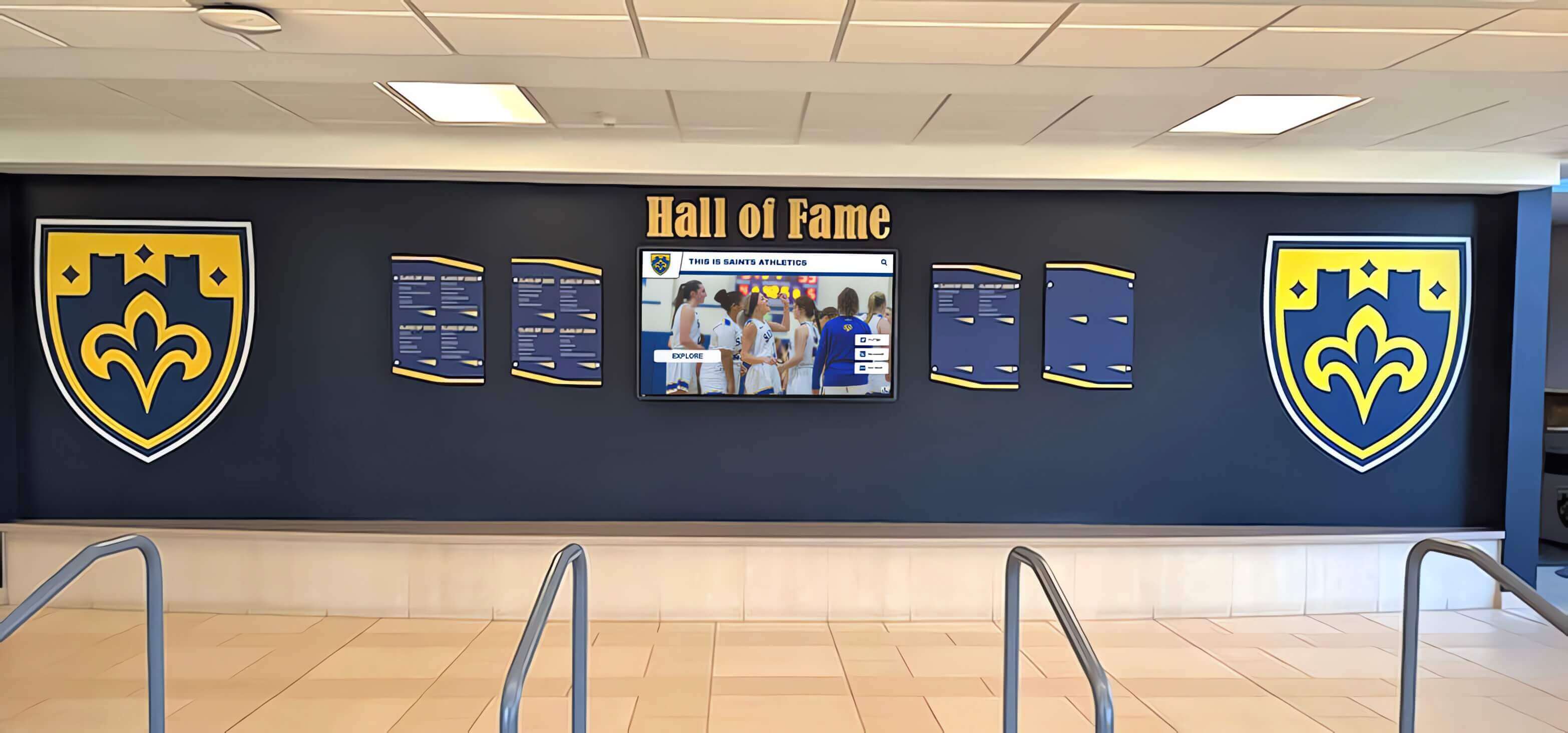
A lobby hall of fame installation where physical shield plaques establish the visual identity and a digital display extends recognition capacity — this format serves both current students building a mental model of program history and returning alumni searching for specific names and seasons
Donor wall designs that connect giving to legacy illustrate how the same multi-generational recognition logic that makes gym artwork powerful applies to donor recognition — past supporters seeing their names alongside current program achievements creates the continuity that encourages continued investment.
Modern donor wall ideas for schools extend this further: when recognition systems connect athletic achievement with institutional philanthropy on the same wall, both categories of recognition gain credibility.
When Static Gym Artwork Reaches Its Limits
Physical gym artwork — murals, banners, record boards, trophy cases — is permanent by design. That permanence is part of its value: a championship banner that hangs in the gymnasium for thirty years communicates something about institutional commitment that a digital slide can’t replicate.
But permanence becomes a limitation when:
- A record holder’s name changes (marriage, transition) and the physical record board cannot be updated
- A new sport or program needs recognition capacity that the existing wall doesn’t have space for
- Alumni searching for specific athletes or seasons need more information than the physical display holds
- Annual inductees exceed the physical space available for expansion
Digital recognition systems address each of these limitations without replacing the physical artwork. The combination of painted mural for identity and digital display for searchable, updatable recognition represents the current standard for schools that take both the visual and the data dimensions of athletic recognition seriously.
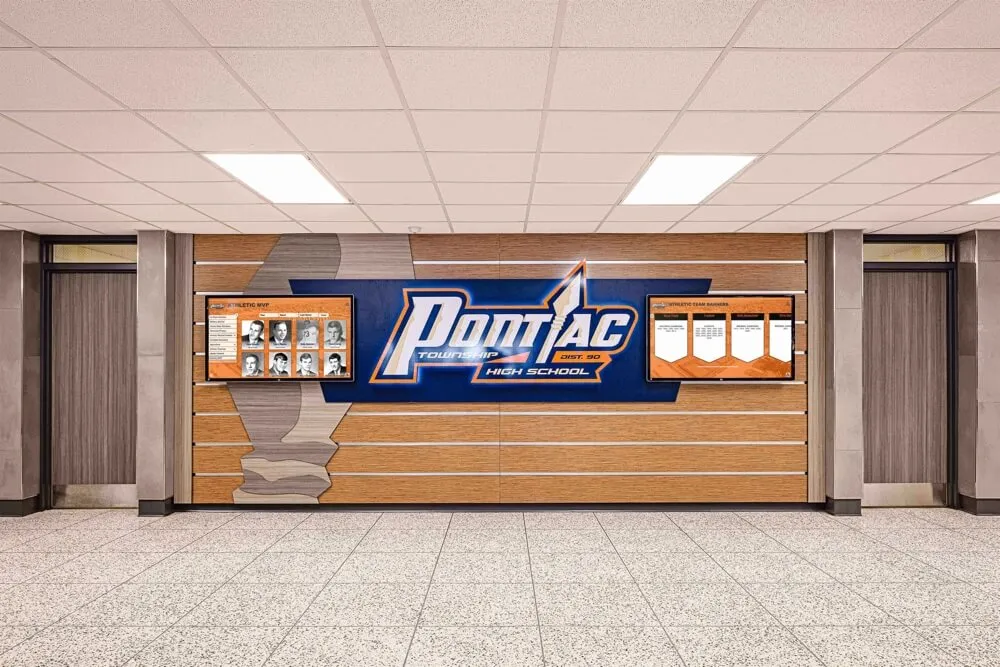
A physical athletic honor wall installation — the structured panel format establishes recognition standards that translate directly into digital display organization when the school expands its recognition system
Frequently Asked Questions About School Gym Artwork
What types of artwork are most common in school gyms?
The most common types are championship banner displays, mascot murals, hall of fame panels, record boards, trophy wall installations, and retired number displays. Schools increasingly combine these with interactive digital touchscreen displays that allow searchable athlete databases and annual updates.
How should school gym artwork be designed to last for decades?
Longevity requires consistent school color specifications (official hex codes applied to every format), modular architecture that allows new inductees and records without replacing the full installation, and high-contrast typography readable at gymnasium viewing distances. Bold school colors, clean condensed typefaces, and clear visual hierarchy age well across decades.
What is the difference between a gym mural and a hall of fame display?
A gym mural serves visual identity — school colors, mascot, and program culture through large-scale imagery. A hall of fame display serves recognition — specific athletes, achievements, and years. The most effective gyms use both: a mural for the visual identity layer and a hall of fame system for the recognition data layer.
Can digital displays replace traditional school gym artwork?
Digital displays extend rather than replace traditional gym artwork. Physical murals and championship banners provide permanent visual identity readable without power that accumulates institutional meaning over decades. Digital systems add searchability, annual updating, and expanded recognition capacity for sports and programs physical walls can’t accommodate. The combination provides the most complete recognition environment.
How much information should gym artwork include for each athlete?
Follow a three-layer hierarchy: name and primary achievement in large type readable from 10+ feet; sport, year, and brief summary at 5 feet; full statistics and biography at arm’s length. Digital displays extend this to include full career statistics, team rosters, and photographic archives beyond what physical panels can hold.
Build a Recognition System That Grows With Your Program
Rocket Alumni Solutions builds touchscreen walls of fame, digital record boards, and interactive recognition displays that extend your school gym artwork into a living, searchable archive of every team, champion, and tradition your program has built. Connect your physical installations with a digital system that adds new inductees every year without reprinting a single panel.
Get notified when Rocket Graphics opens