A game day graphic template is a pre-structured layout designed to help school athletic departments, booster clubs, and coaches produce consistent, on-brand visuals throughout a game day — from pre-game starting lineup posts to final-score announcements and post-game player recognition. Unlike general sports poster templates, game day templates are built around a communication workflow: each template handles one specific moment in the game day timeline, so a staff member can update and publish in under two minutes without redesigning from scratch.
For school athletic communications, the game day workflow typically spans five to eight distinct graphic types — and without templates, producing all of them manually creates a bottleneck that most schools can’t sustain across multiple sports on the same night. A well-organized game day template set solves that problem at the design level.
What Makes a Game Day Graphic Template Different
General-purpose sports poster templates and game day templates serve different purposes. A sports poster template is designed to be finalized days or weeks before a game — it promotes an upcoming event, presents season schedules, or generates pre-season hype. A game day graphic template is designed for speed during a live communication window: score updates, lineup reveals, momentum posts, and result graphics all need to be produced and posted within minutes.
The defining characteristics of an effective game day template set:
Speed over customization. Fields that change (score, opponent name, player name, quarter or period) are isolated in clearly labeled zones. Everything else — school logo, colors, mascot graphic, background treatment — is locked so staff can update the variable fields without touching the design.
Platform-ready dimensions. Game day content is primarily social: Instagram Stories (1080 × 1920px), Instagram feed posts (1080 × 1080px), and Facebook posts (1200 × 630px) are the core formats for school athletics. Templates sized for each platform eliminate the resize step that slows production.
Consistent visual system. When every graphic in the game day set shares a common color palette, typeface, and layout logic, the posts work as a coherent story across a fan’s feed — even when published hours apart by different people on the same account.
AI-powered school graphics tools have made it significantly easier to generate and maintain template sets like these — the same branded visual language can be applied automatically across every template in a set without manual effort per post.
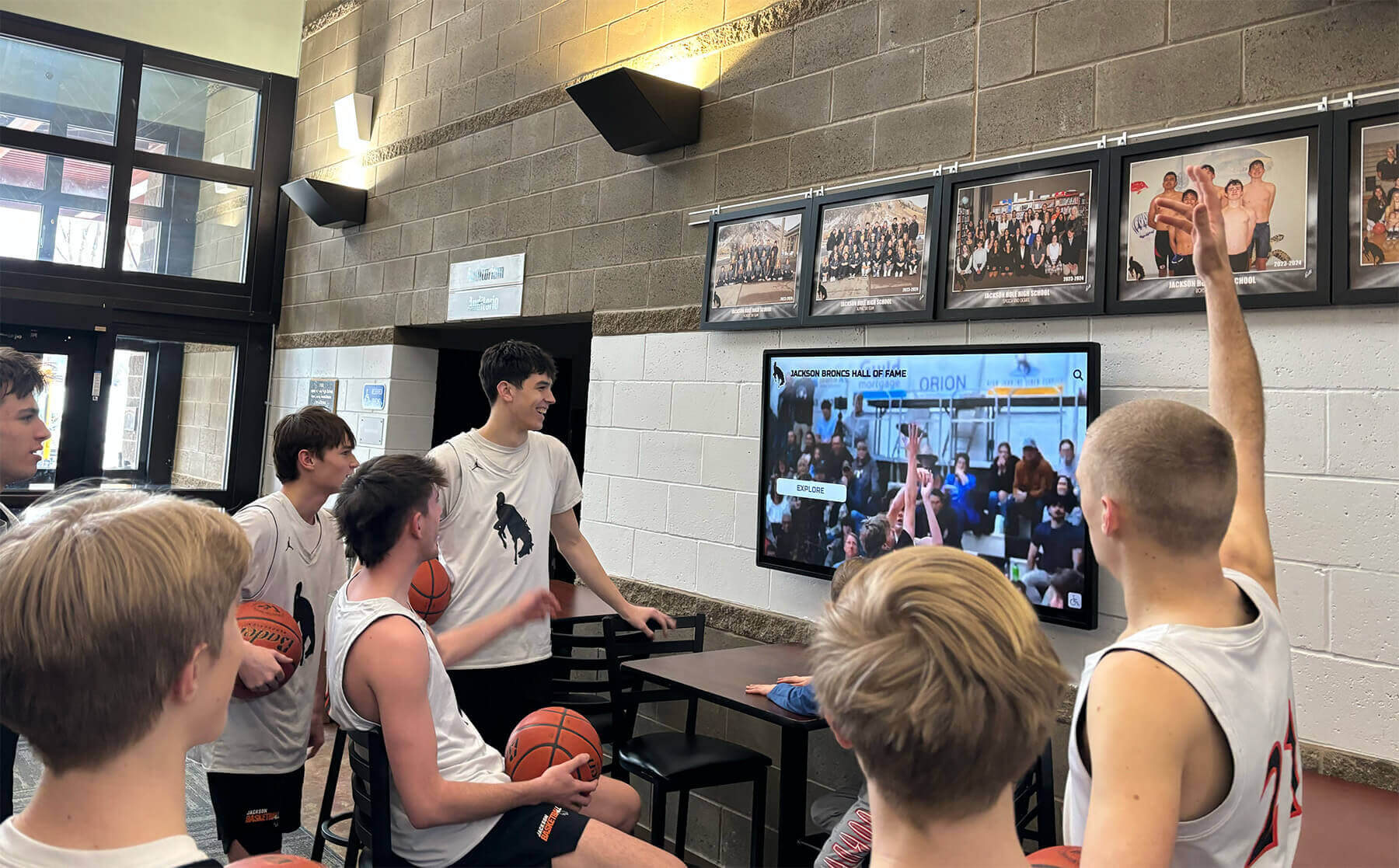
Game day graphics extend recognition beyond the gym — lobby screens, social media feeds, and display boards all benefit from a consistent template set that covers every moment in the game day timeline
Essential Game Day Graphic Types for School Athletics
A complete game day template set covers the full communication arc — from the hours before tip-off to the final result post and beyond. The following six template types are the core of any school athletic game day workflow.
1. Starting Lineup / Roster Graphic
The starting lineup graphic is often the most-shared game day post. Published one to two hours before game time, it introduces the starting five (basketball), offensive lineup (baseball/softball), or first-string squad (football) with player names, jersey numbers, and headshots or silhouettes.
What the template needs:
- Six to eight player slots with name and number fields
- A photo zone or numbered silhouette placeholder per slot
- Game information line (opponent, date, time, location)
- School logo and mascot graphic
- A strong visual frame — this graphic gets shared most by athletes and parents
For schools that don’t have current headshots, a silhouette or abstract player graphic avoids the awkward blank-photo problem while keeping the design clean. Mascot and logo consistency matters especially here — the starting lineup graphic is often the first thing opponents’ fans see shared from your account.
2. Score Update / Live Quarter Graphic
Live score update graphics keep fans who can’t attend engaged in real time. For most school athletic programs, these are published at halftime and at the end of each quarter or period.
Required fields:
- Your school and opponent name
- Current score (large, high-contrast, immediately readable)
- Period, quarter, or half indicator
- Time remaining (optional — becomes stale quickly)
- Game location
The score update template is the format where legibility matters most. The graphic will be viewed on mobile screens in a scrolling feed. The score needs to read at thumbnail size — 24pt or smaller text for the score is too small. Design for a viewer who is skimming, not studying.
3. Halftime Spotlight / Athlete Recognition Graphic
Halftime is the highest-traffic moment of a game day social window. A halftime spotlight template recognizes one player’s first-half performance — points scored, goals, hits, tackles, saves — giving fans a shareable moment at the peak engagement window.
Halftime spotlight template fields:
- Player name (large)
- Headshot or action photo zone
- First-half stat line (3–4 stats max)
- “Halftime” identifier
- School logo and game opponent
This template type connects game day communications to longer-term recognition workflows. An athlete spotlighted at halftime this season becomes a candidate for end-of-year awards — and the halftime graphic itself becomes part of the photographic record of their season, useful for yearbooks, sports certificate presentations, and hall-of-fame induction materials.
4. Final Score / Game Result Graphic
The final score graphic is the most-shared post of any game — win or loss. It closes the game day story and archives the result in a format that will be referenced, screenshot, and shared repeatedly.
Final score template structure:
| Zone | Content |
|---|---|
| Primary visual | Score (your school vs. opponent, large and centered) |
| Result label | “WIN” / “Final Score” / “W [Score]–[Score]” |
| Game info | Sport, date, opponent, location |
| Stat line (optional) | One or two headline stats from the game |
| Branding | School logo, mascot, colors |
A win graphic and a loss graphic should be separate templates with appropriate visual treatments. Celebration visual language (gold, bold, high-contrast) suits wins; a more restrained version of the same layout handles losses without looking dismissive of the result.
5. Post-Game Player Recognition Graphic
The post-game recognition graphic extends game day communications into a player-specific spotlight — naming the game’s MVP, top performer, or standout individual with a stat line and photo. This is distinct from the halftime spotlight: the post-game version is the definitive recognition of the game, suitable for printing, archiving, and referencing in season summaries.
For school athletic programs, these post-game graphics feed directly into larger recognition workflows:
- Coaches pull the most-shared post-game graphics when selecting end-of-season award nominees
- Athletic directors use them to document program highlights for alumni archives
- Yearbook staff reference game-by-game player graphics as a season performance record
6. Senior Night / Special Occasion Recognition Graphic
Senior night, homecoming, rivalry week, and milestone games warrant a dedicated template variant — the standard game day framework with modified visual treatment to signal the special context.
Senior night graphics in particular need a slightly more ceremonial visual language: larger athlete name treatment, a photo-forward layout, and wording that acknowledges career context (“4-Year Varsity Player,” “Team Captain”) alongside game day details.
Social media graphics built with AI tools can generate senior night and special occasion variants automatically once the base template and student information are in the system — reducing production time to under a minute per athlete.
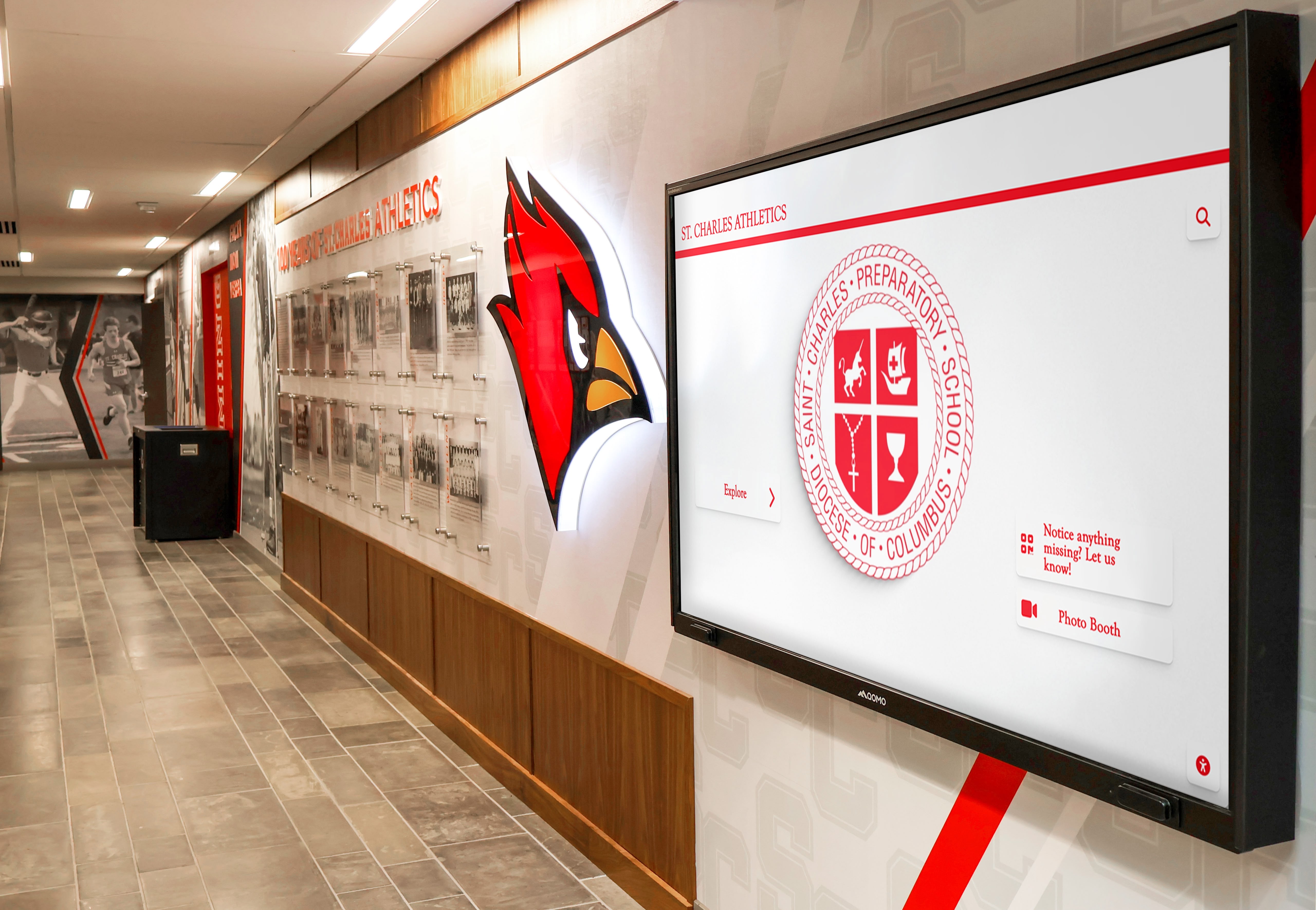
The visual language developed for game day graphics — school colors, mascot graphic, consistent typography — applies equally to hallway recognition displays, creating a unified athletic identity from social media to the building itself
Game Day Graphic Workflow Checklist
The value of a game day template set comes from the workflow it enables. Use this checklist to establish a repeatable production process before the first game.
Pre-Season Setup (do once per season):
- Confirm school logo files are available in vector (SVG/AI) or high-resolution PNG format
- Establish official color hex codes for the primary and secondary school colors
- Gather current headshots or action photos for all varsity athletes (even a consistent silhouette placeholder eliminates production delays)
- Build or import templates for all six graphic types above in your chosen platform
- Create a master roster file (name, number, sport, class year) to pull from for every post
- Set platform-specific dimensions for each template (Stories: 1080×1920, Feed: 1080×1080, Facebook: 1200×630)
Game Day Morning:
- Confirm starting lineup with head coach
- Draft starting lineup graphic; schedule or have ready to post 90 minutes before game time
- Confirm opponent name spelling, location, and tip-off / first pitch time
During the Game:
- Quarter/period score update — publish within 2 minutes of the period ending
- Halftime spotlight — draft during first-half play; publish within 5 minutes of halftime
- Identify the top-performer candidate for post-game graphic
Post-Game:
- Final score graphic — publish within 10 minutes of the final whistle
- Post-game player recognition — publish within 30 minutes with stat line confirmed by coach
- Save all graphics to the athletic department’s game archive folder
End of Season:
- Archive the full season’s game day graphics by sport and opponent
- Flag graphics that document record-setting performances for permanent recognition records
- Submit standout images to yearbook staff and hall-of-fame documentation system
Branding Your Game Day Templates
Game day graphics are one of the highest-visibility outputs of a school athletic department’s communication strategy — they reach alumni, parents, opposing fans, and prospective students who may never visit the school’s website. The visual quality of game day graphics reflects directly on the perceived quality of the athletic program.
Mascot Integration
The school mascot graphic should appear on every game day template, but its treatment varies by template type. On score update and final result graphics, the mascot works best as a background element at reduced opacity — it reinforces brand identity without competing with the score data. On starting lineup and player recognition graphics, a full-color mascot at full size works well as a framing element on one side of the layout.
Color Consistency
Every game day graphic should use the school’s official primary and secondary colors — not close approximations. Hex code consistency across templates ensures that when all six graphics from a game day appear in sequence on a social media profile, they read as a unified visual system.
If your school’s official colors aren’t documented, the athletic director or school marketing office should have them on file. If not, sampling from an official printed document (letterhead, uniform) is more reliable than eyeballing from a website screenshot.
Typography
One typeface family — bold/display weight for the score and athlete name, regular weight for supporting information — is almost always stronger than mixing multiple typefaces. A condensed bold sans-serif reads well at all sizes and works across the short, punchy text that game day graphics require.
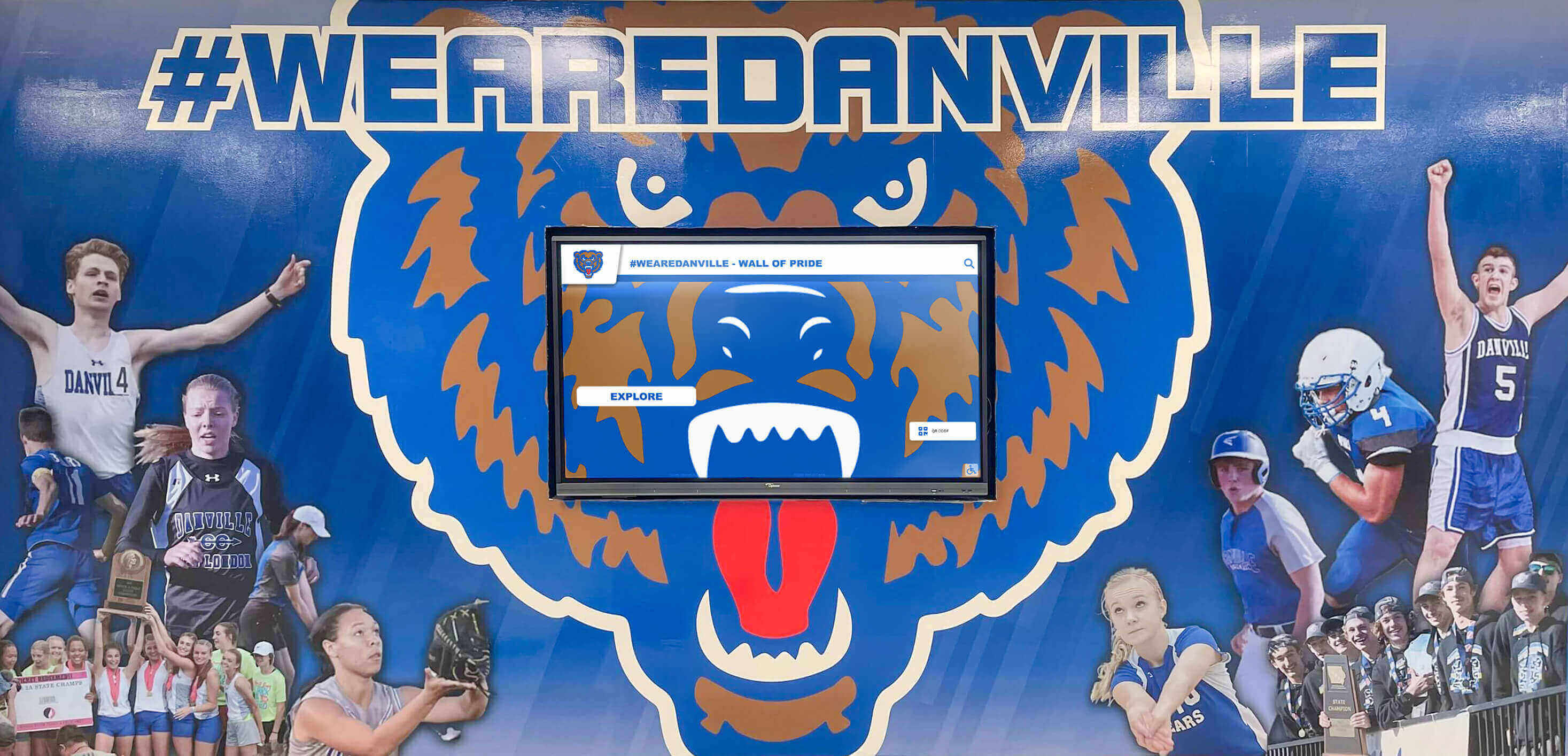
School mascots and branding developed for game day graphics translate naturally into hallway murals and digital display environments — a consistent visual system from social media to the building itself
From Game Day to Permanent Recognition
Game day graphics have a longer lifespan than their immediate social media post. Schools that treat game day graphic output as part of a broader recognition infrastructure create connections between daily communications and long-term program history.
Feeding the Athletic Archive
Every post-game player recognition graphic documents a specific performance — a player, a date, a stat line, an opponent. When saved systematically, these records become a searchable performance archive that serves hall-of-fame research, alumni communications, and end-of-season award preparation.
Athletic photo and graphics archives that include game day social media output alongside traditional photography provide the most complete record of a season’s individual and team performances.
Supporting End-of-Season Awards
Coaches and athletic directors who review the season’s game day graphics when selecting end-of-season award nominees — MVP, Most Improved, Coaches Award — have a documented record to draw from rather than relying on memory alone. The halftime spotlight and post-game recognition graphics create a natural candidate nomination trail across the season.
When awards are presented at an end-of-season banquet, the same images used in game day graphics appear again in slideshow presentations, awards programs, and sports certificate designs that name specific performances as the basis for the recognition.
Integration with Digital Recognition Displays
Rocket Alumni Solutions’ touchscreen hall-of-fame and digital recognition display systems can incorporate game-day-documented performances directly into long-term recognition interfaces. A starting lineup graphic from the championship game becomes part of the team’s historical record; a post-game MVP graphic feeds into an athlete’s career profile.
Touchscreen digital display systems for school athletics demonstrate how game-by-game communication output — when structured and archived — becomes the raw material for recognition displays that visitors and students interact with for years after the season ends.
Schools using digital hall-of-fame wall installations that include season-by-season performance data rely on the kind of structured game documentation that a consistent game day graphic workflow produces automatically.
Frequently Asked Questions About Game Day Graphic Templates
What is a game day graphic template?
A game day graphic template is a pre-designed layout for producing school athletic social media graphics quickly during a game day — starting lineup posts, live score updates, halftime spotlights, final score announcements, and post-game player recognition. Templates isolate the variable fields (score, player name, opponent) so staff can update and publish each graphic in under two minutes without redesigning from scratch.
How many templates does a school need for a complete game day graphic set?
A complete school athletic game day graphic set typically includes six template types: starting lineup, score update (per quarter or period), halftime spotlight, final score/result, post-game player recognition, and a special occasion variant for senior night or milestone games. Each template should exist in the primary social media dimensions your school uses — typically Instagram Stories (1080×1920px) and feed post (1080×1080px) at minimum.
What size should game day graphics be for school social media?
For school athletics social media, the primary game day graphic dimensions are: Instagram Stories (1080×1920px portrait), Instagram feed posts (1080×1080px square), and Facebook posts (1200×630px landscape). Most school athletic programs prioritize the Stories and feed post formats. Designing templates at these exact dimensions avoids platform cropping and ensures graphics display correctly without resizing.
Can game day graphics be used in long-term school recognition programs?
Yes — game day graphics, when archived systematically, document specific performances that feed into hall-of-fame research, end-of-season award selection, yearbook production, and athletic archive systems. Post-game player recognition graphics create a season-long performance record that supports award nominations and can be incorporated into touchscreen hall-of-fame and digital recognition display systems.
Who should produce game day graphics for a school athletic department?
With pre-built templates, game day graphic production requires no design experience. Most schools assign a student manager, booster club volunteer, or junior varsity athlete to the role during varsity games. The role becomes a data-entry and scheduling task: update the variable fields (score, player name, stat line), schedule the post, and save the file to the archive. AI-powered school graphics platforms can further reduce this to a prompt-based workflow where the graphic is generated from text input.
Build Game Day Templates That Connect to Lasting Recognition
Rocket Alumni Solutions and Rocket Graphics help school athletic departments create consistent, on-brand game day graphics — and connect that game-by-game documentation to touchscreen halls of fame, digital record boards, and recognition displays that keep athletic achievement visible long after the final whistle.
Get notified when Rocket Graphics opens