Planning football senior banner ideas for your program involves more design decisions than most athletic departments initially expect. A banner that looks polished in a design file needs to work at gymnasium scale, hold up under Friday night stadium lighting, and represent a player’s entire high school career in a format their family will want to frame and keep. The best football senior banner ideas share three qualities: design specifications matched to their display environment, a layout that communicates player identity clearly at viewing distance, and a connection to a recognition workflow that preserves the tribute well beyond the night it was printed.
This guide covers the design elements that define effective football senior banners, the standard and creative formats programs use, visual examples of what works, and a post-season workflow for converting temporary banners into permanent digital and physical recognition.
What Makes Football Senior Banners Work at Scale
Football senior banners succeed or fail based on how they’re viewed — not how they look in design software. Most senior banners are displayed at distances ranging from 8 to 30 feet: along hallway walls, on gymnasium fences, beside the field entrance, or mounted above locker room exits. At that range, the design decisions that determine readability are font weight, text scale, contrast ratio, and the number of visual elements competing for the viewer’s attention.
The signage industry guideline is 1 inch of letter height per 10 feet of viewing distance. For a banner read at 15 feet, the player’s name should be rendered at no less than 1.5 inches of physical letter height. For outdoor banners viewed from 25–30 feet away in varying light conditions, letter height should reach 2.5–3 inches for primary text — which, at a standard 2’ × 3’ senior banner size, limits how much supporting text can reasonably appear at a readable scale.
Heavy weight typography almost always outperforms light weight in these environments. Condensed bold fonts — a player name rendered in an extra-bold condensed sans-serif — maximize both the text size and the amount of information that fits at readable scale. Script and decorative typefaces that look appealing at thumbnail size often become illegible at distance under gymnasium lighting or afternoon sun.
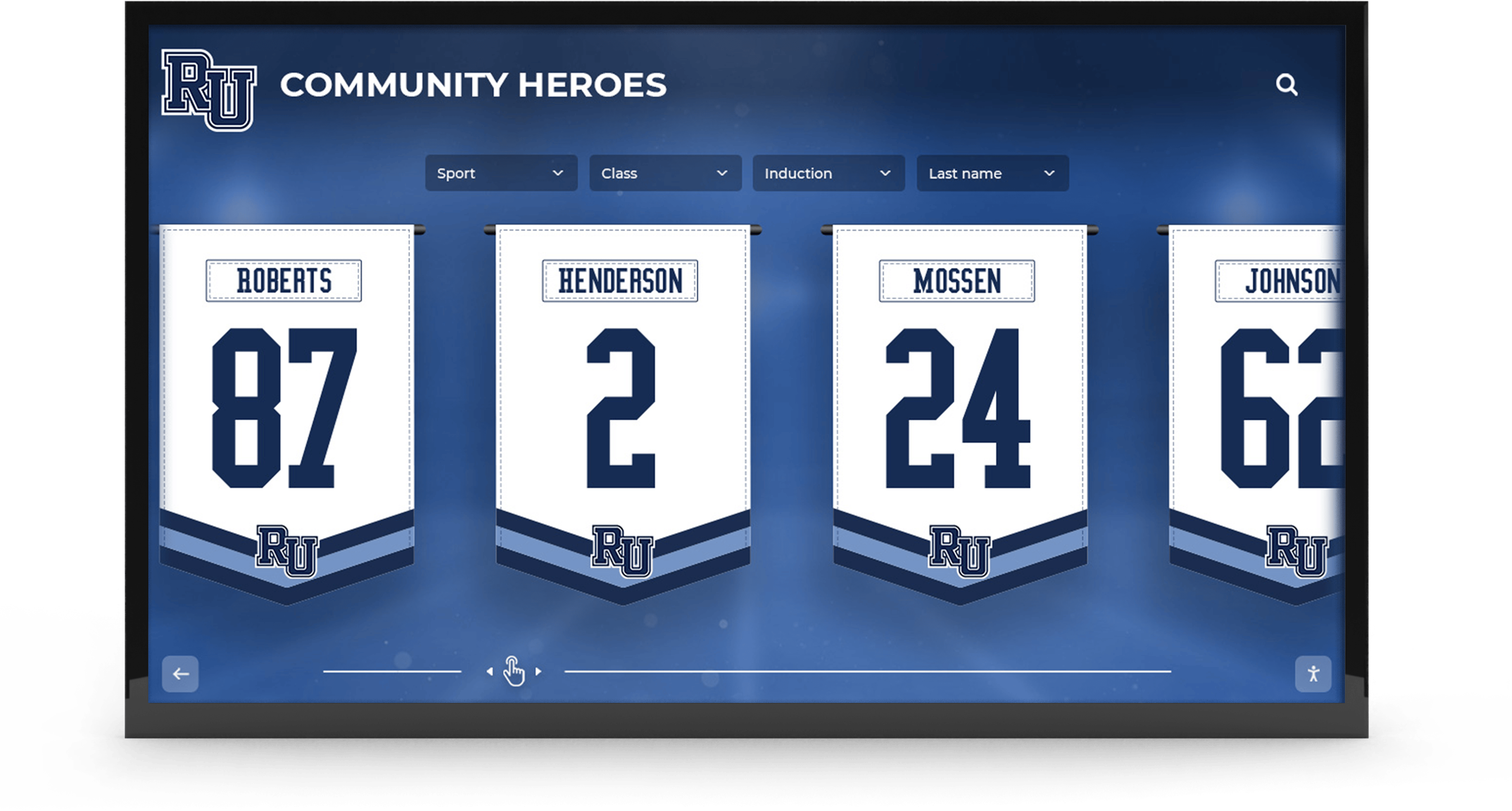
A community heroes banner format with jersey numbers — the large-scale type, high contrast, and centered identity elements are the same principles that make football senior banners readable at field and gymnasium viewing distances
Standard Football Senior Banner Formats
Most high school football programs use one of four banner formats for senior recognition. Each has a natural use case, production cost range, and set of design tradeoffs.
Full-Bleed Action Photo Banner
The full-bleed action photo banner uses a high-resolution game or practice photograph as the dominant design element, with the player’s name, number, and graduation year overlaid at high contrast. This format communicates athletic identity most powerfully when the photography is strong — a clear action shot with identifiable features, captured at game quality.
Design specifications:
- Background: High-resolution action photo, minimum 3000 × 2000px at intended print scale
- Primary text: Player name, extra-bold condensed, white with dark drop shadow over photo background
- Secondary text: Jersey number, graduation year, sport/position — medium weight, same font family
- Logo: School mascot or athletics logo, corner placement, 10–15% of banner width
- Contrast: Text treatment must achieve minimum 7:1 contrast ratio against photo background — dark areas of photo need lighter text overlay; light areas need darker treatment
Best for: Programs with a dedicated team photographer who captures individual action shots during games; players with strong game moments documented in high resolution.
Jersey-Highlight Banner
The jersey-highlight format centers the player’s number as the dominant visual element, with name and supporting information arranged around it. This works consistently across all photography quality levels because the number — rendered in official school colors at large scale — carries the visual weight without depending on action photography.
Design specifications:
- Background: School color gradient or solid, with subtle texture (carbon fiber, brushed metal, field turf) if desired
- Jersey number: Extra-large display type, 40–60% of banner height, school colors with contrasting stroke
- Name: Bold condensed, white or school color accent, 1/3 the height of the number
- Supporting text: Position, years on varsity, graduation year — smaller scale, secondary visual weight
Best for: Programs recognizing large senior classes where individual action photography coverage is uneven; programs with strong jersey number traditions.
Portrait-Plus-Stats Banner
The portrait-plus-stats banner pairs a high-quality headshot or uniform portrait with a statistical summary of the player’s career. This format translates well from the field to the hallway display: families can read the career summary, and the portrait communicates identity clearly.
Design specifications:
- Portrait section: 40–50% of banner width; professional or team-provided uniform headshot
- Stats panel: Clean data layout — years played, games started, key position stats, awards (all-conference, all-district selections)
- Typography: Two-weight system — bold for stat values, regular for labels
- Colors: School primary colors for background; maximum contrast on all text
Best for: Programs that track and publish program statistics; players with distinguished career records worth displaying in detail.
Senior Night Event Banner
The senior night event banner is a larger-format display — typically 3’ × 6’ or wider — that features the full senior class as a group. Individual player images or names appear in a grid layout with the event name, date, and program branding. These are often displayed at the entrance to the stadium or gymnasium on senior night and then relocated to a hallway or facility corridor.
Best for: Programs that recognize seniors as a cohesive class; facilities with corridor or lobby space for a multi-player display that remains up after the season.
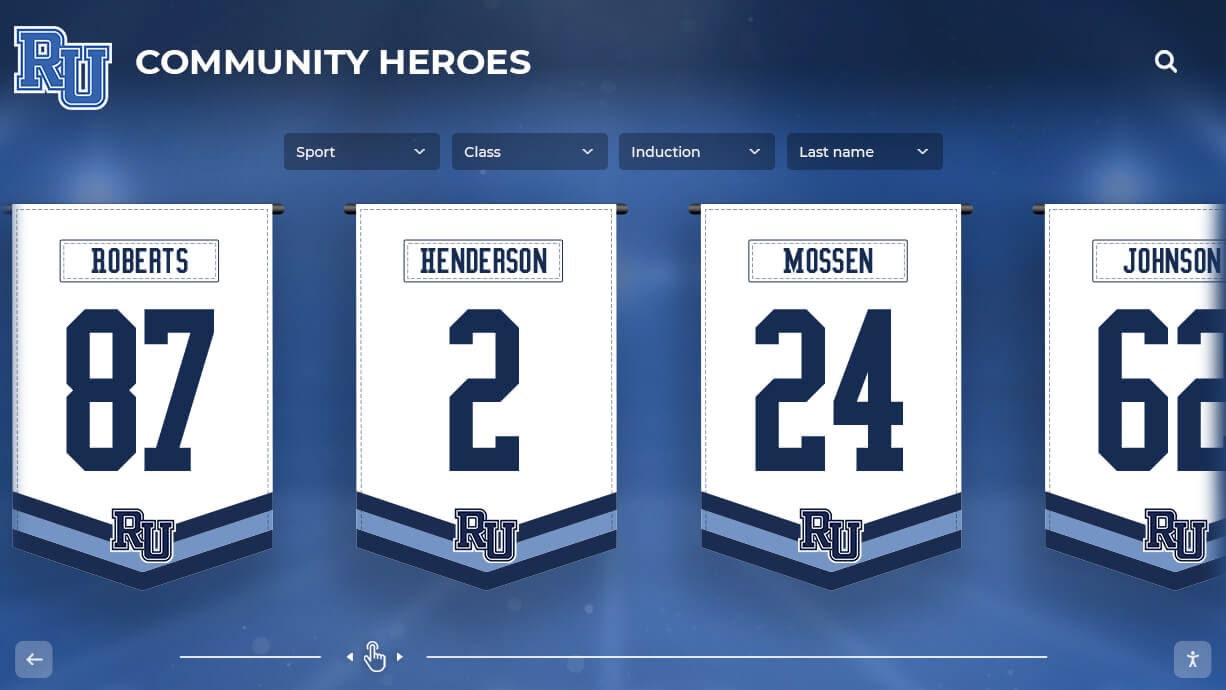
Hanging jersey banners create a visual recognition environment in athletic corridors that functions as permanent senior recognition after the seasonal event concludes
Visual Elements That Differentiate Football Senior Banners
Within each format, the specific visual elements a program chooses communicate program identity as strongly as the player’s individual information. These choices compound across a senior class — when eight or twelve banners hang together, their shared visual elements define the program’s aesthetic.
Helmet and Equipment Iconography
Football senior banners frequently incorporate helmet silhouettes, jersey number treatments, and equipment references in ways that other sports’ senior banners don’t. A helmet rendered in school colors — whether as a background watermark, a prominent design element, or a small accent — immediately identifies the sport without requiring text. When the helmet design uses the exact school helmet paint scheme, it grounds the banner in program identity rather than generic football iconography.
Field and Turf Textures
Field turf or natural grass texture used as a background element grounds football senior banners in the environment where the player competed. Subtle enough to preserve text readability, a green turf texture behind a high-contrast name and number communicates sport context without requiring explicit sport labeling.
Dual-Season or Multi-Year Treatments
Some football programs choose senior banners that reference the player’s full varsity career rather than just their senior season. A banner that shows a player’s progression — freshman and senior photos side by side, or a timeline of seasons played — carries a different kind of recognition weight than a single-season snapshot. This requires more upfront planning (photos from all four years need to be on hand) but produces banners that function as genuine career records.
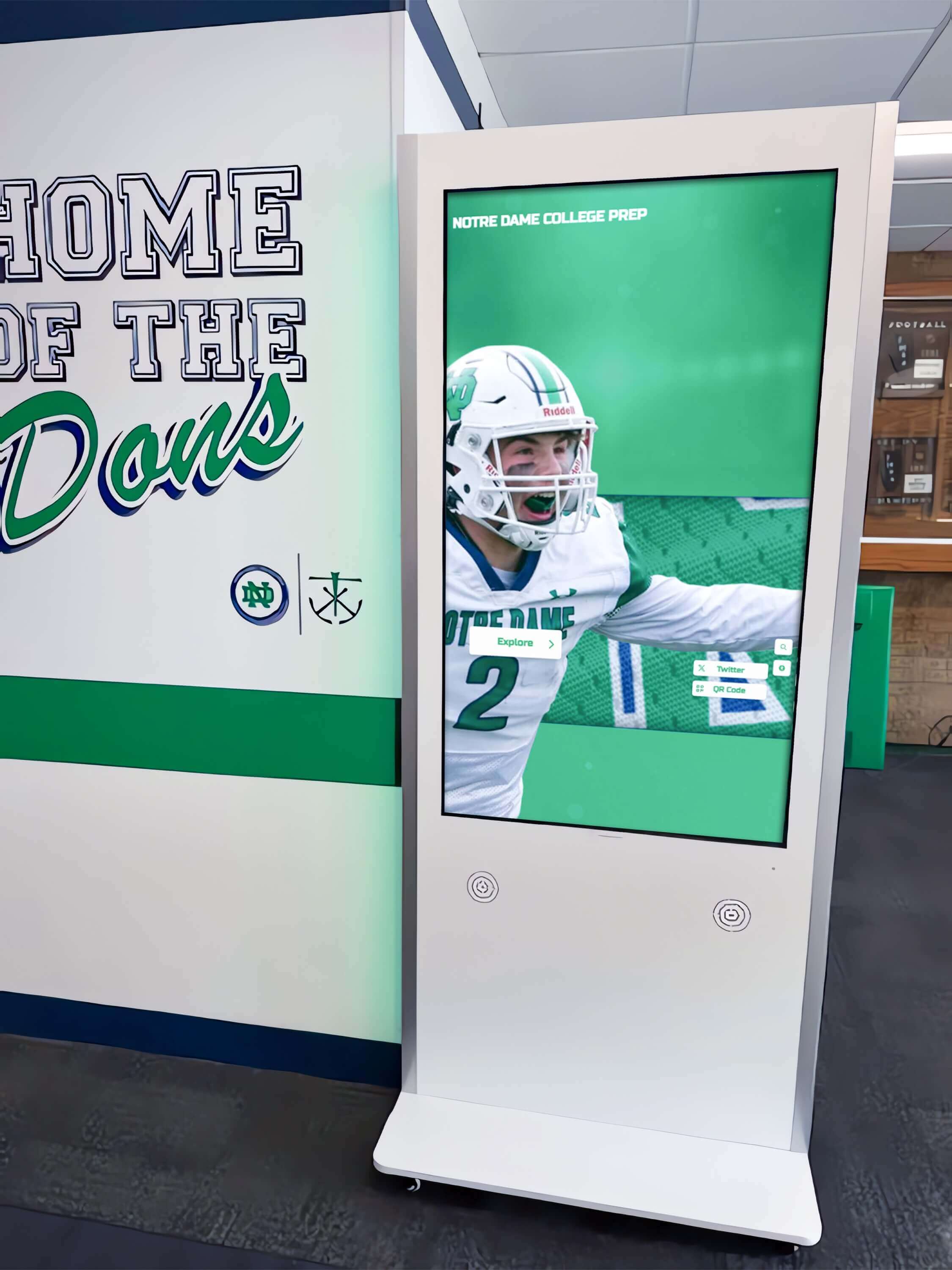
An interactive hallway kiosk at a prep football program — the digital display format allows football senior recognition to expand from a single banner to a full athlete profile with career statistics, awards, and photos
Design Specs and Production Checklist
Before sending any football senior banner to print production, confirm the following specifications:
Resolution and File Format
- Minimum 150 DPI at final print dimensions for vinyl or fabric banners
- 300 DPI for paper, foam board, or premium substrate prints intended for indoor display or framing
- Export as PDF/X-1a or high-resolution TIFF for professional print vendors; PNG at 300 DPI for school in-house printing
Color Specifications
- All school colors specified in PMS or CMYK values, not RGB — RGB colors shift significantly in print production
- Request a color proof from the vendor before approving full production runs if ordering multiple banners simultaneously
Typography Checks
- All fonts embedded in final export files, or all text converted to outlines before export
- Minimum 1.5-inch letter height for primary text at intended display distance
- All text elements verified for contrast ratio — use a contrast checker against background colors before finalizing
Physical Specs
- Finished banner size confirmed before ordering (2’ × 3’ is the most common senior banner format; 2’ × 5’ for vertical corridor displays; 3’ × 6’ for event or lobby installations)
- Grommets or hanging hardware specified at order — top corners minimum, four corners preferred for outdoor or high-traffic display
- Vinyl vs. fabric material chosen based on display environment — outdoor or high-moisture environments require vinyl; indoor corridor displays work well with fabric
For programs planning to produce multiple senior banners simultaneously, a comprehensive awards and recognition planning guide provides a useful framework for coordinating football senior banners alongside other end-of-season recognition elements.
Football Senior Banner Ideas by Display Location
The intended display location is the most important variable in football senior banner design. Each location has different viewing distances, lighting conditions, physical constraints, and audience behaviors that should directly inform design decisions.
Locker Room and Tunnel Displays
Banners displayed in locker rooms or the walkway tunnel are viewed at close range — typically 3–8 feet — by an audience of players and coaches who are already deeply familiar with the featured player. These banners can carry more detail than corridor or gymnasium versions: career statistics, all-conference recognitions, college commitment information, and a longer biographical note. The close viewing distance makes detail legible and appropriate.
Hallway and Corridor Displays
Corridor banners are viewed by a broader audience — students, parents, visitors, prospective players — who are often walking past rather than stopping to read. The 10–20-foot viewing distance and brief attention window require a simpler hierarchy: player name, number, and one or two distinguishing achievements, nothing more. A corridor banner that requires the viewer to stop and approach to read the text has failed as a corridor display.
Corridor banners that remain in place long after senior night function as year-round recognition. Programs that keep well-designed football senior banners on hallway walls beyond graduation create a visible program history that current players can see and connect themselves to — motivating sustained commitment in the same way that championship banners do.
Field-Side and Fence Displays
Outdoor senior night banners — displayed along the fence line, at the entrance gate, or on the stadium perimeter — face the most challenging readability conditions: variable lighting, direct sunlight, viewing distances up to 30–40 feet, and wind movement. For these environments:
- Use the heaviest font weights available in your type family
- Target contrast ratios of 10:1 or higher
- Limit text to name, number, and graduation year — nothing smaller than 3 inches at final print size
- Specify reinforced banner material with windscreen venting for outdoor fence mounting
Athletic Lobby and Trophy Case Areas
Athletic lobby displays are the highest-prestige location for football senior banners. These spaces receive attention from visiting teams, parents at evening events, and alumni returning to campus. Lobby banners can be larger format and higher production quality than corridor versions, and they often persist in place for multiple seasons before being rotated.
For athletic lobby environments, consider how football senior banners align visually with adjacent recognition elements — championship banners, record boards, trophy cases, and any digital display infrastructure. Visual consistency across all surfaces creates a cohesive recognition environment; mismatched banner styles in the same lobby create visual noise that undermines the professionalism of all the recognition elements present.
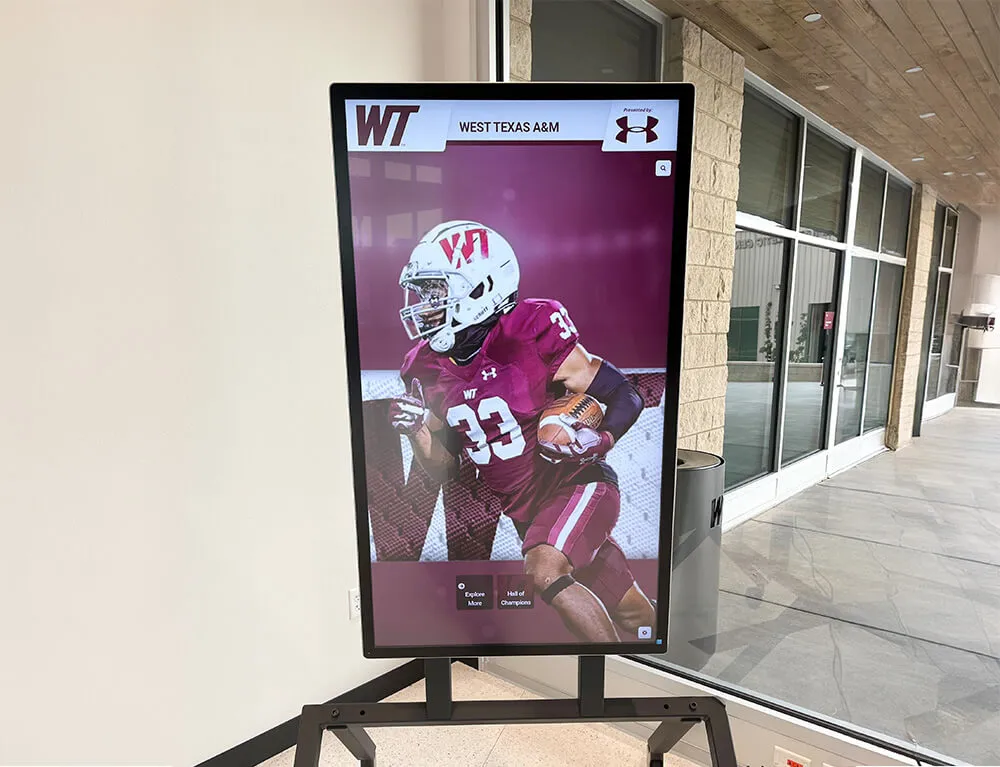
A football player recognition display in a university lobby — the jersey number treatment, program colors, and portrait format illustrate how football senior banner design principles scale from printed banners to permanent digital installations
The Recognition Workflow: From Senior Banner to Permanent Record
The most common gap in football senior recognition programs is the workflow gap: the banners are designed, printed, and displayed on senior night, then dismantled at season’s end with no path to permanent preservation. The player’s recognition exists for a single night and then disappears from the school’s institutional memory.
Building a workflow that converts temporary football senior banners into permanent records serves multiple stakeholders: the athletes themselves, who deserve recognition that persists beyond a single game; the families, who often want their student’s achievement documented formally; the program, which benefits from the visual history of every player who contributed; and future players, who see a program that takes recognition seriously across generations.
Step 1 — Archive the Banner Files
Every football senior banner file should be archived in a program-accessible location at the end of each season. This includes the original design files, all source photography, and the final print-ready exports. Programs that maintain a consistent archive across multiple seasons can produce retrospective recognition — a decade-summary display, a historical digital gallery — without rebuilding assets from scratch.
Step 2 — Transfer Player Data to Program Records
The information compiled for each senior banner — career statistics, awards, team roles, graduation year — should be entered into a permanent program database or recognition system at the end of each season. This creates the foundation for a hall of fame induction process, a digital record board update, or a school website athlete profile page.
Step 3 — Identify Candidates for Permanent Recognition
Not every senior banner subject becomes a permanent hall of fame inductee, but every player’s career record should be accessible in some form. Programs that use digital recognition platforms — interactive touchscreen hall of fame installations, digital record boards, or online athlete archives — can maintain a searchable roster of every graduate rather than limiting permanent recognition to statistical standouts.
Digital hall of fame tools for athletic programs provide a practical overview of the platforms and approaches programs use to maintain this kind of permanent, searchable athlete recognition alongside physical installations.
Step 4 — Physical Preservation Options
For players whose banners will remain on permanent display, the production format matters. Fabric banners are appropriate for first-season corridor display; for long-term wall mounting, direct-to-substrate printing on rigid aluminum, acrylic, or sintra board provides durability that outlasts seasonal vinyl formats. Programs that invest in higher-quality substrates for permanent corridor displays avoid the faded, curling banner problem that makes years-old recognition look neglected rather than honored.
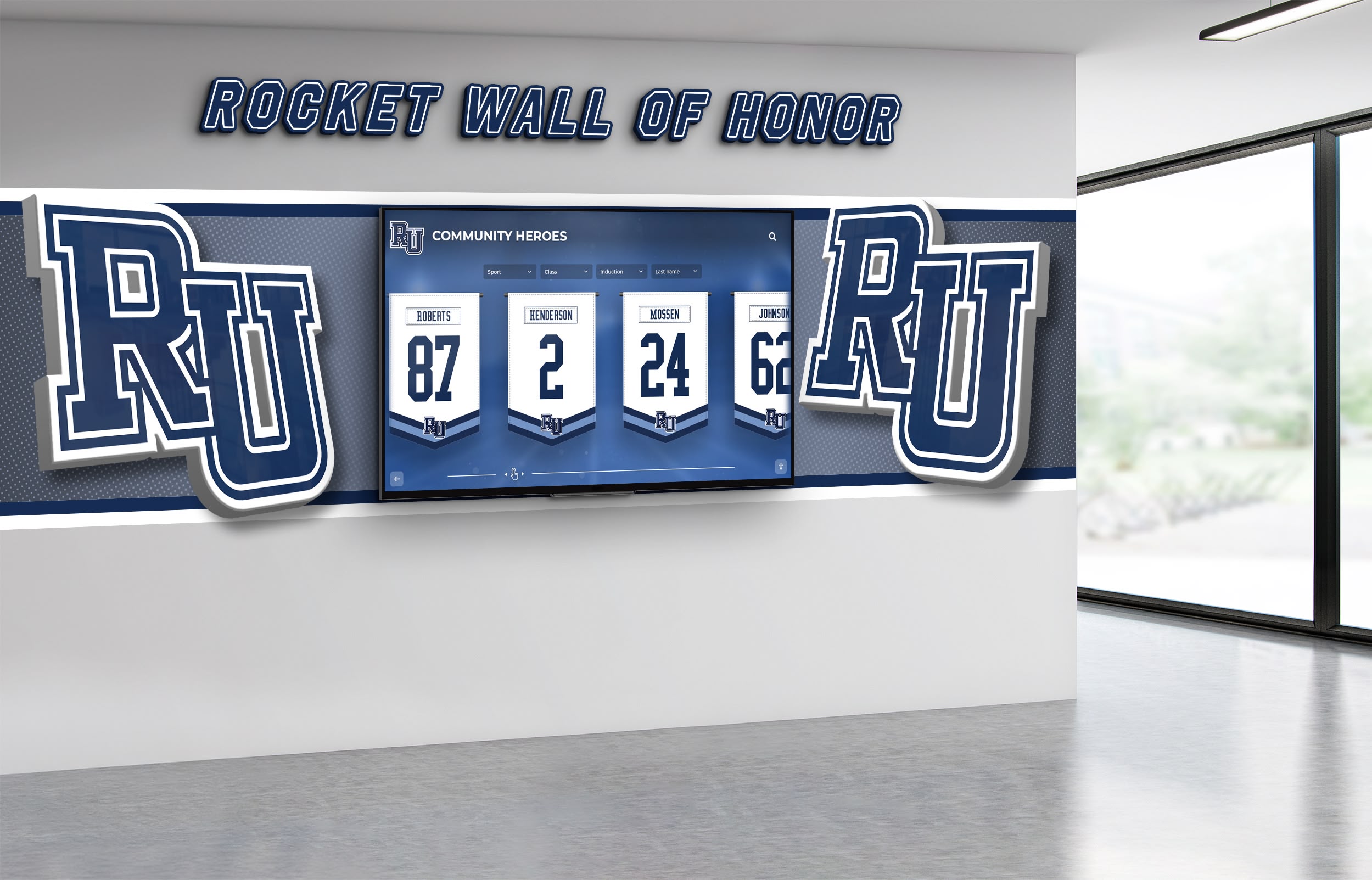
A lobby wall of honor with digital jersey displays — this installation format preserves the jersey-number-centered design identity of football senior banners in a permanent, high-visibility recognition environment
Step 5 — Integrate with School-Wide Recognition Systems
Football senior banners that connect to broader institutional recognition systems — athletic hall of fame installations, digital record boards, alumni engagement platforms — create a recognition continuity that serves the athlete throughout their relationship with the school, not just in their senior season.
Schools that coordinate recognition tools across athletics, donor recognition, and alumni engagement create environments where athletic achievement isn’t siloed from the broader institutional story — and where football program alumni remain connected to the school through ongoing recognition rather than single-event ceremonies.
If your program is building out this kind of integrated recognition system, Rocket Alumni Solutions designs touchscreen halls of fame and digital recognition displays specifically for athletic programs that want to connect seasonal recognition like senior banners to permanent, searchable athlete profiles.
Football Senior Banner Ideas for Different Program Scales
The right approach to football senior banners depends significantly on program scale — the number of seniors recognized, the budget per player, and the facilities available for display.
Small Programs (5–8 Seniors)
Smaller senior classes allow for higher per-player investment in design and production. At this scale, full-bleed action photo banners with custom photography become financially accessible, and each banner can be treated as an individual design project rather than a batch production run. Small programs often display all senior banners together in a single lobby or gymnasium installation, which benefits from consistent design — same dimensions, same color system, same typography — to create visual cohesion.
Youth sports awards frameworks for smaller programs provide useful context for thinking about how football senior banners fit within a broader awards and recognition calendar rather than as a standalone event.
Mid-Size Programs (9–20 Seniors)
Mid-size programs balance the need for visual consistency across a larger cohort with the desire for meaningful individual personalization. Template-based design — where a standardized layout uses each player’s photo, name, number, and stats in fixed positions — maintains visual cohesion across the full senior class while preserving individual identity. At this scale, production efficiency matters: designs that require significant custom work per player become expensive and logistically difficult for a single athletic department to manage.
Large Programs (20+ Seniors)
Large programs with 20 or more football seniors face real production and display logistics challenges. Individual full-size banners for every player require significant display space and production budget. Common approaches at this scale include smaller-format individual banners (18" × 24" is more manageable than 2’ × 6’ for a class of 25), a combined class banner with individual player panels, or a hybrid approach where featured players receive individual banners and the full class appears on a composite display.
For large programs, comprehensive youth sports recognition guides provide planning frameworks for coordinating multiple recognition formats — individual banners, class composites, award presentations, and permanent recognition installations — across a full athletic department.
Post-Season Recognition: Taking Football Senior Banners Further
The senior banner is a starting point, not an endpoint, for the best athletic recognition programs. Translating the design assets, photography, and career information from the banner production process into extended recognition formats amplifies the value of the work already done.
Digital Athlete Profile Pages
Many schools maintain program websites or athletic section pages where senior player profiles can live permanently. The photography and career data compiled for the banner production process maps directly onto the content needed for a digital profile. Converting these assets into web-accessible profiles extends recognition to audiences who weren’t present on senior night — alumni, prospective players, college scouts, and community members.
Hall of Fame Integration
Standout seniors — those who broke program records, earned all-state recognition, or served as multi-year program leaders — are natural hall of fame candidates whose recognition should extend beyond the senior banner. Athletic hall of fame tools and platforms provide a range of options for programs at different scales and budget levels — from simple online hall of fame pages to full touchscreen corridor installations.
Interactive Touchscreen Displays
Schools that have invested in touchscreen corridor displays can incorporate senior player data directly into the athletic recognition kiosk, making every football senior’s career record searchable and accessible year-round. This format is particularly valuable for corridor installations adjacent to the football facility: current players can look up program history, prospective players touring the facility can see the depth of the program’s record, and alumni returning for homecoming can find their own profiles alongside current seniors.
Youth sports awards programs that incorporate digital touchscreen recognition consistently extend the recognition impact beyond the original event by making award information permanently accessible rather than archived in a folder or on a display that most students never stop to read.
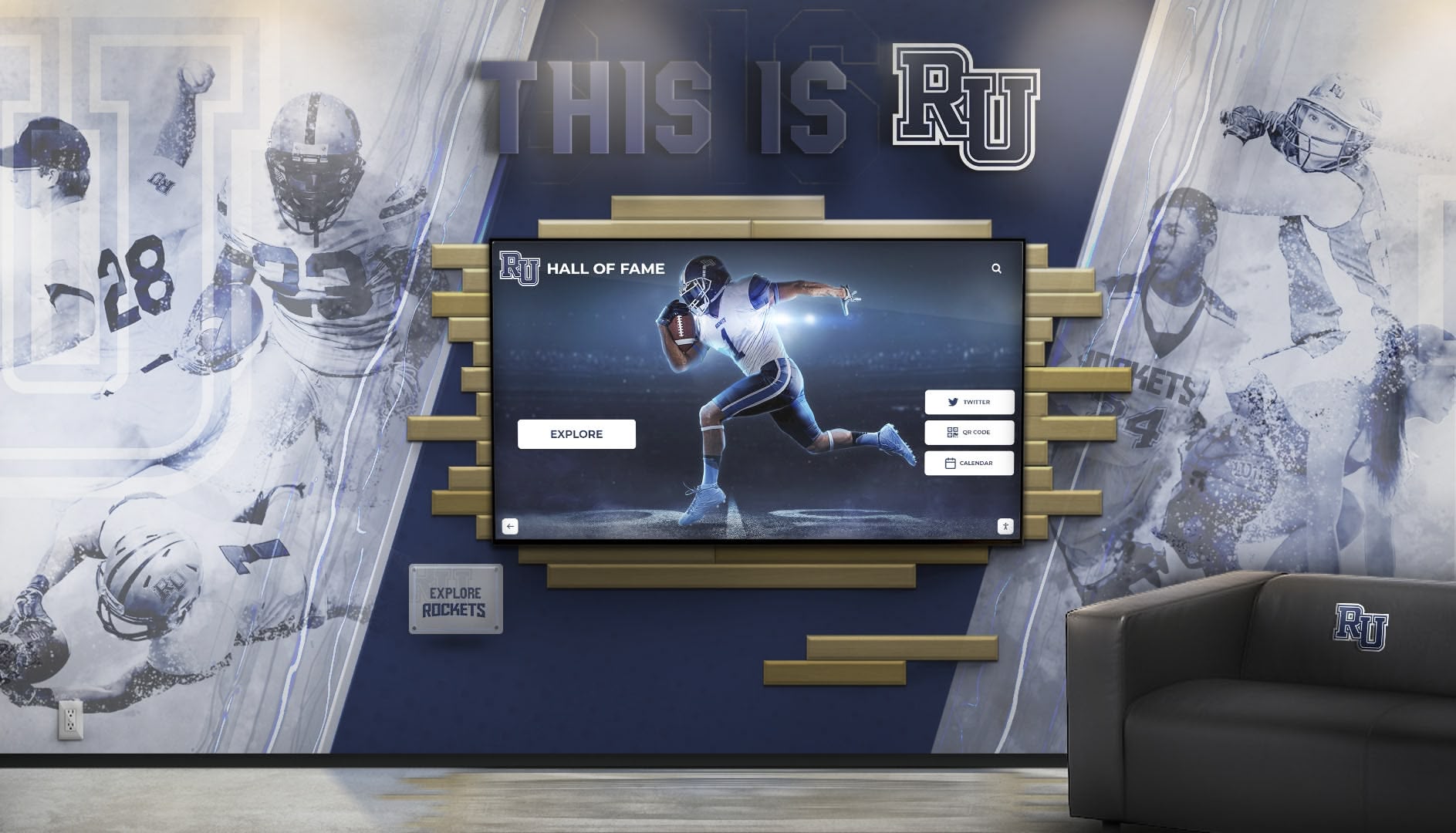
An integrated football recognition environment with physical mural and interactive touchscreen — the combination of permanent mural identity and searchable digital profiles shows how football senior banner design concepts extend into a comprehensive, lasting recognition system
Frequently Asked Questions About Football Senior Banner Ideas
What is the standard size for football senior banners?
The most common individual banner is 2’ × 3’, appropriate for corridor and field-entrance displays viewed at 10–20 feet. Vertical hallway displays scale to 2’ × 5’ or 2.5’ × 6’. Full senior class event banners typically run 3’ × 6’ or larger. Confirm letter height at final print size against the 1-inch-per-10-feet viewing distance guideline before approving production.
What design elements make football senior banners stand out?
The most effective football senior banners combine a dominant visual anchor (large jersey number, full-bleed action photo, or extra-bold player name), school-specific visual identity (official colors, helmet reference, mascot element), and a clear information hierarchy that reads at viewing distance before the viewer needs to approach. Avoiding low-contrast color combinations, decorative fonts, and visual clutter at small text sizes are the decisions that most consistently separate readable banners from ones that only work in the design file.
How do you preserve football senior banners as permanent records?
Preserving football senior banners requires both physical preservation (higher-quality substrate materials for corridor displays) and digital archiving (original design files, source photography, and player career data entered into a program database or digital recognition system at season’s end). Programs that complete both tracks maintain accessible records that serve athletes, families, and future players for years after the original senior night.
What should be included on a football senior banner?
At minimum: player name, jersey number, graduation year, and school or team logo. Add career statistics, key achievements, a high-quality photograph, and college commitment information when available. Rank all information by visual hierarchy — most important at largest scale, supporting details at secondary visual weight.
How early should you start planning football senior banners?
Begin 6–8 weeks before senior night to allow time for photo collection, design, vendor proofing, and production. Action photography coverage for individual banners should be arranged at the start of the season. Career statistics should be tracked throughout the season rather than compiled retroactively in the final weeks.
Turn Football Senior Banners Into Lasting Athlete Profiles
Rocket Alumni Solutions helps athletic programs build touchscreen halls of fame, digital record boards, and corridor recognition displays that preserve every football senior's career record long after senior night ends. Connect your seasonal banner production to a permanent recognition system that serves athletes, families, and alumni year-round.
Get notified when Rocket Graphics opens