A commitment graphic template is a pre-structured design layout used by school athletic departments, coaches, and communications staff to announce an athlete’s college commitment — typically published on signing day or when an athlete shares their verbal commitment on social media. At its most basic, a commitment graphic includes the athlete’s name, the institution they are committing to, the sport, and a celebratory visual treatment. But commitment graphics that stop there create a problem athletic programs encounter years later: a disorganized folder of signing-day posts that no one can search, sort, or connect to a hall-of-fame display because the underlying data was never structured.
This guide covers both halves of that challenge — what every template needs to produce a compelling signing-day announcement, and how designing those same graphics with display archives in mind turns a social media moment into a permanent piece of your program’s recognition history.
Why Commitment Graphics Need a Template
Signing day is emotionally significant for athletes, families, coaches, and communities. From a communications standpoint it also creates a production deadline that arrives unpredictably — a verbal commitment can be announced any day of the recruiting calendar, and National Signing Day clusters multiple announcements that a small staff must handle simultaneously.
A commitment graphic template solves two problems at once:
Speed: A coach or communications staffer can update a pre-built template with an athlete’s information and publish a polished graphic in under ten minutes, regardless of design experience.
Consistency: Every athlete in the program receives a recognition graphic that looks like it came from the same institution — not a mix of phone screenshots, Canva exports, and social media frames that reflect whatever effort was available on that particular afternoon.
Athletic recognition programs that use consistent graphic templates across their communications workflows produce recognition environments where consistency itself communicates institutional investment — recruits, parents, and community members form impressions of a program partly through the quality and uniformity of its recognition graphics.
The Commitment Graphic Template Checklist
A complete commitment graphic template includes fields across three categories: athlete identification, commitment details, and visual identity. The tables below cover every field that belongs in a well-designed template — for the signing-day social post and for an archive entry that can be referenced years later.
Athlete Identification Fields
| Field | Required for Social | Required for Archive | Notes |
|---|---|---|---|
| Athlete full name | Yes | Yes | Full name for archive; display name for social if different |
| Sport | Yes | Yes | Be specific: “Varsity Baseball,” not just “Baseball” |
| Team level | Yes | Yes | Varsity / JV / Multi-sport |
| Class year / graduation year | Yes | Yes | e.g., “Class of 2026” — critical for archive sorting |
| Jersey number | Optional | Yes | Helps archive retrieval when searching career data |
| Headshot or action photo | Yes | Yes | Archive version should be higher resolution |
| Years on varsity | Optional | Yes | Career context for future hall-of-fame nominations |
| Key career stats | Optional | Yes | One to three headline stats per sport |
Commitment Details Fields
| Field | Required for Social | Required for Archive | Notes |
|---|---|---|---|
| Committed college or university | Yes | Yes | Full official institution name, not abbreviation alone |
| College division | Optional | Yes | NCAA DI / DII / DIII / NAIA / NJCAA — archive-critical |
| College sport program | Yes | Yes | Specify if different from high school sport |
| Scholarship type | No | Yes | Full / Partial / Walk-on / Academic — for context |
| Commitment date | No | Yes | Exact date for archive sorting |
| Signing date | Yes | Yes | National Signing Day date or individual LOI date |
| Announcement type | No | Yes | Verbal / Letter of Intent / Preferred Walk-On |
Visual Identity Fields
| Field | Required for Social | Required for Archive | Notes |
|---|---|---|---|
| School logo | Yes | Yes | Your high school’s logo, not the college’s |
| School colors (hex codes) | Yes | Yes | Document hex codes so every graphic matches |
| Committed college logo or colors | Optional | No | Secondary element only if used at all |
| Background treatment | Yes | No | Photography, color field, or team imagery |
| Template variant identifier | No | Yes | Helps locate the source file for reprints |
Signing Day Graphic: Social Media Specifications
The commitment graphic published on signing day functions primarily as a social media post. Design requirements follow platform-specific dimensions and the visual conventions of the moment — energy, celebration, school identity front and center.
Dimensions by Platform
| Platform / Format | Dimensions | When to Use |
|---|---|---|
| Instagram Feed (square) | 1080 × 1080px | Primary sharing format for most signing-day posts |
| Instagram Story | 1080 × 1920px | Athlete self-share; parent and teammate re-shares |
| Facebook Post | 1200 × 630px | Community, alumni, and booster audience |
| Twitter / X | 1600 × 900px | Program announcement paired with commitment text |
| Digital Lobby / Corridor Screen | 1920 × 1080px | Hallway display in the days following signing |
Design at 1920 × 1080px first if you plan to run the commitment graphic on a school lobby screen. Scaling down to Instagram dimensions from a display-resolution master retains quality; upscaling a social-first file for lobby display introduces visible degradation.
Visual Hierarchy for Signing Day Posts
The social commitment graphic should prioritize information in this order:
- Athlete name — the largest text element on the graphic
- Committed institution — immediately readable alongside or below the name
- Sport — the qualifying context
- “Committed” or “Signed” — the event label, styled to match the celebratory tone
- School identity (logo, colors) — present throughout without competing with athlete information
A commitment graphic is not the place for a full stat line or career summary — that belongs in the caption and, more permanently, in the archive entry. The graphic’s job is to make the athlete’s name and destination immediately readable at thumbnail size on a mobile feed.
Connecting signing-day graphics to the broader game-day and school record graphic workflow your program already uses creates visual coherence across every type of athletic recognition your department produces throughout the year.

Commitment graphic templates built around action photography and program identity give signing-day announcements the visual weight the moment deserves — for the athlete, their family, and the broader school community following along
Designing for Archive and Display from Day One
The commitment graphic published on signing day has a second life that most athletic programs don’t plan for: it becomes a data record in your program’s history. When an athlete recognized today is nominated for the athletic hall of fame fifteen years from now, the commitment graphic from their senior season is part of the documentation trail — if it was designed to hold up as a record, not just as a social post.
The archive-first design philosophy applies the same principle to commitment graphics that it does to school record graphics and seasonal performance documentation: design the social version with enough structured information that it can serve directly as an archive entry without reformatting.
This means:
- The commitment date appears on the graphic itself — not just in the caption, which gets separated from the image when files are downloaded and moved
- The graduation year is visible — “Class of 2026” on the graphic, not assumed from the file’s creation date
- The college division is noted — a DI commitment and a DIII commitment both deserve recognition, but the distinction matters for archive context and hall-of-fame research
- The athlete’s full name is present — not a jersey number or nickname that requires prior knowledge to interpret
Archiving athlete commitment data alongside recognition graphics is particularly important when athletic directors transition — an incoming AD inherits a recognition system they didn’t build, and structured archive records make program history accessible without institutional memory.

Hall of fame displays draw from years of recognition materials — commitment graphics designed with archive-first fields make eventual induction preparation faster, more accurate, and more complete
Building a Reusable Commitment Graphic Template System
Athletic programs that produce commitment graphics from scratch for each signing lose consistency and staff time. A template system sets a quality floor that every announcement reaches automatically, regardless of who produces it or how many signings occur in the same week.
Template Variants to Build
Standard Commitment Template: Single athlete, one sport, one committed institution. The workhorse for the majority of signing-day announcements. Fields: athlete name, school, sport, class year, headshot zone, committed institution name and colors, “Committed” or “Signed” label.
National Signing Day Variant: A visually distinct treatment for formal Letter of Intent signings — more ceremonial visual language than a verbal commitment announcement. Use this variant specifically for the NSD date and individual early signing period dates.
Multi-Sport Commitment Template: For multi-sport athletes committing in two programs simultaneously. Less common, but high-value from a recognition standpoint — the template needs to accommodate two sport and program entries cleanly without crowding the design.
Verbal Commitment Variant: Visually distinct from a signed LOI — use the label “Verbally Committed” rather than “Signed” and a slightly less formal visual treatment. Both variants should include archive-quality fields; distinguishing the announcement type on the graphic itself prevents archive confusion when records are reviewed later.
Production Workflow
Once templates are built, the production process becomes consistent:
- Receive commitment information from athlete or coach
- Open the appropriate template variant (standard / NSD / verbal / multi-sport)
- Update: athlete name, headshot, committed institution, sport, class year
- Export: social dimensions (1080 × 1080px and 1080 × 1920px) and display version (1920 × 1080px)
- Post social version; upload display version to lobby or corridor content system
- Archive both files under the program’s naming convention
- Log structured commitment data (athlete, institution, sport, division, announcement type, date) to the program’s athlete commitment record
Step 7 — logging to a structured record — is what most programs skip. It is also what makes every subsequent recognition use case faster. Academic and athletic award programs that recognize seniors’ post-graduation plans alongside on-field achievements draw from a well-maintained commitment record; hall-of-fame research relies on it entirely.
The same archive-first discipline that governs game day graphic production and seasonal photo archives applies here: consistent source material accumulated over years creates the historical record that recognition displays and induction ceremonies eventually depend on.
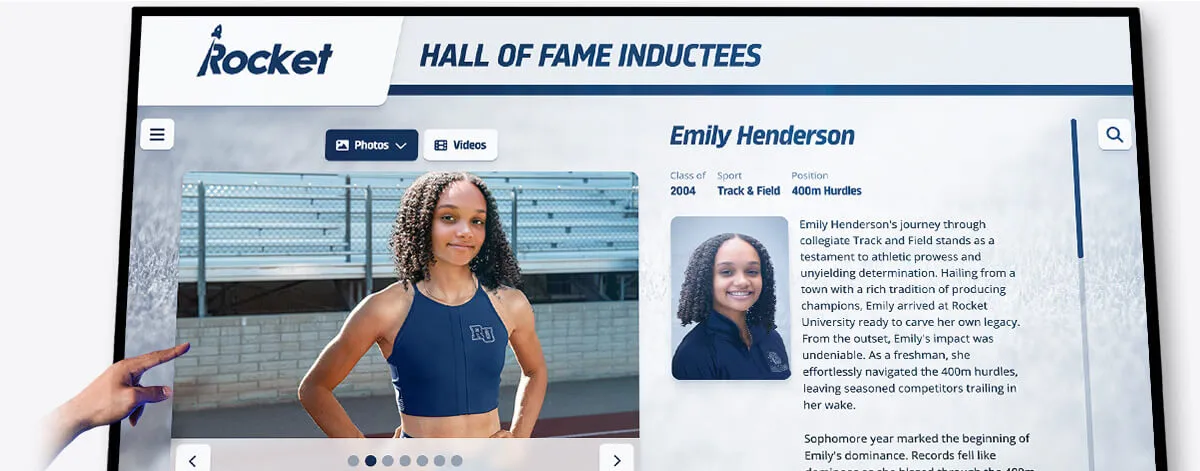
Individual athlete cards on touchscreen recognition displays rely on structured career data — commitment graphics that document institution, sport, division, and signing date contribute directly to the data layer that powers displays like this one years later
Connecting Commitment Graphics to Hall-of-Fame and Recognition Displays
A commitment graphic is one moment in an athlete’s career story — but often the most publicly visible moment of their high school athletic career. When schools build hall-of-fame installations, digital recognition walls, or touchscreen athlete archives, the commitment information is one of the most searched data points: where did they go, in what sport, on what kind of scholarship.
Hall-of-fame and recognition display systems that incorporate commitment data need that data to be structured — not embedded in a JPEG caption from six years ago. This is why commitment graphic design decisions at the social post stage have real consequences years later.
What Hall-of-Fame Systems Need from Commitment Records
Hall-of-fame research workflows for high school programs typically seek the following from commitment records:
- Institution name and division (for career achievement context)
- Signing date (for timeline accuracy)
- Sport and program (for sport-specific HOF category filtering)
- Scholarship level (for program prestige documentation)
- Announcement type — verbal vs. LOI (for timeline sequencing)
Hall-of-fame tools for school athletics programs increasingly connect to structured data sources — programs that maintain commitment records in a spreadsheet or database can export directly to display systems without manual re-entry for each inductee.
Digital recognition board tools that include athlete achievement timelines benefit particularly from commitment records: an athlete’s signing date can anchor their career timeline display between their varsity debut and any eventual post-graduate honors, creating a coherent narrative arc that static plaques cannot replicate.
From Signing Day to the Display Wall
The path from a signing-day commitment graphic to a permanent display wall entry follows a predictable pattern in programs that manage it intentionally:
- Signing Day (Year 0): Commitment graphic published, archived, and commitment data logged to the program’s record
- Alumni Years (Year 1–4): Athlete’s college career tracked as available; archive record updated with notable college achievements if the program monitors alumni
- Hall-of-Fame Eligibility (typically Year 5+): Athlete’s complete career reviewed for nomination; commitment graphic and any college achievement records are primary documentation sources
- Induction: Commitment graphic from senior season appears in ceremony materials, on the digital display entry, and in printed programs
Digital wall-of-fame systems that feature career timelines and achievement archives rely on having consistent source material across an athlete’s complete high school career — commitment graphics designed to the same template and archive standard as game-day and record graphics create that consistency automatically.

Touchscreen hall-of-fame displays aggregate career recognition data from multiple sources — commitment graphics designed with archive-first fields are one of the earliest entries in the career documentation chain these systems eventually draw from
Displaying Commitment Graphics in School Lobbies and Hallways
Between the signing-day social post and any eventual hall-of-fame induction, commitment graphics have immediate display value inside the school building. A corridor or lobby screen running a commitment announcement in the days following signing day extends recognition beyond social media to audiences who see the building but may not follow the athletic program’s accounts.
A day in the life of school digital displays typically includes rotating content — game results, upcoming events, recognition spotlights, and seasonal announcements. Commitment graphics fit naturally into this rotation: the same 1920 × 1080px file exported from the signing-day template runs in the corridor display for two to four weeks with no additional production.
Display recommendations for school hallways and lobbies:
- Run the commitment announcement graphic for seven to fourteen days in the corridor display rotation following signing day
- Create a “Class of [Year] Commitments” summary slide that aggregates all athlete commitments from the senior class in one graphic — useful at the end of signing periods when multiple athletes have committed
- Maintain a permanent digital display entry for each committed athlete beyond the signing-day rotation, available in the program’s digital archive for ongoing reference
Academic achievement recognition programs that run alongside athletic recognition in school corridors benefit from the same template consistency: when academic and athletic recognition graphics share a visual system, the overall hallway recognition environment looks intentional rather than assembled from different tools and departments.
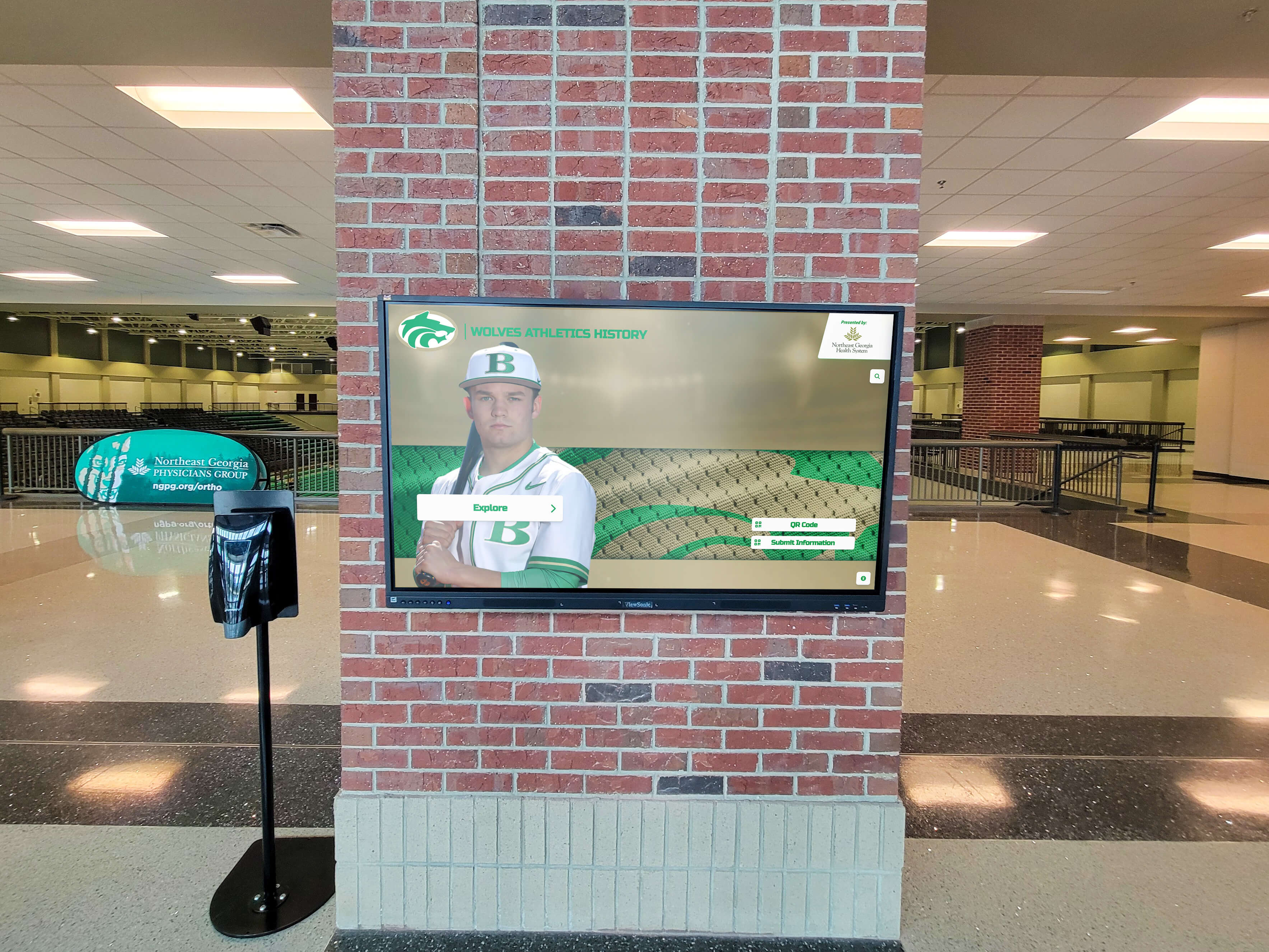
Lobby digital displays running commitment graphic announcements reach audiences inside the school building — students, prospective athletes, visiting families, and community members — who may not follow the athletic program's social accounts
Award Connections: Commitment Graphics and Year-End Recognition
Athlete commitments documented through commitment graphics connect to year-end recognition workflows in ways athletic departments often underutilize. When end-of-season award ceremonies, sports banquet programs, and senior recognition events are being planned, commitment information is one of the most emotionally resonant data points available.
A senior athlete’s commitment to a college program — institution, sport, scholarship level — is frequently highlighted in:
- Sports banquet slideshow presentations covering the senior class
- Senior recognition program booklets distributed at the awards ceremony
- End-of-season award announcements that honor seniors’ post-graduation plans alongside on-field achievements
- Athletic department recognition programs that celebrate academic all-American and scholarship recipients alongside athletic commitment milestones
Programs that have commitment graphics archived systematically can pull them directly into banquet slideshows and printed programs without requesting new materials from the athlete or family — a meaningful convenience when producing recognition materials for a large senior class under time pressure.

Alumni athlete portrait archives draw from years of consistently formatted recognition materials — commitment graphics designed with full data fields from signing day become searchable, displayable records for exactly these kinds of permanent recognition environments
Frequently Asked Questions About Commitment Graphic Templates
What is a commitment graphic template?
A commitment graphic template is a pre-structured design layout for producing signing-day and athlete commitment announcement graphics consistently and quickly. It includes placeholder fields for the athlete’s name, sport, class year, headshot, and committed college — plus school branding elements. Templates ensure every athlete receives a consistent, polished commitment announcement regardless of who produces it or how many signings happen at once.
What fields should a commitment graphic template include?
A complete commitment graphic template should include the athlete’s full name, sport, class year, graduation year, headshot or action photo zone, the committed institution’s name, college sport program, commitment or signing date, and school branding (logo, hex-code colors). For archive purposes: college division, scholarship type, and announcement type (verbal vs. LOI). Fields documented on the graphic itself — not only in the social media caption — remain interpretable when retrieved from an archive years later.
What size should a commitment graphic be?
For Instagram feed posts: 1080 × 1080px. Instagram Stories: 1080 × 1920px. Facebook: 1200 × 630px. Twitter/X: 1600 × 900px. For school lobby or hallway screen display: 1920 × 1080px. Design at the largest format first and export scaled-down versions for social platforms — quality is always preserved scaling down, never scaling up.
How do commitment graphics connect to hall-of-fame displays?
Commitment graphics become part of the hall-of-fame documentation trail when designed with structured archive fields visible on the graphic itself — institution name, sport, division, signing date. When an athlete is nominated years later, the commitment graphic from their senior season serves as archival documentation. Hall-of-fame digital display systems that pull from structured athlete career records rely on commitment data being logged consistently at the time of signing.
Should verbal and signed commitments use different templates?
Yes — verbal commitments and signed Letters of Intent are distinct milestones that benefit from visually different template variants. A verbal commitment graphic uses the label “Verbally Committed” with a slightly less formal treatment; a signing-day LOI graphic carries “Signed” or “National Signing Day” language with a more ceremonial layout. Both should include archive-quality data fields, and distinguishing the announcement type on the graphic itself prevents archive confusion when records are reviewed later.
Commitment Graphics That Last Beyond Signing Day
Rocket Alumni Solutions helps school athletic programs build recognition systems that connect signing-day commitment graphics to touchscreen halls of fame, digital display archives, and long-term athlete recognition environments. Turn every commitment announcement into a permanent part of your program's history.
Get notified when Rocket Graphics opens