A cheer team’s logo is the visual anchor that connects every part of the program — the warm-up jacket worn on the bus to an invitational, the backdrop banner behind the halftime performance, the recognition plaque in the school hallway, and the social media graphic posted after a competition win. Cheer team logos that are designed with intention don’t just look good in one context; they carry the squad’s identity across every surface and scale where the program appears. For school spirit squads competing at NFHS state competitions, UCA and NCA nationals, or simply bringing energy to Friday night football games and homecoming rallies, a strong visual identity signals program quality before a single cheer is performed.
This guide covers the full range of cheer logo design ideas — from structural formats and mascot integration strategies to color palette planning, apparel applications, and how cheer team logos translate into school recognition displays and digital walls. Whether your squad is building a new identity from the ground up or refreshing one that has drifted out of alignment with your school’s brand, these design concepts provide a concrete starting point.
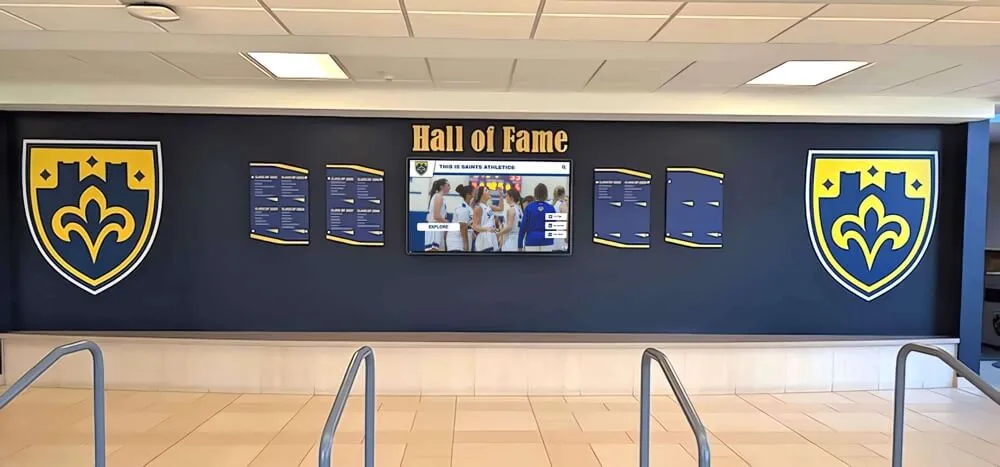
A school recognition wall featuring shield-format program logos alongside a digital display screen — the environment where a well-designed cheer team logo builds lasting program presence across generations of squad members
Why Cheer Team Logos Shape Program Identity
A cheer team logo is doing more work than most coaches or sponsors realize. It appears on uniforms and warm-up gear, competition backdrops, award plaques, the school trophy case, and every social media post the program publishes. Every time the logo appears in a new context, it either reinforces program quality or quietly undermines it.
The logo communicates program seriousness. A cheer squad with a polished, professionally designed visual identity reads differently than one using an inconsistently applied mascot clip or a stock star graphic. That perception influences recruitment, community support, and how the program is positioned within the school’s broader activities and athletic landscape.
It creates visual continuity across generations. Alumni who competed three or ten years ago should recognize the team’s logo when they see it on a current competition flyer or the school’s recognition wall. That continuity is what transforms a mark into a symbol of program tradition rather than just a seasonal graphic update.
It anchors every recognition display. Championship team recognition displays always have a clear visual anchor — a dominant element that tells any visitor immediately which program they’re looking at and why it matters. For cheer squads, that anchor is the logo. Without it, a wall full of trophies and competition photos reads as a collection of hardware rather than a coherent program legacy.
It enables consistent competition representation. Cheer teams competing at regional and national events project an impression that extends beyond their performance score — and that includes the visual presentation of warm-up gear, coach materials, backdrop banners, and social media content heading into the competition weekend. A strong logo ties all of it together.
Cheer Team Logo Formats: A Visual Overview
The most important early decision in any cheer logo project is which structural format serves the program’s identity goals. Each format has distinct visual characteristics, application strengths, and design challenges.
The Mascot Crest or Shield Format
The crest format — a shaped shield or heraldic device containing the team’s central symbol — communicates tradition, achievement, and institutional seriousness. It’s the format most associated with programs that have built multi-year legacies and want a logo that reflects that history.
For cheer squads, a crest typically includes:
- Shield field — the background area establishing the dominant color palette, almost always drawn from school colors
- Central charge — the primary design element inside the shield; often a stylized cheerleader silhouette, megaphone, pompom, or school mascot in an energetic pose
- Banner or ribbon element — carrying the team name, school name, or motivational motto
- Year of program founding — optional but meaningful for squads with long competitive histories
- Surrounding text — school name, team name, and optional tagline framing or arcing around the crest
Crests work best on competition backdrop banners, trophy case displays, and any application where the logo has room to breathe at appropriate scale. At very small sizes — social media profile icons or embroidered collar details — they can feel dense, which is why programs using a crest should develop a simplified companion version for compact applications.
The Circular Badge or Roundel Format
The circular badge places the central device inside a circle and surrounds it with the team and school name in text arcing around the ring. This format is highly versatile: it reads clearly at both large (banner) and small (Instagram profile icon) sizes, reproduces cleanly in single-color embroidery, and feels both modern and timeless depending on typeface and color choices.
Circular badges are one of the most practical formats for cheer team logos because they require no orientation decision — they work the same way regardless of placement — and scale down without losing essential design elements.
The Wordmark with Accent Symbol
A wordmark-dominant logo places the squad name in strong, well-chosen typography as the primary visual element, with a smaller symbol — a star, crown, megaphone, or mascot — serving as a secondary accent. This works well for squads whose team name is itself memorable and distinctive: the letters carry the identity, and the symbol adds personality without competing.
Wordmarks are the easiest format to maintain across materials because they don’t require precise color matching of complex graphic elements. However, they depend heavily on typography quality — a generic or inconsistently applied typeface undermines the entire mark.
The Monogram Lockup
Monogram logos use the squad’s initials — typically the school initials combined with “Cheer” or “Cheer Squad” — in a stylized, interlocking, or designed letterform treatment. Monograms work particularly well for programs that need a compact mark for uniform application: on shell tops, warm-up jacket chest areas, and accessories where a full crest would be too detailed at the required embroidery size.
The Motion or Dynamic Silhouette Mark
A cheerleader silhouette — a recognizable human form in an iconic pose (basket toss, back tuck, herkie, high-V, or pompom extension) — creates immediate visual communication about what the program is. The challenge with silhouette marks is avoiding generic clip-art execution. The silhouette must have enough visual strength and specificity that it doesn’t look like it could belong to any squad; it should feel like it belongs to this program.
The most effective silhouette marks are drawn with custom linework rather than pulled from a stock library — the specific angle, proportions, and gesture details make the difference between a mark that feels designed and one that feels assembled.
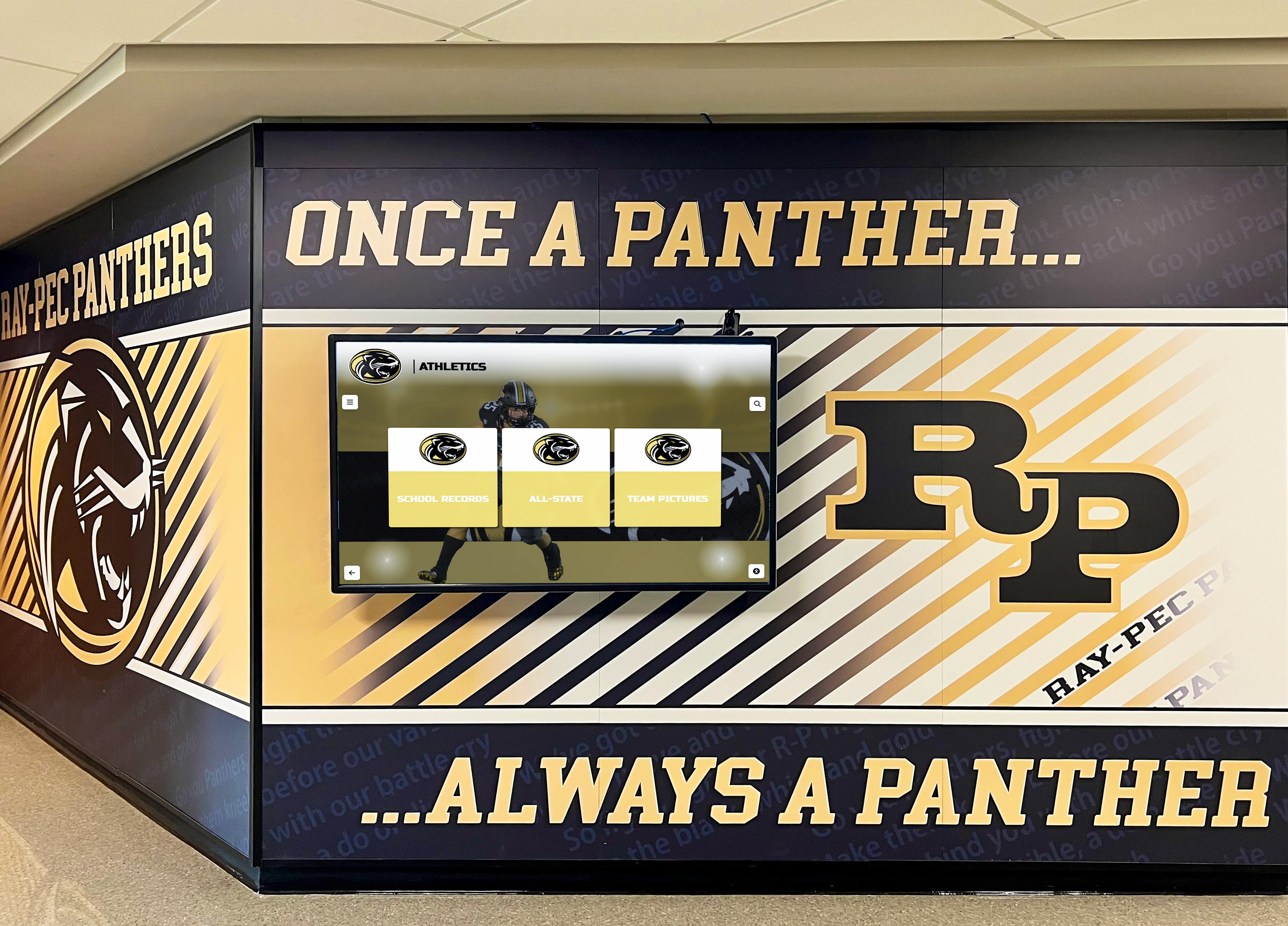
A school hallway mascot mural integrated with a digital display screen — the recognition environment where a strong cheer team logo creates lasting visual presence alongside other school programs
Color Palette Strategy for Cheer Team Logos
Color is the fastest communicator in any logo. A viewer processes color before they read type or recognize a symbol — which means your squad’s color choices establish the emotional tone of the logo before anything else registers.
Lead with School Colors
The baseline approach for any school spirit squad logo is school colors first. The cheer program’s logo should be immediately recognizable as belonging to the same school family as the basketball jersey, the soccer banner in the hallway, and the football program’s recognition display. Departing significantly from school colors creates confusion and weakens the team’s connection to the broader school identity.
Primary school color as the dominant field — Use the primary school color as the background field for the shield, badge circle, or dominant text treatment. This establishes the most immediate color signal for any viewer.
Secondary school color for accent and detail — Use the secondary color for text, borders, dividing lines, and secondary design elements. This creates visual contrast while keeping the palette unified.
White or light neutral for legibility — Most school color combinations benefit from a third element — typically white, cream, or light gray — to ensure text and fine details remain legible across all applications. A solid white version of the logo and a reversed version (white elements on a color field) should both be part of every standard logo deliverable set.
Metallic Accents for Competition Identity
Many cheer programs incorporate metallic gold or silver into their visual identity — both for the associations with championship achievement and for the literal shine that aligns with competition aesthetics. Metallic accents work well in printed applications (foil stamping on recognition plaques, metallic vinyl on banners) but require careful handling in digital contexts where metallic simulation can look flat or muddy on screen.
A practical approach: design the logo using a standard yellow-gold or cool gray for digital applications, then specify the metallic upgrade for premium physical production where the effect is achievable and impactful.
High Contrast for Display Readability
Any logo intended for display on a large gymnasium banner, a competition backdrop, or a digital recognition screen must be designed for high contrast. Critical pairs that read well at distance:
- Dark navy or maroon on white: excellent readability, classic school identity aesthetic
- Black on gold or yellow: high contrast, strong sports identity feel
- White or light gold on dark field: dramatic effect, excellent legibility in low-light performance environments
Avoid mid-value color combinations where the logo and its background have similar tonal values — even if the hue difference appears clear on screen, the combination becomes unreadable at viewing distance or under gymnasium lighting conditions.
Integrating Your School Mascot into Cheer Logo Design Ideas
For most school cheer squads, the mascot is the most powerful element available for creating visual identity alignment with the broader school community. A cheer program that incorporates the school mascot into its logo immediately communicates school pride and signals that the squad is a central part of — not separate from — the school’s athletic identity ecosystem.
Adapting the Mascot for Cheer Identity
The key challenge with mascot integration is adapting the school’s standard mascot graphic to feel appropriate for a cheer program rather than simply reusing the same image from the football team’s banner. This doesn’t mean making the mascot less powerful — it means finding the intersection between the mascot’s established personality and the energy, precision, and crowd-engagement role of competitive cheer.
Approaches that work well:
- The mascot in a cheer or performance pose — a panther holding pompoms, an eagle with wings spread in a V-motion, a hawk mid-jump with energy
- The mascot interacting with cheer symbols — holding a megaphone, pompoms, or a trophy; positioned behind a “Go” or school motto banner
- The mascot silhouette in dynamic pose — simplified to the most recognizable elements and placed as the central charge in a crest or badge format
- The mascot head in bold heraldic rendering — as used in most school athletic crests, maintaining the recognizable identity marker without requiring a full-body illustration
School spirit wear programs that build visual consistency between the cheer logo, competition apparel, and school recognition environment create the kind of sustained identity that prospective squad members, families, and community supporters respond to — it signals a well-organized program that takes its presentation as seriously as its performance.
When the Mascot Doesn’t Translate Directly
Some school mascots — abstract concepts, symbolic objects, or highly stylized figures — don’t adapt naturally to cheer logo applications. In these cases, a wordmark approach using the school name and “Cheer” or “Spirit” in strongly designed typography, with the mascot appearing as a secondary element rather than the primary visual anchor, often produces a cleaner result. The mascot still appears in the logo, maintaining the school identity connection, but it doesn’t need to carry the full identity burden.
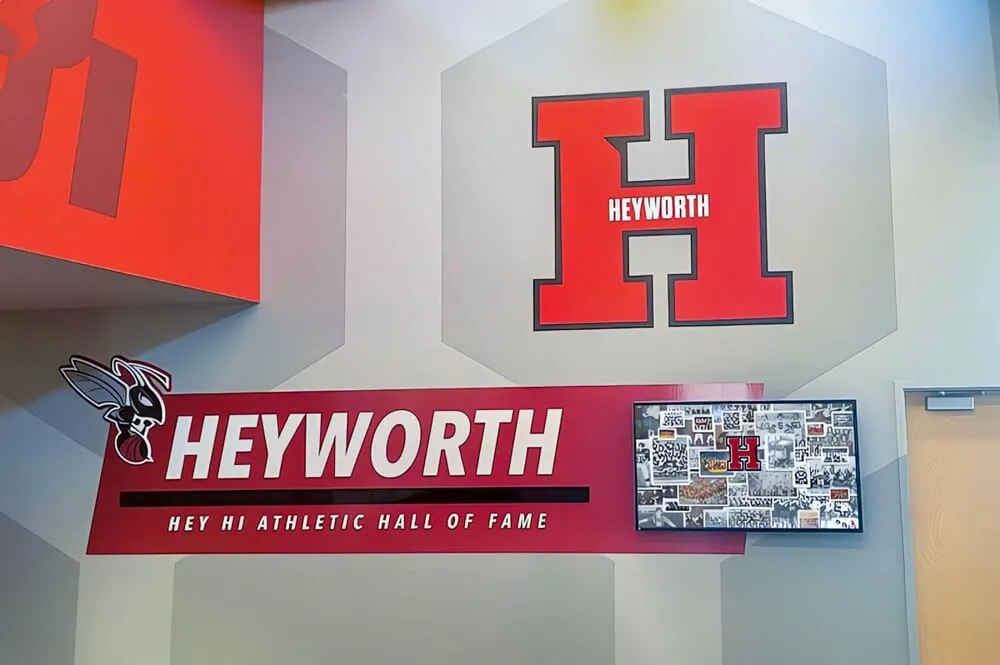
Athletic hall of fame wall signage creates a permanent recognition presence in school buildings — cheer programs with a strong, consistent logo identity are positioned to claim a prominent section of this recognition environment
Typography: The Element Most Often Underestimated
Typography choices can define or undermine a cheer team logo — yet it’s the element most often handled with the least intentionality. Common mistakes include defaulting to an overly decorative script because it “looks like cheer,” or using a generic system font that lacks visual character.
Script Fonts: Use Deliberately
Script or handwritten fonts feel natural for cheer team logos because they suggest movement, energy, and personality. The risk is that poorly chosen scripts can read as low-effort or dated — many scripts popular in design trends from a decade ago now signal “this was made in a hurry.”
If using a script, choose one with enough weight and specificity to stand out from generic alternatives. The script should be used for the team name only, with the school name and supporting text set in a complementary clean serif or sans-serif that provides contrast and legibility.
Serif Fonts for Tradition and Institutional Authority
A classic serif typeface communicates program history and school pride. Serif type pairs well with crest and badge formats and reads with authority on large-format display applications — banners, trophy case graphics, and recognition wall panels where the logo represents the full history of the program.
Bold Sans-Serif for Modern, Athletic Identity
Programs that want a contemporary, competition-oriented visual identity often choose bold geometric sans-serif typography. This approach aligns well with the aesthetic of modern cheer competition uniforms and photographs well on digital display screens and social media graphics where sharpness and contrast matter most.
The Two-Typeface Rule
A cheer team logo should not use more than two typeface families. One primary typeface for the team name, one complementary typeface for supporting text (school name, tagline, founding year). Every additional typeface beyond two increases visual complexity without adding identity value.
Apparel and Uniform Applications for Cheer Team Logos
The cheer uniform is the logo’s most visible real-world application — hundreds of visible instances at every game, competition, and pep rally. Design decisions that work on a banner don’t automatically translate to the uniform or warm-up jacket; each context has specific technical requirements.
Shell Top and Uniform Chest Application
The logo version used on the shell top or uniform chest is typically the most compact version — often the monogram or simplified badge — because the available area is small and the logo must remain legible at close viewing range while surviving repeated washing and performance movement. Requirements:
- Minimum viable detail: The logo at this scale should retain only the elements that are visible and clear at 3–4 inches in the primary dimension
- Heat transfer or sublimation compatibility: If uniforms are sublimated or heat-transferred, vector artwork must be provided in the exact color values specified in the uniform manufacturer’s palette
- Embroidery path: For warm-up jackets, the logo must be compatible with embroidery path requirements — fine lines, gradients, and details that look clean in print often do not translate to thread
Warm-Up Jacket and Bag Application
Marching band and spirit squad uniform programs use the same procurement and specification considerations that apply to cheer warm-up gear: consistent color matching across vendors, file format requirements, and minimum size standards for embroidered applications on polyester fabrics. Maintaining a written specification document for the cheer team logo — with hex values, Pantone equivalents, and minimum size requirements — prevents the inconsistent results that arise when a new vendor produces the logo from a downloaded JPEG at unknown color settings.
Competition Backdrop Banners
The backdrop banner represents the cheer logo at its largest and most publicly visible scale, with the added pressure of competition photography. Design principles that matter at banner scale:
Bold and uncluttered. At 4×8 or 6×10 feet, fine details disappear. The version used on the competition backdrop should use the full-color clean variant — not a version with thin lines, small text, or subtle gradients.
Optimized for photography. Competition backdrops appear in every team photo taken at the event, which then circulates on social media, in school publications, and in recognition displays for years. A logo designed for print clarity rather than photographic reproduction often looks washed out or overly bright in photos. Test the backdrop design in photographic simulation before production.
Placing Cheer Team Logos in School Recognition Displays
A cheer team logo that exists only on social media and uniforms is missing the most lasting recognition context available: the school’s physical recognition environment. Cheer programs that establish a visual presence in hallway displays, trophy cases, and digital recognition screens build program prestige in a way that digital promotion alone cannot replicate.
Trophy Case Integration
Well-designed digital trophy case displays consistently use program logos as the visual anchors for individual case sections — identifying each program’s trophies and awards before a visitor reads any specific text. A cheer team with a distinctive, well-designed logo can claim a clearly defined section of the trophy case that communicates program identity from across the hallway.
For maximum impact in trophy case displays:
- Display the logo at the top center of the squad’s designated section at a minimum of 8–10 inches in its primary dimension
- Use a printed background panel in school colors rather than leaving trophies against a bare shelf or glass background
- Include the competition event, division, and year for each major trophy so the display communicates achievement context, not just hardware volume
Hallway Banners and Spirit Wall Displays
Hallway recognition displays for school programs represent the most sustained daily visibility any school program can achieve — a hallway near the gym or main entrance means hundreds of students, families, and visitors see the logo every school day. For cheer programs, a hallway presence anchored by the logo creates the kind of ambient recognition that builds community support over time.
For hallway banner applications:
- Test at viewing distance: a banner that looks balanced on a monitor may be illegible from the 15-foot viewing distance of a hallway visitor
- Include the competition level and region to communicate the program’s scope to visitors unfamiliar with cheer competition tiers
- Refresh the banner’s supporting content (photos, season highlights) annually while keeping the logo consistent and stable
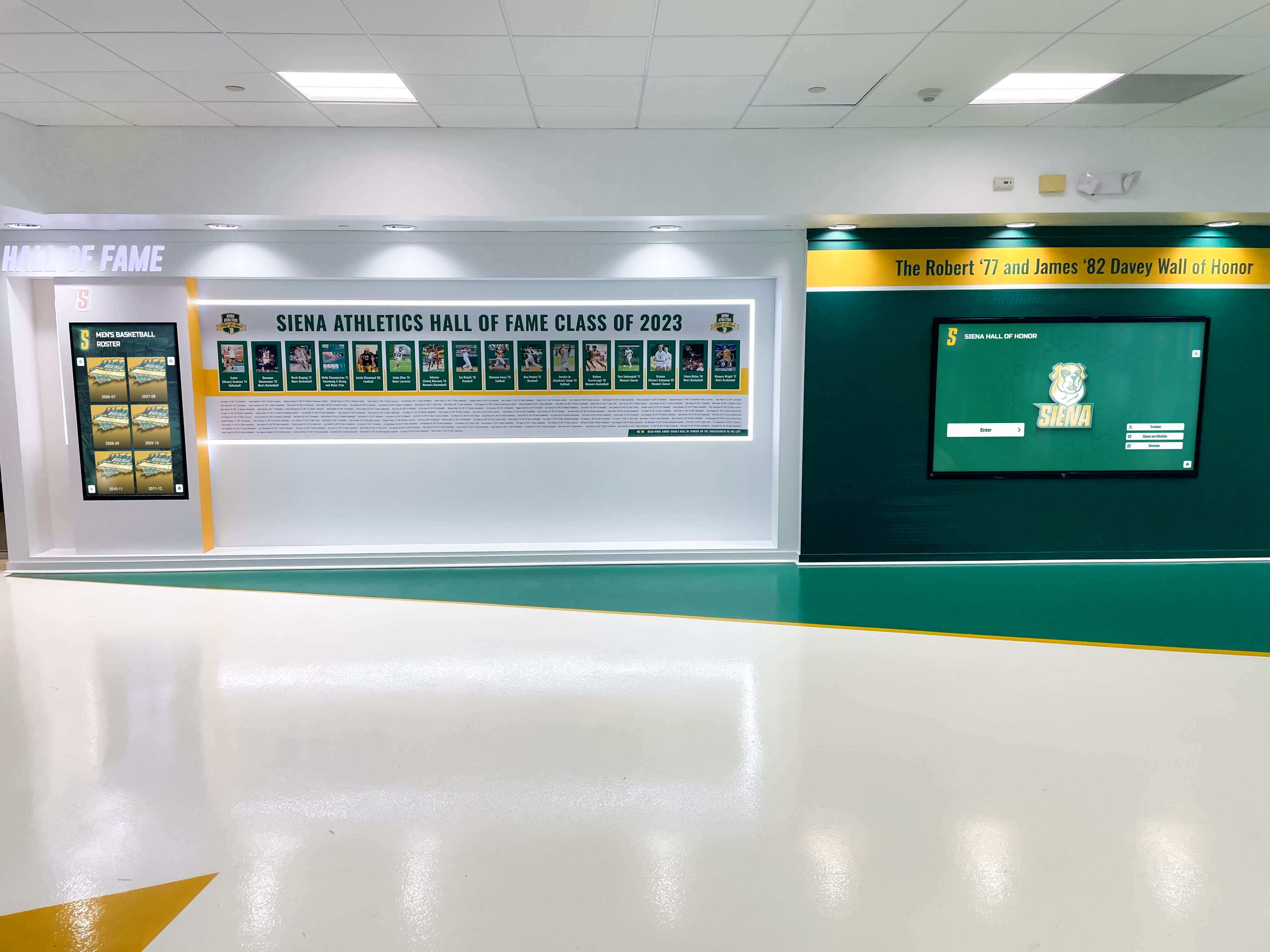
An athletics hall of fame display wall with year-specific program recognition — cheer teams can build a comparable layered presence using the squad logo as the consistent visual anchor across competition seasons
Digital Display Applications for Cheer Program Identity
Schools increasingly use digital recognition systems to display program history, achievement records, and visual content that would require dozens of physical panels to present in static format. Cheer programs are well-positioned to benefit from this transition, particularly for programs with multi-year competition histories.
Athletic Recognition Walls and Digital Displays
Gym digital signage programs for K-12 schools now regularly include cheer and spirit programs alongside athletics — particularly schools where the cheer program competes at the state or national level. A digital recognition display anchored by the squad’s logo and organized by competition season creates a searchable, updateable legacy system that physical trophies and static banner displays cannot match.
Athletic Stats and Achievement Records
Athletic stats display systems for schools increasingly support spirit and performance programs alongside traditional sports, documenting competition placements, team records, championship wins, and individual achievement milestones. For cheer programs with deep competition histories, organizing this record under the team’s logo identity creates a legacy display that current squad members, alumni, and families can explore.
Homecoming and Game Day Digital Content
Homecoming poster and spirit graphic programs benefit significantly from having a strong cheer logo as the visual anchor. When the team’s logo is consistently and cleanly applied in digital content — game day graphics, competition preview posts, and recognition posts after events — it builds the program’s social media presence into an extension of the physical recognition environment.
Athletic Recruiting Recognition Displays
Athletic recruiting and recognition display systems show how schools use program identity assets — including logos — to present the full scope of their athletics culture to incoming students, recruits, and visiting families. For cheer programs with college-bound athletes receiving scholarships or continuing in collegiate cheer, a recognition display that documents that achievement under the program’s logo creates the kind of visible legacy that supports recruiting for future classes.
Building Community Around Program Identity
Innovative approaches to building community through recognition consistently demonstrate that programs with unified visual identities — where the logo appears consistently in hallways, on digital displays, in event materials, and on social media — generate stronger community engagement and alumni connection than programs with fragmented or inconsistent branding. For cheer squads, the logo is the visible symbol of everything the program stands for; using it with discipline and consistency pays long-term recognition dividends.
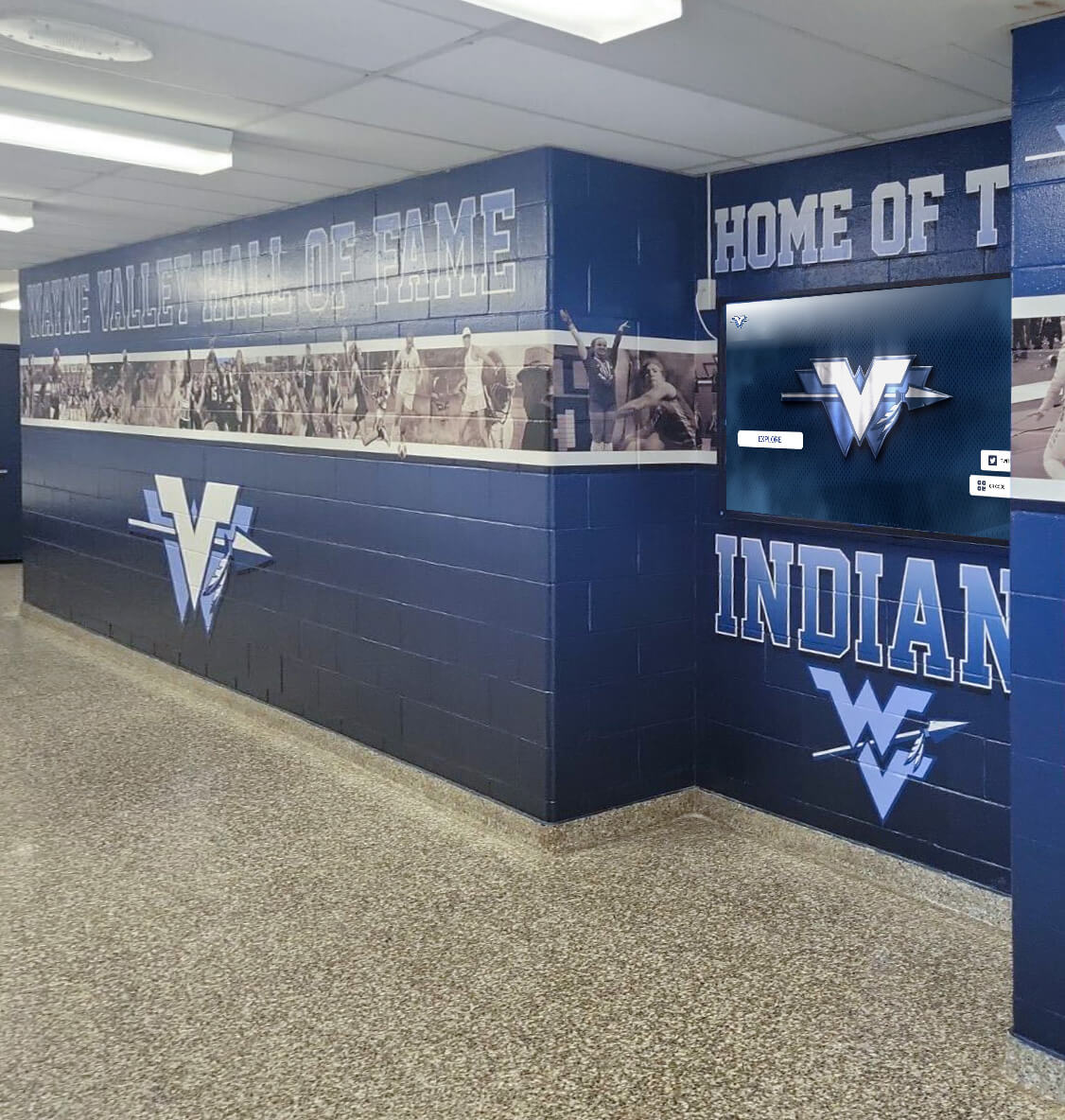
A hallway wall of fame mural in school colors — the kind of physical recognition environment where a consistently applied cheer team logo builds program identity visible to every student, visitor, and prospective squad member who walks through the building
File Format and Technical Requirements for Cheer Team Logos
A cheer team logo is only as durable as the files used to maintain it. The most common source of logo quality problems in school programs isn’t poor design — it’s inadequate file management that forces teams to reproduce the logo from increasingly degraded sources over time.
Always Maintain a Vector Master
The logo must be created in a vector format — SVG, Adobe Illustrator (AI), or EPS. Vector files describe graphic shapes as mathematical objects rather than pixel grids, meaning they scale to any size — from a half-inch collar emblem to a ten-foot competition backdrop — without any loss of quality.
If the squad’s current logo exists only as a JPEG, PNG, or photo scan, the most important step is a one-time investment in having a designer re-create it in vector format. This single step enables every other quality improvement and prevents the escalating quality degradation that affects programs operating from raster-only files.
Standard Export Set
Once the master vector file is maintained, keep a library of standard exports:
- PNG with transparent background — for digital overlays, social media graphics, and web use
- SVG — for web applications and digital screens that support vector rendering
- PDF — for print vendor submissions; preserves vector quality and color profiles
- JPEG with white background — for email, document insertion, and contexts that don’t support transparency
Color Variants to Maintain
Every cheer team logo should have three color variants prepared and labeled:
- Full-color standard — the primary version used across most applications
- Reversed/white — white or light elements on dark or transparent background, for colored backgrounds
- Single-color black — for contexts where color printing isn’t available or required
Having these variants prepared in advance prevents the improvised, inconsistent versions that get produced under deadline pressure when the right file isn’t accessible.
Common Cheer Logo Design Mistakes to Avoid
Using a raster file as the master logo. JPEG and PNG exports look fine on screen but produce blurry or pixelated results when scaled up for banner or backdrop production. The master logo must always be in vector format.
Too many design elements in a single mark. The impulse to include the team name, school name, mascot, a pompom, a star, a silhouette, and a motto all in the same logo produces a mark that communicates nothing clearly. A crest with one strong central image, the team name, and the school name is sufficient; add more only when each element carries genuine visual necessity.
Inconsistent color application. Using slightly different shades of the school’s primary color across different materials — because the designer guessed at the hex value, or because different vendors calibrated their equipment differently — creates a logo that looks like it belongs to multiple different programs. Maintain exact hex values for digital and Pantone values for print, and provide those specifications to every vendor.
Designing only for screen. A logo that looks clean on a 4K monitor may be illegible when embroidered on a uniform top or printed on a large competition banner. Every design decision must be evaluated across the full range of sizes and production methods the logo will encounter.
Redesigning the logo every season. A logo that changes annually never builds the recognition value of a stable program identity. Minor refinements are acceptable; wholesale redesigns should be reserved for significant program transitions. The goal is a logo that alumni recognize years later when they see it on social media or return to the school for a reunion event.
Not planning the reversed version. Cheer performance photos are frequently taken against dark, colored, or stage-lit backgrounds. A logo designed only against a white background will disappear in those contexts. The reversed (white or light) version must be designed alongside the standard version before the logo is finalized.
FAQ
What should a cheer team logo include? At minimum, a cheer team logo should include the team name, school name or initials, and a primary visual element — a school mascot in an energetic pose, a cheer-specific symbol (megaphone, star, pompom), or a distinctive geometric device. The most effective logos also include a clear color identity tied to school colors and a format (crest, badge, or wordmark) that scales cleanly across applications from uniform embroidery to gymnasium banners and digital recognition screens.
What is the best format for cheer team logos — crest, badge, or wordmark? The right format depends on the program’s personality and usage priorities. Crest formats project tradition and achievement — best for programs with long competition histories and a formal recognition culture. Circular badge formats are more versatile and scale better to compact sizes like social media profile icons and collar devices. Wordmark formats work well when the team name itself is memorable and distinctive. Many programs develop a full crest or badge for primary display applications and a simplified companion mark for uniform and accessory use.
How do I integrate the school mascot into our cheer logo design? The most effective approach is adapting the school mascot into a cheer-specific or performance pose — mid-jump, holding pompoms or a megaphone, or positioned in a V-motion — that communicates energy rather than the static side-profile used in many standard athletic crests. Place the adapted mascot as the central charge within a crest or badge format, with the team and school name in supporting text. The mascot version in the cheer logo should feel specific to the squad, not identical to the mascot graphic used by every other school program.
How do cheer team logos appear on recognition walls? Cheer team logos serve as the visual anchors for program sections in trophy cases, hallway banner displays, and digital recognition screens. At minimum, the logo should appear at the top of any dedicated cheer section at a clearly visible size (minimum 8–10 inches in the primary dimension for physical displays). In digital recognition systems, the logo appears as the consistent header element that identifies the program across all content states — competition results, team photos, milestone records, and alumni recognition.
What file formats are required for cheer team logos? The master design must be maintained in a vector format (SVG, AI, or EPS). From this, maintain standard exports: a PNG with transparent background for digital use, a PDF for print vendors, and a JPEG with white background for documents and email. Maintain full-color, reversed (white), and single-color black variants so the right version is always available for any application context.
Showcase Your Cheer Program on a Recognition Display That Lasts
Rocket Alumni Solutions helps schools create digital recognition systems that showcase cheer team competition history, championship milestones, and program achievements — searchable, updateable, and designed to reflect the identity your squad has built season after season.
Get notified when Rocket Graphics opens