Championship banner wording is the one design decision that, once printed on vinyl or fabric and hung in a gymnasium, cannot be quietly corrected without reordering. Schools that standardize how they name sports, format seasons, designate team levels, and phrase championship titles before ordering banners avoid the inconsistency that accumulates over years — and they build a recognition infrastructure that transfers cleanly into digital archives, touchscreen halls of fame, and searchable program records. This guide covers every field that should be decided at the program level, with standard options and the tradeoffs behind each choice.
Why Championship Banner Wording Needs a Written Standard
Most athletic departments don’t notice a wording problem until a new banner contradicts an old one. The gymnasium has “Girls Basketball State Champions 2018” on one banner and “Lady Rockets — 2023 State Championship” on another. One football banner says “District 7 Champions” while the next three say “District Champions” with no number. A swimming banner includes the coach’s name; no other sport does.
These inconsistencies happen because each banner was ordered by a different athletic director, a different coach, or a different booster club committee — each doing what felt right at the time, without a written standard to follow. The result is a gymnasium that looks like the program had no consistent identity across its history, even when the program itself was excellent.
The cost isn’t only aesthetic. Schools building digital archives, interactive touchscreen recognition displays, or searchable record databases face a secondary problem: wording inconsistency in physical banners creates inconsistency in the data that feeds those systems. “Girls Basketball” and “Lady Rockets Basketball” and “WBB” all refer to the same sport, but they index as different entries without manual reconciliation.
A written championship banner wording standard solves both problems: it makes future banners consistent with past ones, and it creates the canonical field vocabulary for any digital recognition system built on top of the same data.
The Seven Fields Every Championship Banner Decision Document Should Cover
Before any banner is ordered, designed, or digitized, an athletic department should have documented decisions for each of the following fields:
| Field | Decision Required | Common Options |
|---|---|---|
| Sport name | Canonical name for each sport | “Boys Basketball” vs “Basketball” vs “Men’s Basketball” |
| Team level | Which levels earn a banner | Varsity only; Varsity + JV; all levels |
| Gender designation | Standard phrasing | “Girls / Boys” vs “Women’s / Men’s” vs mascot-based |
| Season year format | How years appear | “2024-25” vs “2025” vs “2024-2025” |
| Championship title | What level earns what phrasing | State, Regional, District, Conference, League |
| Coach name | Whether and how coaches appear | Name only; Name + record; No coach names |
| Sponsor acknowledgment | Where and how sponsors appear | “Presented by” zone; separate sponsor panel; no sponsors |
Documenting these seven fields eliminates the most common sources of wording inconsistency. The decisions themselves matter less than the fact that they are made once and written down.
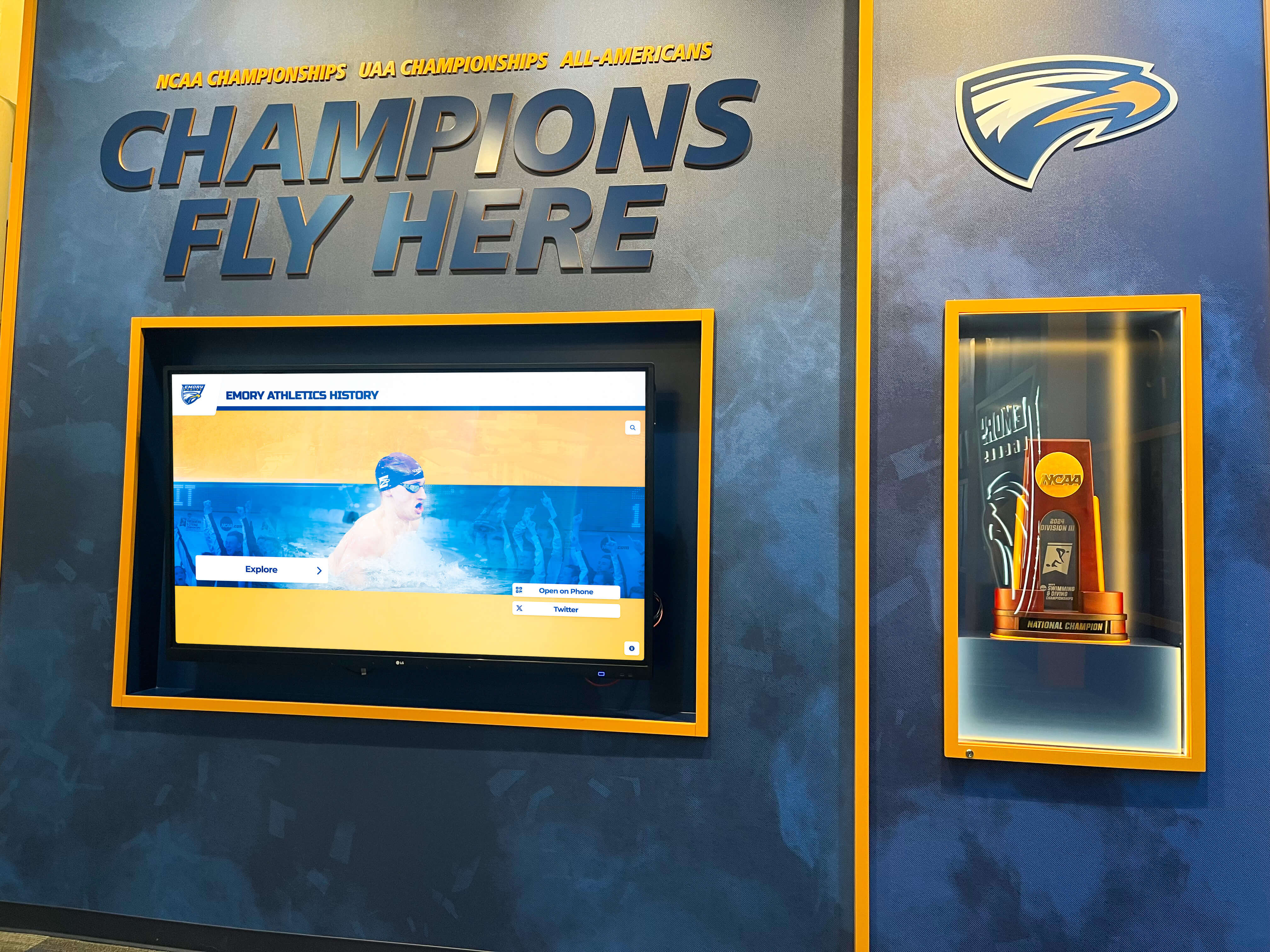
Championship recognition environments that span multiple sports and decades depend on consistent wording decisions made at the program level — not sport by sport at banner ordering time
Sport Name Standardization: The Foundation of Everything Else
The canonical name for each sport is the most consequential wording decision a school makes, because it appears on every banner, every record board, every program guide, and every digital archive entry for that sport in perpetuity.
Gender Designation Options
Three conventions are in active use at U.S. high schools and colleges:
“Girls / Boys” format — Most common at the high school level. Matches the language used by the National Federation of State High School Associations (NFHS) in its participation data and official records. Example: “Girls Basketball,” “Boys Soccer.”
“Women’s / Men’s” format — Common at the college level and in schools that prefer a more formal register. Example: “Women’s Basketball,” “Men’s Swimming.” Some high schools adopt this format when they want recognition materials to feel consistent with college program conventions.
Mascot-based designation — Some programs use a gendered mascot variant: “Lady Eagles Basketball.” This format creates recognition problems when the mascot name changes or when the school moves away from gendered mascot variants, which has become more common over the past decade. It also indexes poorly in digital archives.
The NFHS uses “Girls” and “Boys” throughout its official documentation, which makes this the most standard choice for high school programs that want wording consistent with state association reporting.
Sport Name Consistency Across Documents
Every banner, every digital record entry, and every award certificate should use the same canonical sport name. Schools that use “Cross Country” on one banner and “XC” on another, or “Track & Field” in some places and “Track and Field” in others, create ambiguity in archives and databases.
The simplest solution: create a master sport list at the start of each academic year, using the same spelling, capitalization, and abbreviation (if any) used by the state athletic association for that sport. Building comprehensive season recap archives becomes significantly easier when every source document uses identical sport names — no cleanup required when pulling data into a recognition display.
Season Year Format: Picking One and Staying With It
The season year on a championship banner seems like a minor decision until a gymnasium has banners spanning four decades with three different formats. Common options:
Academic year format: “2024-25” — Compact, widely understood, and consistent with how most schools label academic calendars. Works for all sports regardless of when in the school year the season falls. This is the most common format in NFHS documentation.
Calendar year: “2025” — Simpler, and appropriate for sports whose season falls entirely within one calendar year (spring sports like baseball, softball, and track). Creates ambiguity for fall and winter sports: a football championship in November 2024 belongs to the “2024-25” school year but the “2024” calendar year.
Full academic year: “2024-2025” — Unambiguous but consumes more space on the banner and in archives. Less common at the K-12 level.
Recommendation: Use academic year format (“2024-25”) across all sports for consistency, regardless of season timing. It matches how students, coaches, and administrators already refer to school years, and it matches the format used by most state athletic associations in their official championship records.
Championship Title Wording: Precision Prevents Misrepresentation
The championship title line — “State Champions,” “Conference Champions,” “Runner-Up” — is the most visible line on the banner, and the most important to get precisely right.
Levels and Their Standard Titles
| Level | Standard Wording | Notes |
|---|---|---|
| State | “State Champions” or “State Championship” | Use the title conferred by the state association; some distinguish “Champion” (won bracket) from “Champions” (team title) |
| Regional | “Regional Champions” or “Regional Finalists” | Specify region if meaningful: “Region 4 Champions” |
| District | “District Champions” | Include district number or name if multiple districts compete in your conference |
| Conference | “Conference Champions” | Use the conference name if the school is in multiple conferences over time: “Great Plains Conference Champions” |
| Runner-up | “State Runner-Up” | Not “Second Place” or “State Finalist” — “Runner-Up” is the standard at all levels |
| Sectional / Sub-state | Use the term the state association uses | Varies by state — match the official terminology exactly |
The most common wording error on championship banners is using a title that is more general than the actual achievement. “State Champions” when the school won a regional but not a state title is a misrepresentation that will be noticed — by alumni, by opposing schools, and eventually by the community. Use the exact title conferred, at the exact level achieved.
Documenting football program milestones and other sport-specific achievements in digital archives requires the same precision — the title used in the archive entry should match the title on the physical banner exactly.
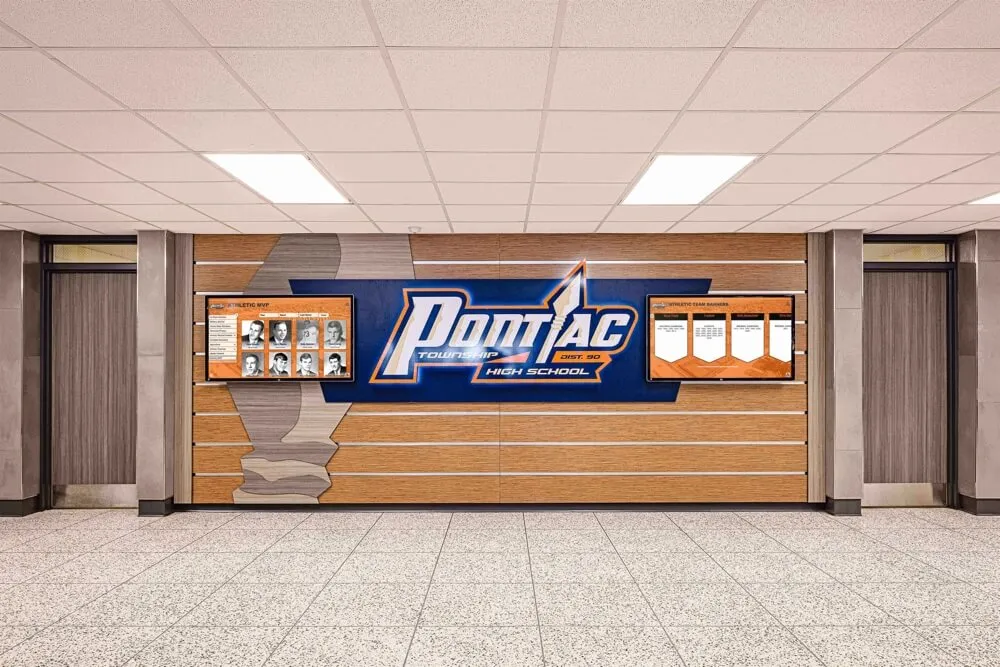
Recognition environments like this athletic honor wall depend on standardized wording conventions applied consistently across sports and years — inconsistency breaks the visual and archival coherence of the installation
Coach Name Policy: The Decision That Affects Every Future Banner
Whether to include coach names on championship banners is a policy decision, not a design decision. Once you include a coach name on one banner, the absence of a coach name on another banner signals an omission — intentional or not — that coaches and their families will notice.
Options for Coach Name Treatment
No coach names — The cleanest policy for long-running programs. Championship recognition belongs to the team; the coaching staff is recognized through other channels. This eliminates future ambiguity about whose name appears on a banner for a team with co-head coaches, interim coaches mid-season, or coaching transitions.
Head coach name only — The most common policy when schools do include coaches. Format: “Head Coach: [Name]” on a secondary line, below the title and year.
Head coach + assistant coaches — Occasionally used for programs with long-running coaching staffs. Creates practical challenges as banners age and coaching staffs change.
Head coach + season record — Adds the final season record (e.g., “28-4”) to the banner. Provides historical context but can feel awkward for titles won in rebuilding years with modest records.
Whatever policy is chosen, document it formally and apply it uniformly across all sports. End-of-year recognition programs that honor coaching staff separately — through banquet recognition, program guides, or digital displays — allow coach contributions to be celebrated without requiring their names on physical banners that may outlast the relationship.
Sponsor-Safe Wording on Championship Banners
School championship banners occupy a regulatory space where sponsor acknowledgment is permitted but constrained. State athletic associations — whose guidelines derive from NFHS framework standards — generally allow sponsor acknowledgment on athletic facilities and recognition displays, but prohibit sponsors from being visually dominant or from appearing alongside student athlete imagery in ways that imply endorsement.
What Sponsor-Safe Wording Looks Like
Permissible:
- A separate “Presenting Sponsor” panel below or adjacent to the championship recognition
- “Made possible by [Business Name]” in small type at the banner’s bottom edge
- A sponsor acknowledgment section in the broader hallway display environment, visually separate from the championship banners
What to avoid:
- Sponsor logo integrated directly into the championship title field
- Sponsor name in the same typeface and weight as the championship title
- Any language suggesting the sponsor contributed to the athletic achievement rather than the facility or display
When building recognition environments that include both championship banners and sponsor acknowledgment — a common combination in athletic lobbies and gymnasium hallways — digital recognition display platforms can handle the separation cleanly: championship content on one layer, sponsor acknowledgment cycling in a designated zone, keeping both compliant and visible.
Connecting Standardized Wording to Digital Archives
Every championship banner hanging in a gymnasium is an asset in a larger historical record. Schools with well-managed digital archives can surface that record through searchable websites, interactive museum-style display installations, and touchscreen walls of fame. Schools without standardized wording spend significant staff time cleaning data before any digital system can use it accurately.
The connection is direct: the seven fields documented in a wording standard become the data schema for the digital archive. “Sport Name,” “Season Year,” “Championship Level,” “Title Won,” “Coach,” “Team Level” — these fields, consistently applied across every banner in the gymnasium, map directly to the database fields a digital recognition system uses to display, filter, and search program history.
What a Standardized Banner Archive Makes Possible
When championship wording is standardized and documented:
- Athletic staff can pull a complete championship history for any sport in seconds
- Recruiting materials can display verified achievement lists without manual compilation
- Digital hallway displays can show auto-updated championship counts by sport
- Donors and alumni can browse program history on touchscreen installations without staff facilitation
- Back-to-school recognition programs can incorporate program achievement history without requiring data entry each fall
When championship wording is inconsistent, none of these downstream benefits are available without a data-cleaning project first.
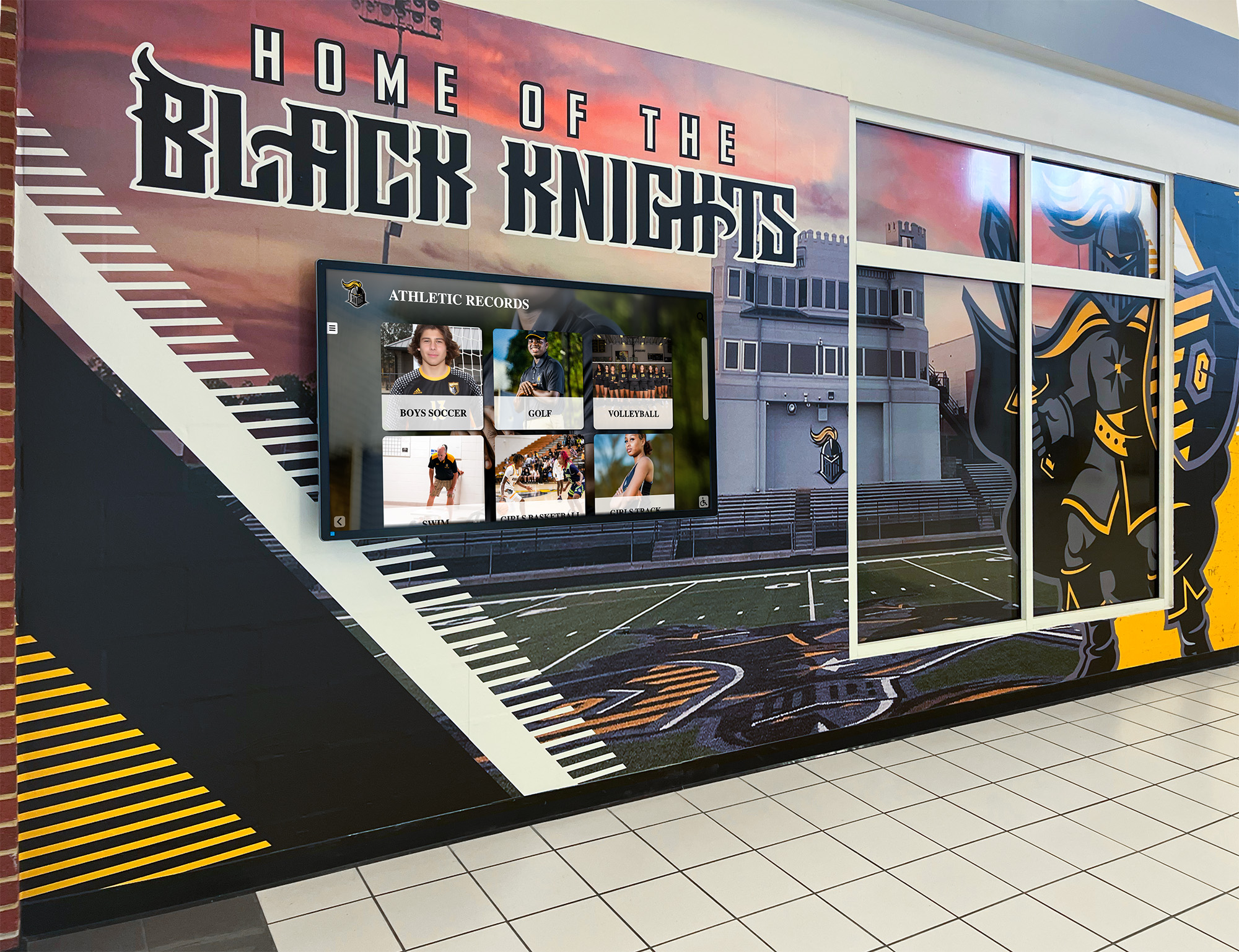
Digital record boards and championship history displays depend on standardized wording from physical banners — accurate digital archives begin with consistent data at the source
Building and Maintaining a Championship Banner Wording Standard
A championship banner wording standard doesn’t require a committee or a lengthy approval process. It requires one document, updated annually, that every person ordering or designing a banner can reference.
Minimum Contents of a Banner Wording Standard Document
- Canonical sport list — Every sport offered by the school, with the exact name, capitalization, and abbreviation (if any) used on all recognition materials
- Season year format — Which format the school uses, with an example (“2024-25”)
- Championship level vocabulary — The exact title for each achievement level, matched to state association terminology
- Team level policy — Which team levels earn a physical banner vs. a digital archive entry
- Coach name policy — Include or exclude, and format if included
- Sponsor acknowledgment policy — Whether sponsors appear on banners, and how
This document belongs in the athletic director’s shared drive, referenced when banners are ordered and when new recognition installations are planned. Academic recognition programs use the same principle — standardized field definitions applied consistently produce records that are both meaningful and usable over time.
Frequently Asked Questions About Championship Banner Wording
What should championship banner wording include?
Championship banner wording should include the sport name (with gender designation and team level), the season year in a consistent format, and the championship title at the exact level achieved. Coach names and season records are optional fields — include them if school policy calls for it, exclude them if not. A formal wording standard covering all seven core fields prevents the inconsistency that compounds across sports and decades.
Should school championship banners include coach names?
Whether to include coach names is a policy decision that should apply uniformly across all sports. The cleanest approach for long-running programs is to exclude coach names from physical banners and recognize coaching staff through award ceremonies, digital displays, and program materials instead. If coach names are included, use only the head coach’s name in a secondary line below the championship title and year.
What is the standard season year format for championship banners?
The most consistent format is the academic year format: “2024-25.” It applies uniformly across all sports regardless of when in the school year the season falls, matches how staff and students already refer to school years, and aligns with NFHS documentation standards. Avoid mixing calendar-year formats for spring sports with academic-year formats for fall and winter sports.
Can schools include sponsor names on championship banners?
Sponsor acknowledgment is generally permissible in a designated zone — a separate panel below the championship title or a small “Presented by” line — but sponsors should not appear in the championship title field itself or alongside the achievement language. Confirm specific rules with your state athletic association before adding sponsor wording to championship banners.
How does standardized wording connect to digital recognition displays?
Standardized championship banner wording creates the consistent field vocabulary that digital archives, touchscreen halls of fame, and record boards depend on. When every banner uses the same sport names, year formats, and title terminology, that data transfers directly into digital systems without cleanup. Inconsistent wording forces manual reconciliation before any digital recognition platform can present an accurate program history.
Turn Standardized Championship Records Into a Living Recognition Display
Rocket Alumni Solutions builds touchscreen halls of fame, digital record boards, and corridor recognition displays that pull championship history from a clean, standardized data source into an interactive environment your students, alumni, and visitors can explore. When your banner wording is consistent, the digital system builds itself — and stays current without staff effort.
Get notified when Rocket Graphics opens