Intent: decide and act. School championship banner NFPA 701 documentation is the set of certificates, test reports, and material records that confirms a gymnasium display banner was tested — or is made from an inherently flame-resistant material — under NFPA 701, the National Fire Protection Association’s Standard Methods of Fire Tests for Flame Propagation of Textiles and Films. The direct answer: before hanging a championship banner in a school gymnasium, contact your school’s local Authority Having Jurisdiction (AHJ) — typically the municipal fire marshal or fire inspector — to confirm whether NFPA 701 test documentation is required for your specific facility and banner type. If it is required, request a Certificate of Flame Resistance or equivalent test report from your banner vendor before delivery and retain the document in the school’s permanent facilities file.
This checklist is written for school athletic directors, facilities managers, and recognition program coordinators who need to understand what NFPA 701 documentation is, when it applies, how to request it from a vendor, and how to retain it for local authority review. NFPA 701 is a test method, not a building code. Whether your school must have this documentation depends on your state’s adopted fire code, any local amendments, and your AHJ’s enforcement posture — this guide helps you ask the right questions, gather the right documents, and build a records file before a fire inspection raises the issue for you.
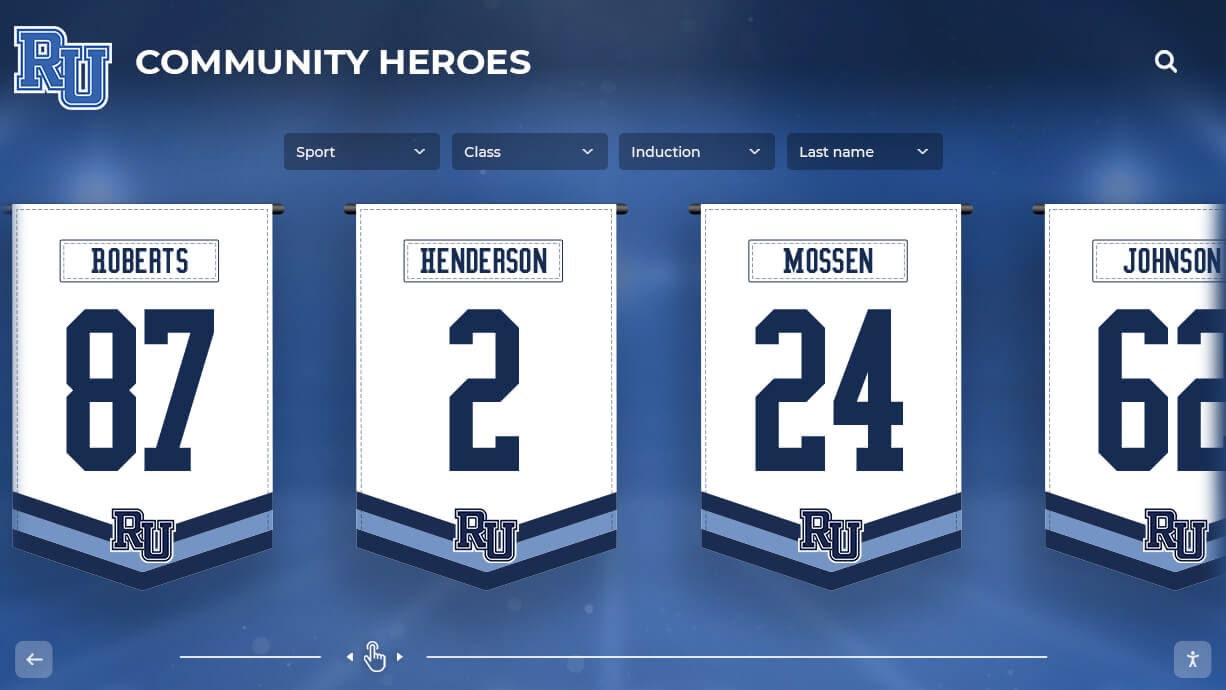
Championship banners and recognition displays hanging in school gymnasiums and corridors may require NFPA 701 flame-propagation documentation depending on the applicable local fire code — confirming the requirement with the Authority Having Jurisdiction before installation is the first step in a compliant banner program
What NFPA 701 Is — and What It Is Not
NFPA 701 is a test method published by the National Fire Protection Association, not a building code or a universal purchasing mandate for school banners. It measures whether a textile or film resists the spread of flame when exposed to a standardized ignition source under controlled laboratory conditions. A material that passes NFPA 701 self-extinguishes when the ignition source is removed; a material that fails continues to propagate flame beyond the test specimen boundary.
The standard’s relevance to a specific gymnasium installation depends entirely on whether the applicable building code, state fire code, or local ordinance requires flame-propagation testing for decorative materials in that occupancy type. NFPA 101, the Life Safety Code — adopted in whole or in part by many states — does address decorative materials in occupied buildings, including educational occupancies, and references NFPA 701 as the test method for verifying flame resistance of textiles. The International Fire Code (IFC), adopted by many jurisdictions, similarly references NFPA 701 for textile materials used as interior finish or decorative elements.
Whether your championship banner requires NFPA 701 documentation is a question for your AHJ — not for the banner vendor, and not for this guide. What this guide provides is the documentation framework so that once your AHJ confirms the requirement, you know exactly what to request, how to evaluate it, and how to retain it.
Why Schools Are Asked for This Documentation
Fire inspectors reviewing school gymnasium spaces commonly examine whether hanging decorative materials — championship banners, spirit banners, paper displays, fabric backdrops — meet flame-propagation requirements applicable to the occupancy. Educational occupancies covered under NFPA 101 or the IFC may be subject to requirements for decorative materials that include quantity limitations (limits on the percentage of a wall or ceiling covered by combustible materials), flame-propagation standards (requirements that textiles meet NFPA 701 test results), and documentation on request (the right of the AHJ to request proof that installed materials meet applicable requirements).
Championship banners are not universally classified as “decorative materials” subject to these provisions — the applicability depends on how the local fire code is interpreted, the specific construction and occupancy classification of the gymnasium, and the AHJ’s enforcement judgment. Some AHJs routinely request NFPA 701 documentation for gymnasium banners; others do not. The risk of being unprepared during a routine fire inspection — with banners installed and no documentation on file — is more easily avoided by building a documentation habit at the time of purchase than by reconstructing records for installed banners after an inspection inquiry.
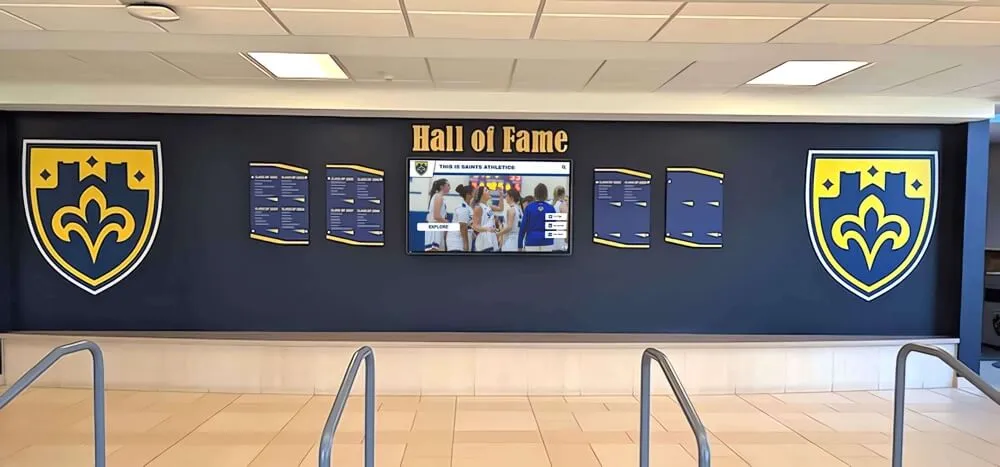
Athletic programs that install championship shields and banners in gymnasium corridors benefit from maintaining NFPA 701 documentation at the time of purchase — records that were easy to obtain at ordering become difficult to reconstruct years later when a fire inspection requires them
NFPA 701 Documentation Checklist: Nine Steps
This checklist covers the documentation process from pre-purchase confirmation through long-term records retention. Complete each step in order; the first step determines whether the remaining steps are mandatory requirements or best practices for your specific facility.
Confirm applicability with your AHJ before ordering. Contact your school district’s facilities department or the local fire marshal directly to ask whether championship banners displayed in your gymnasium require NFPA 701 flame-propagation test documentation under the applicable fire code. Describe the gymnasium construction type, occupancy classification (if known), approximate banner dimensions, and intended installation method (suspended from ceiling trusses, affixed to wall tracks, or mounted on a frame). Request confirmation in writing. This step determines the compliance stakes for everything that follows.
Include a documentation requirement in the banner purchase order. When issuing a purchase order or request for proposal to a banner vendor, add a line item specifying that the vendor must provide NFPA 701 test documentation for the substrate material. Example language: “Vendor shall provide a Certificate of Flame Resistance or test report confirming that the banner substrate material has been tested to NFPA 701 and passed, prior to delivery.” This creates a contractual basis for requesting the documentation if the vendor does not provide it automatically.
Ask the vendor which material the banner will be printed on. Championship banners are commonly produced on polyester fabric (dye sublimation or direct print), vinyl (solvent or latex inkjet), or mesh vinyl. The flame-resistance documentation path differs by material type. Polyester fabric is widely available in inherently flame-resistant formulations — flame resistance is built into the fiber and does not degrade with use. PVC vinyl is generally inherently flame resistant due to chlorine content in the base material, but the specific material specification must still be documented. Chemically treated textiles carry a service life: the topical flame-retardant treatment degrades with cleaning, handling, and age, and these materials require periodic re-treatment and re-certification to maintain compliance.
Request the Certificate of Flame Resistance or test report from the vendor. The document may be labeled differently across vendors and testing laboratories — Certificate of Flame Resistance, Flame Retardant Certification, NFPA 701 Test Report, or Flame Spread Compliance Letter. Regardless of the label, the document should include: the name and contact information of the testing laboratory or certifying party; the specific edition of NFPA 701 referenced; the material description (substrate name, weight, construction); the test result (pass); and the date of testing or certification. If the vendor cannot produce this document for their standard material, request that they source an alternative substrate for which documentation exists.
Verify that the certificate references NFPA 701 specifically. Some flame-resistance certificates reference the California State Fire Marshal (CSFM) standard, CPAI-84 (a standard for tents and tarpaulins), or other test methods. Confirm with your AHJ whether an alternative certification is acceptable under the local fire code before assuming that a document referencing a different standard satisfies the NFPA 701 requirement. Some jurisdictions accept CSFM certification as equivalent; others specifically require NFPA 701 documentation. Do not make this assumption without confirming with the AHJ.
Confirm whether the certification covers the finished printed material. For some substrates, the flame-resistance certification applies to the raw fabric or film before printing. If the printing process applies a heavy ink load or overlaminate coating, the fire characteristics of the finished material may differ from the certified substrate. Ask the vendor whether the certificate applies to the uncoated substrate, the printed material, or the overlaminated finished product, and whether printing or lamination is known to affect flame propagation for the specific material and ink system used.
Record the documentation in the school’s permanent facilities file. Once you receive the documentation, retain it in a facilities file organized by installation location and banner description. Include: the vendor’s Certificate of Flame Resistance or test report; the purchase order confirming the documentation requirement; a photograph of the installed banner with its installation location noted; and a record of the AHJ confirmation received in Step 1.
Re-evaluate documentation after cleaning or extended storage. Chemically treated materials may require re-certification after washing or dry-cleaning. If your championship banners are cleaned between seasons, confirm with the vendor whether the cleaning process degrades the flame-retardant treatment and whether re-treatment and re-certification are required. Inherently flame-resistant polyester does not require this step.
Update documentation when banners are replaced or relocated. When a banner is replaced for any reason — updated championship records, physical damage, branding changes — obtain new documentation for the replacement banner before installation. If an existing banner is moved to a different installation location within the facility, confirm with the AHJ whether the new location triggers a documentation review.
Decision Table: Documentation Action by Situation
Use this table to determine what documentation action applies to your current situation. The “Required action” column assumes your AHJ has confirmed that NFPA 701 documentation is required — adjust for your facility if the AHJ has determined that it is not.
| Situation | Banner Material | Documentation Status | Required Action |
|---|---|---|---|
| New banner, not yet ordered | Unknown | None | Include documentation requirement in purchase order; confirm substrate with vendor before ordering |
| New banner ordered; vendor provides certificate | Polyester, vinyl, or treated fabric | Certificate provided | Verify certificate references NFPA 701; confirm material description matches ordered spec; retain in facilities file |
| New banner ordered; vendor cannot provide certificate | Unknown | None | Request alternative certified substrate or locate a vendor who can provide documentation; do not install without documentation if AHJ requires it |
| Existing banner installed; no documentation on file | Unknown | None | Contact original vendor with purchase order records; request retroactive documentation; if unavailable, contact accredited testing laboratory for material evaluation options |
| Existing banner installed; certificate covers treated material | Chemically treated fabric | Certificate on file, possibly expired | Confirm treatment date and cleaning history; schedule re-treatment and re-certification if past service life |
| AHJ has not confirmed whether documentation is required | Any | Unknown | Contact AHJ before next scheduled inspection; document the inquiry and the response regardless of outcome |
Requesting Documentation from Your Banner Vendor
Most commercial banner vendors that produce championship banners for school gymnasiums can provide flame-resistance documentation for the materials they stock — this is a routine request in the education and public venue market. Documentation is typically held by the material manufacturer (the fabric or vinyl supplier) and passed to the banner vendor as a specification sheet or certificate for the specific substrate.
When requesting documentation, provide the vendor with the intended installation location (gymnasium, lobby, hallway), the occupancy type, a note that the AHJ has indicated documentation is required (or that you are confirming requirements proactively), and a deadline for receiving the documentation before delivery.
If a vendor is unfamiliar with NFPA 701 documentation requests, ask whether their material supplier can provide a fabric or substrate specification that includes flame-resistance test data. Large banner fabric manufacturers routinely publish flame-resistance certifications for their products and can provide documentation that the banner vendor passes along to the school.
Schools planning gymnasium recognition environments that combine championship banners with digital display systems can benefit from reviewing how peer programs are coordinating physical and digital recognition in shared wall space. The state championship banners and gym wall space digital solutions guide covers how athletic programs are planning for both banner and digital display installation — a useful frame when discussing the full recognition environment with your AHJ. Similarly, state championship banners and gym wall space solutions compares how fabric banners, mounted panels, and digital recognition systems each address gymnasium wall space constraints, which matters when deciding how much of the available installation space to dedicate to materials requiring NFPA 701 documentation.
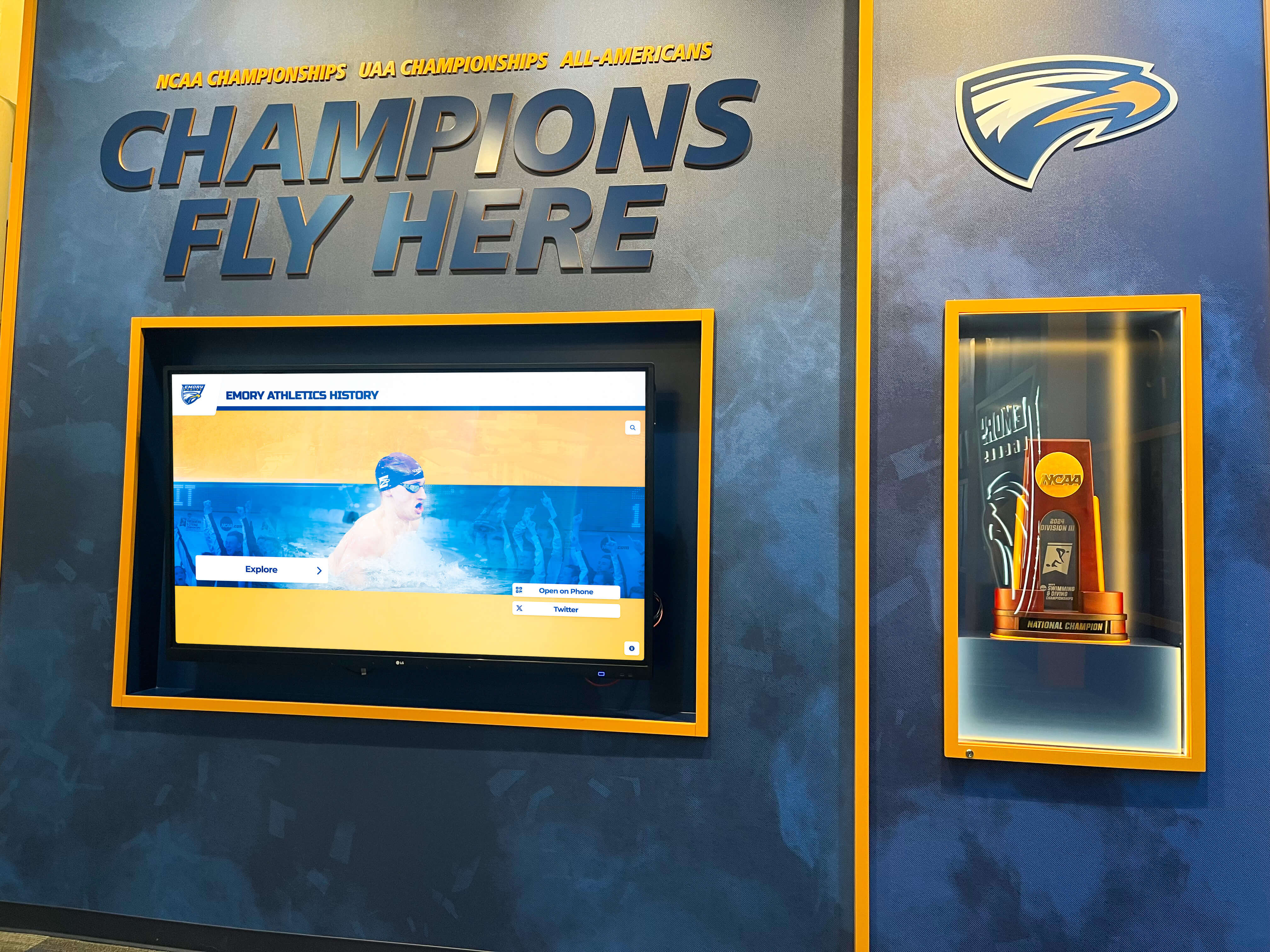
School athletics programs building comprehensive recognition environments — integrating championship banners, trophy displays, and record boards in the same gymnasium space — benefit from consistent documentation practices that cover all installed materials at the time of purchase
Working with the Authority Having Jurisdiction
The AHJ for school fire compliance is typically the municipal or county fire marshal’s office, though some schools operate under state education department facility requirements or insurance-carrier inspection programs with their own standards. Identifying the correct AHJ before making a documentation inquiry is the first practical step.
When you contact the AHJ, frame the inquiry around a specific installation rather than a hypothetical: describe the gymnasium, the approximate banner dimensions and planned material (if known), the installation method, and whether the banners are permanent or seasonally removed and reinstalled. Ask explicitly whether this installation type requires NFPA 701 flame-propagation test documentation under the applicable fire code.
Record the AHJ contact name, the date of the inquiry, the specific question asked, the response received, and any code sections cited. This documentation record protects the school if questions arise at a future inspection and serves as a reference for purchasing decisions on subsequent banner orders. If the AHJ’s response is verbal, send a brief follow-up email summarizing the conversation and the conclusion to create a written record.
Schools that have already installed championship banners without NFPA 701 documentation on file are in a common position — many school athletic programs have accumulated decades of championship banners without a formal documentation process. The appropriate response is not to remove banners but to take the proactive documentation steps described in this checklist and to engage the AHJ directly rather than waiting for an inspection to raise the issue.
For programs considering how traditional banner programs fit alongside digital recognition alternatives, the state championship banners and gym wall space solutions guide from a peer recognition site covers how programs are combining both formats in gymnasium environments.
Practical School Recognition Examples
The following examples illustrate how the documentation checklist applies in real installation contexts. No names, quotes, or fabricated outcomes have been added — these scenarios illustrate procedural patterns, not specific school experiences.
New gymnasium, pre-installation review. A newly completed high school gymnasium is preparing for its first championship banner installation. Before ordering, the athletic director contacts the local fire marshal, who confirms that the gymnasium’s occupancy classification requires NFPA 701 documentation for all textile decorative materials above a minimum dimension threshold. The athletic director adds the documentation requirement to the vendor RFP, receives certificates for the polyester sublimation substrate before delivery, and retains the certificates alongside the AHJ contact record in the facilities file.
Existing banners, documentation gap discovered before inspection. A school athletic director preparing for a scheduled fire inspection discovers that no NFPA 701 documentation exists for the gymnasium’s 18 installed championship banners. Using purchase order records, the director contacts the original vendors. Most are able to provide retroactive certificates for the specific substrates used. For two banners produced by a vendor no longer in operation, the director contacts the AHJ to discuss the options for older installations where original documentation cannot be recovered — and documents this inquiry and the AHJ’s guidance.
Chemically treated material, re-certification cycle. A school’s championship banners were produced on a treated cotton-polyester blend fabric with a five-year service life from the date of treatment. After five years and two cleaning cycles, the certificates on file no longer accurately represent the current flame-resistance status of the material. The athletic director schedules re-treatment and obtains updated certificates from a textile flame-retardant applicator approved by the AHJ before the next facility inspection.
For athletic programs building recognition environments that combine physical and digital elements, championship banners and digital recognition solutions covers how programs are structuring hybrid recognition environments. Championship banners for school gyms and gymnasium wall display ideas with championship banner and record board integration provide additional context on how gymnasium recognition programs are structured — useful when deciding how to allocate gymnasium wall space between materials requiring NFPA 701 documentation and digital systems with different compliance profiles.
Rocket Alumni Solutions develops championship recognition graphics for school athletic programs through Rocket Graphics, its AI-powered design platform. Schools using Rocket Graphics can coordinate their banner artwork specifications — including substrate selection — with their print vendor before ordering, and build NFPA 701 documentation into the purchase workflow at the same time.
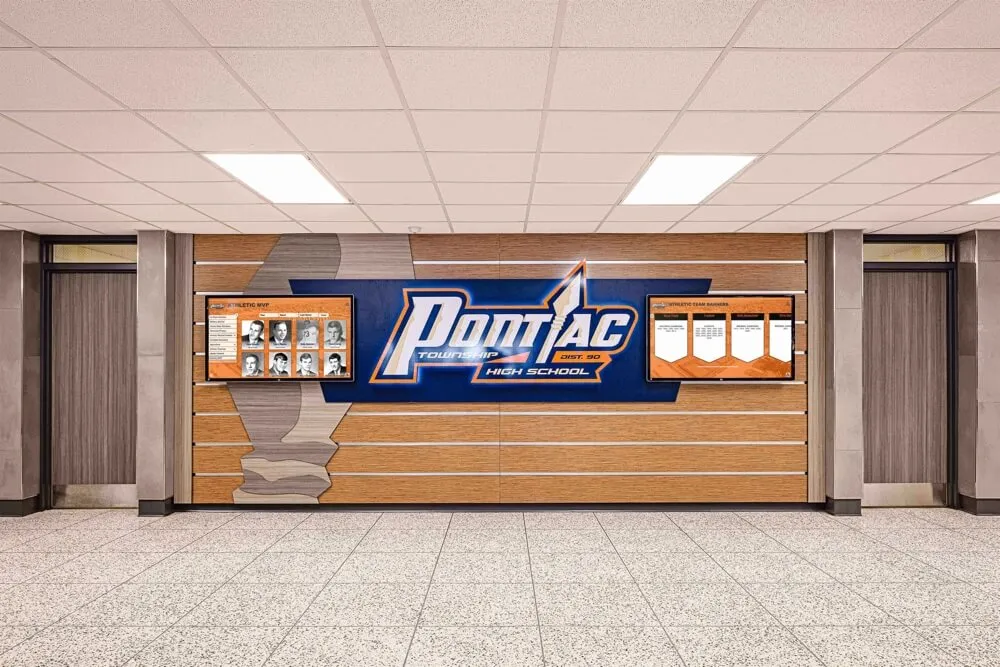
Championship banner and honor wall programs that line school corridors represent a program's competitive legacy — building a consistent NFPA 701 documentation file at the time of purchase protects that investment from compliance risk across decades of seasonal installation and reinstallation
Frequently Asked Questions: School Championship Banner NFPA 701 Documentation
Does every school championship banner need NFPA 701 documentation?
Not necessarily. Whether NFPA 701 documentation is required for a specific championship banner installation depends on the applicable state and local fire code, the gymnasium’s occupancy classification and construction type, and the determination of the local Authority Having Jurisdiction (AHJ). Some AHJs require flame-propagation documentation for all textile materials in educational occupancies above a certain size; others have different thresholds, exemptions, or enforcement practices. Confirm the requirement with your AHJ before ordering or installing banners — do not assume that NFPA 701 documentation is universally required or universally waived.
What is the difference between inherently flame-resistant and chemically treated banner material?
Inherently flame-resistant materials have flame resistance built into the fiber or substrate — the property does not wash out, degrade over time, or require periodic re-treatment. Polyester fabrics used in dye-sublimation banner printing are widely available in inherently flame-resistant grades and are a common choice for school gymnasium installations where NFPA 701 documentation is required. Chemically treated materials carry a finite service life: the topical flame-retardant may degrade after cleaning or extended use and may require re-treatment and re-certification to maintain compliance.
What should a valid NFPA 701 certificate include?
A valid NFPA 701 certificate should include: the name and contact information of the testing laboratory or certifying party; the specific edition of NFPA 701 referenced; the material description (substrate type, weight, and construction); the test result (pass); and the date of testing or certification. Certificates that do not reference a specific edition, that lack a matching material description, or that cannot be traced to an original testing laboratory may not satisfy an AHJ review.
Can the banner vendor provide NFPA 701 documentation?
Yes — in most cases, the banner vendor can provide NFPA 701 documentation for their substrate material, obtained from the fabric or vinyl manufacturer’s specification sheet or test certificate. Include the documentation requirement in your purchase order so the vendor knows to provide it before delivery. If the vendor cannot produce documentation for their standard material, ask whether an alternative certified substrate is available.
What should a school do if championship banners are already installed with no documentation on file?
Contact the original vendor using purchase order records and request retroactive documentation for the substrate material used. Most vendors retain material specifications and can provide certificates for historically used substrates. If the original vendor cannot be identified, contact your AHJ to discuss retroactive compliance options, including whether material sampling and independent testing is a viable path for older installations. Document all AHJ inquiries regardless of outcome.
Retain the Documentation Before the Banner Goes Up
NFPA 701 documentation for school championship banners is a records-management task that is easiest to complete at the time of purchase — when the vendor knows exactly what material was used, when the documentation is most readily available, and before any questions arise at a fire inspection. Athletic directors who build a documentation step into the banner ordering workflow protect their recognition programs from the administrative burden of a retroactive compliance inquiry and keep their championship displays focused on honoring athletes, not on remediation paperwork.
The nine-step checklist in this guide — confirm the AHJ requirement, specify documentation in the purchase order, verify the certificate, and retain records in the facilities file — applies to every championship banner your program installs going forward.
Championship Banner Graphics Built for School Recognition Programs
Rocket Graphics is an AI-powered school graphics platform for athletic departments and recognition programs. Design championship banner artwork with production-ready specifications — and coordinate your substrate selection with your print vendor to meet NFPA 701 documentation requirements before ordering.
Get notified when Rocket Graphics opens.