Intent: decide. Championship banner ink rub resistance is the printed ink’s ability to withstand mechanical abrasion — from handling, folding, mounting-hardware contact, and surface cleaning — without smearing, scuffing, or transferring to adjacent surfaces. The direct answer: before accepting delivery and before hanging a championship banner in a school gymnasium, perform a dry rub test using a clean white cotton cloth applied to a printed ink area under firm, consistent pressure for a minimum of twenty complete passes. If ink transfers visibly to the cloth, or if the printed surface shows dull streaking or surface disruption after rubbing, the banner fails the rub resistance check and should be returned to the vendor before installation. A banner that fails this test on the gymnasium floor will fail more visibly — and more publicly — after a season of rolling, storage, and reinstallation.
This guide is written for school athletic directors, facilities staff, and recognition program coordinators who receive championship banners from print vendors and must approve or reject them before gymnasium installation. It covers what ink rub resistance means for banner applications, a step-by-step dry and wet rub test protocol, a pass/fail decision table by defect type, and pre-installation handling practices that protect finished banners during the installation process itself. Technical production decisions — ink selection, cure settings, substrate specification — belong to the print vendor; the school’s role is to verify the finished product before the banner goes up and before any warranty window closes.
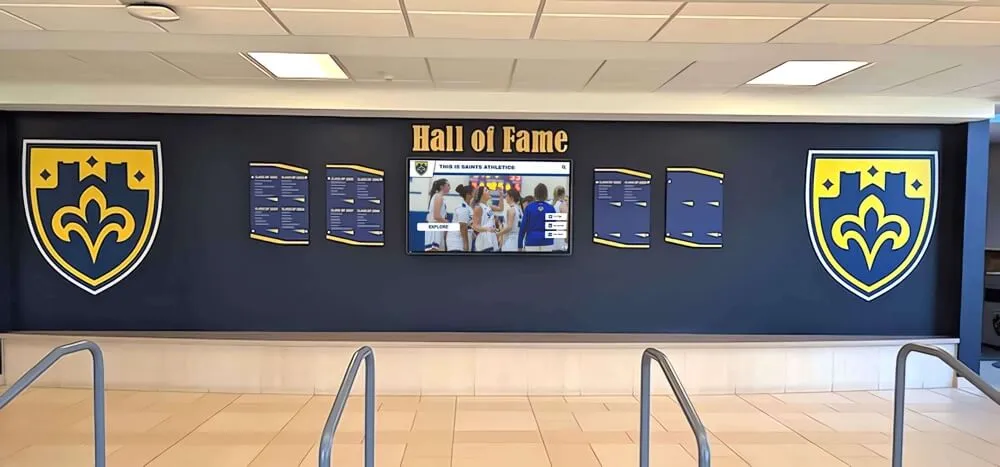
Championship recognition displays in school athletic corridors hold team records for decades — banners that pass a rub resistance inspection before installation maintain print quality through seasonal removal, storage, and reinstallation without ink scuffing or surface damage that would obscure athlete names and year numerals
What Is Ink Rub Resistance and Why It Matters for Championship Banners
Ink rub resistance measures how well a printed surface holds up under friction — the kind generated during shipping contact, gymnasium installation handling, rolled storage between championship seasons, and incidental contact from staff or students who pass through the recognition space. For championship banners displayed in school gymnasiums, banner rub resistance determines whether the ink remains sharp and fully legible across years of use or begins to show scuff marks, dull tracks, and faded areas at the points where the banner has been handled most.
The mechanism of rub resistance differs significantly by ink system. Dye-sublimation printing on polyester fabric — the most common process for school gymnasium championship banners — bonds disperse dye molecules within the polyester fiber matrix during the heat-transfer phase rather than depositing a separate ink film on the surface. Because the dye is part of the fiber and not a film that can be abraded away, properly sublimated polyester banners carry the highest native rub resistance of any common banner ink process. A rub test on a correctly processed sublimated banner should produce no ink transfer to the rubbing cloth under normal hand pressure.
Solvent and eco-solvent inkjet printing on vinyl substrates forms an ink film that sits on or partially penetrates the vinyl surface. Rub resistance in solvent-printed banners depends on the ink fully outgassing and curing after the print run — a process that requires adequate time and ventilation before the banner is packaged and shipped. A vendor who ships immediately after printing introduces rub failure risk regardless of substrate quality. Latex inkjet printing produces a thermoplastic film that bonds well when the printer’s drying system applies sufficient heat, but inadequate cure heat produces a tacky surface that fails under even light abrasion. UV-curable inkjet creates a hardened ink layer through ultraviolet exposure during printing; fully cured UV ink resists abrasion well, but incompletely cured UV ink is brittle and subject to cracking and scuffing.
Understanding which ink system a vendor used for a specific championship banner order sets the expected baseline for the rub resistance test and the likely cause of failure if the test is not passed.
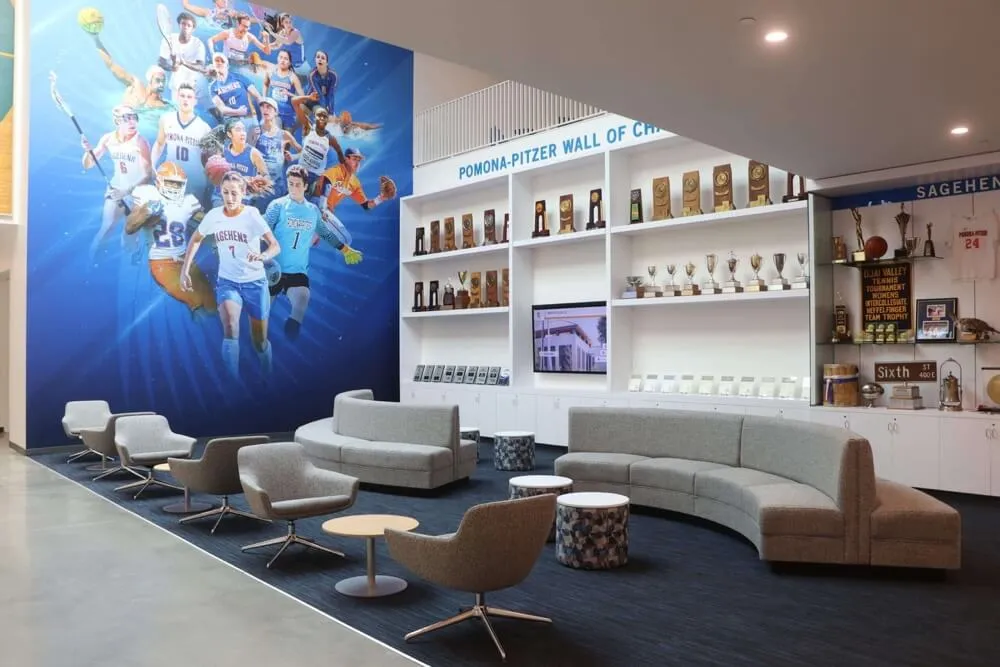
School athletic facilities integrating championship banners, trophy cases, and wall murals require each display element to maintain its print quality through years of active use — rub resistance testing at delivery confirms that a banner's ink will hold through the handling cycles of gymnasium installation, seasonal storage, and reinstallation
When to Test Championship Banner Rub Resistance
The optimal moment to perform a rub resistance test is immediately after accepting delivery of the finished banner — before signing a delivery receipt that waives inspection rights, and before the banner is transported to the gymnasium installation site, stored, or rolled for any period.
Testing at delivery allows defects caused by incomplete curing or processing failures to be documented before the vendor could attribute damage to post-delivery handling. A delivery receipt signed without inspection creates ambiguity about when damage occurred and limits the school’s ability to request a reprint under vendor warranty.
A second test should occur after any extended storage period. Championship banners stored rolled or folded for months between seasons can accumulate contact pressure. Before reinstalling a stored banner at the start of a new school year or for a special recognition ceremony, run a rub test on a leading edge of a text area to confirm the ink surface is still intact. Solvent-based inks are particularly susceptible to this concern: residual solvent that was not fully evaporated during production can continue outgassing slowly during storage, and a banner that passed a delivery rub test may show surface changes after a summer in a storage room with elevated temperature.
Dry Rub Test Protocol for Championship Banners
The dry rub test is the primary field-accessible banner rub resistance evaluation available to school athletic departments. It requires no laboratory equipment and produces a clear, visual result that can be documented with a photograph and included in a vendor return communication.
Materials required:
- One clean, white, lint-free cotton cloth or cotton round pad (not synthetic fiber — synthetic cloth can produce false negatives by absorbing ink without leaving a visible mark)
- A smooth, hard backing surface beneath the banner section being tested
- Consistent hand pressure — approximately 2–4 pounds of force, roughly the pressure of pressing firmly with the heel of the hand
Protocol:
Select test areas in printed ink zones. Choose two or three locations covering the most critical print elements: mascot name lettering, year numerals, and a solid school-color field adjacent to a lighter color or white background. Do not test on blank substrate areas with no ink — those areas cannot fail a rub test and do not reflect ink behavior.
Back the test area with a firm, flat surface. Place the banner face-up on a clean, flat, hard surface — a table or gymnasium floor protected with clean paper. The backing prevents the substrate from flexing under pressure and ensures consistent contact force across the test area. Testing on a soft or uneven backing produces inconsistent results because the cloth and substrate deflect rather than sustaining friction.
Fold the white cloth to a compact 2-inch square pad and position it on the selected ink zone. Apply firm downward pressure with the palm of the hand on the cloth pad.
Rub the cloth back and forth across the test area with consistent pressure for twenty complete passes. One pass is a complete stroke from one edge of the selected area to the other. Maintain consistent pressure throughout — do not reduce pressure partway through because the cloth begins to show color.
Inspect the cloth under good light after twenty passes. A passing result shows no visible ink on the white cloth, or only a faint ghost that requires close examination and does not correspond to a visible defect on the banner. A failing result shows clear ink transfer — a color-matched smear, rub pattern, or offset impression of the printed text — that is visible at arm’s length under normal light.
Inspect the tested area of the banner. Even if the cloth shows no transfer, examine the rubbed area on the banner for dull streaking, loss of color saturation, or a matte track where a glossy printed surface was disrupted. Any of these surface changes indicate rub resistance below the threshold acceptable for a gymnasium display that will be touched, cleaned, and repeatedly handled over its service life.
Document each test location with a photograph before and after. Photograph the white cloth alongside the tested area on the banner. This documentation is the basis for a vendor return request and the comparison check when a corrected replacement banner arrives.
Wet Rub Test for Gymnasium Environments
School gymnasiums are cleaned regularly with water-based solutions applied to floor surfaces and sometimes to adjacent wall and display areas. A dry rub test confirms that a championship banner’s ink holds under handling friction; a wet rub test confirms that the ink holds under incidental moisture contact from cleaning operations.
Perform a wet rub test on a non-critical area of the banner — or on a separate test swatch if the vendor provides one — using a white cotton cloth dampened with clean water and wrung until moist rather than dripping. Apply the same twenty-pass protocol as the dry rub test with consistent pressure on the same ink types tested dry.
A banner that passes the dry rub test but fails the wet rub test should not be installed in a position where it could be contacted by cleaning equipment or moisture from adjacent floor cleaning. Most championship gymnasium banners hang from overhead trusses or ceiling tracks and are not reached during routine cleaning — but record whether a wet rub failure was found so that installation location decisions account for it. For vinyl banners with protective overlaminate coatings, the wet rub test also confirms whether the laminate adhesive is fully bonded to the print surface: a wet cloth on a poorly bonded laminate can cause edge lifting or hazy delamination that is a structural defect distinct from ink rub failure.
Rub Resistance Decision Table: Pass, Review, Reject
Use this table when evaluating dry and wet rub test results at delivery and before gymnasium installation. Record the observed result, the test location, and the decision before contacting the vendor.
| Observed Result | Test Location | Decision | Required Action |
|---|---|---|---|
| No visible ink on cloth; no surface change on banner | All ink zones tested | Pass | Accept delivery; proceed to installation |
| Faint ghost on cloth visible only under close inspection; no banner surface change | Solid color field | Pass with note | Document location and finding; acceptable for installation; inform vendor for awareness |
| Visible color transfer matching print element; no banner surface change | Text or solid color area | Review | Do not install; contact vendor to determine cause — curing time, substrate specification, or ink loading — and request corrected banner or additional cure time before reinstallation |
| Clear smear or rub pattern on cloth; dull streaking visible on banner surface | Any ink zone | Reject | Return to vendor; document with photographs; specify the test method, pass count, pressure, and specific areas in the return communication |
| Progressive ink increase on cloth with each pass; banner surface softening | Text or logo area | Reject — active instability | Banner is not suitable for installation; return immediately and request vendor inspection before replacement is produced |
| Wet rub fails; dry rub passes | Any ink zone | Review | Install only in overhead positions not subject to moisture contact; document finding and installation position for program records |
Ink System Comparison: Rub Resistance for Championship Banners
Different banner printing technologies produce different native rub resistance levels. This comparison applies to banners that have received complete production processing — banners with incomplete curing or finishing may show rub resistance lower than typical for their ink type.
| Ink System | Substrate | Native Rub Resistance | Primary Risk Factor |
|---|---|---|---|
| Dye sublimation | Polyester fabric | High — dye bonded within fiber matrix, no surface film | Dye migration (separate from rub) if substrate lacks anti-migration coating |
| UV-curable inkjet | Vinyl, rigid substrates | High when fully cured — hardened ink resists abrasion | Incomplete UV cure produces brittle ink subject to cracking and flaking under light abrasion |
| Latex inkjet | Vinyl fabric | Good when fully cured — thermoplastic film adheres well | Inadequate drying-system heat produces tacky, transferable ink film |
| Solvent / eco-solvent inkjet | Vinyl, scrim | Moderate to good after full outgassing | Premature shipping before solvent has fully evaporated |
Pre-Installation Handling Checklist for School Gymnasium Banners
Installation handling is the period during which a championship banner accumulates the most mechanical contact before entering service. Protective handling during gymnasium installation reduces the total friction the ink surface absorbs before the banner reaches its installed position.
Wear clean cotton or nitrile gloves during all banner handling. Bare hands introduce skin oils and salts that can chemically interact with ink surfaces, and fingernail edges can score solvent-printed or laminate-coated surfaces at grip points.
Unfurl banners by rolling open rather than shaking or snapping. Shaking or snapping a rolled banner to open it causes the banner to contact itself at speed, which can transfer ink from one area to another where the printed layers touch — particularly a risk on solvent or latex banners where the ink film is on the surface rather than within the substrate.
Keep banners face-out (printed side facing away from the core) when re-rolling for transport from storage to the installation site. Face-out rolling means the print surface does not contact the banner backing when rolled, reducing ink-transfer risk during the carry from the storage area to the gymnasium floor.
Lay banners on clean, dry surfaces if resting during installation. Do not lay a banner print-side-down on a gymnasium floor, concrete staging area, or rough rolling cart — surface texture can score UV or solvent ink. Lay print-side-up on a clean paper or fabric drop cloth if the banner must rest at any point during the installation sequence.
Confirm mounting hardware edges are smooth before the banner makes contact. Grommets with rough edges, or mounting cables with frayed wire ends, can score ink surfaces along the top hem during installation and leave visible scuff marks where the banner is most closely examined at ceremony height. Inspect mounting hardware before threading or attaching the banner.
Perform a final visual inspection of the print surface after installation is complete. Walk the gymnasium floor and examine the banner from the standard viewing distance of thirty to sixty feet, then approach and inspect at close range for any scuff marks, dull streaks, or surface deformation introduced during the installation process. Marks found immediately after installation are attributable to installation handling, not to prior damage — which matters if the school needs to request vendor remediation.
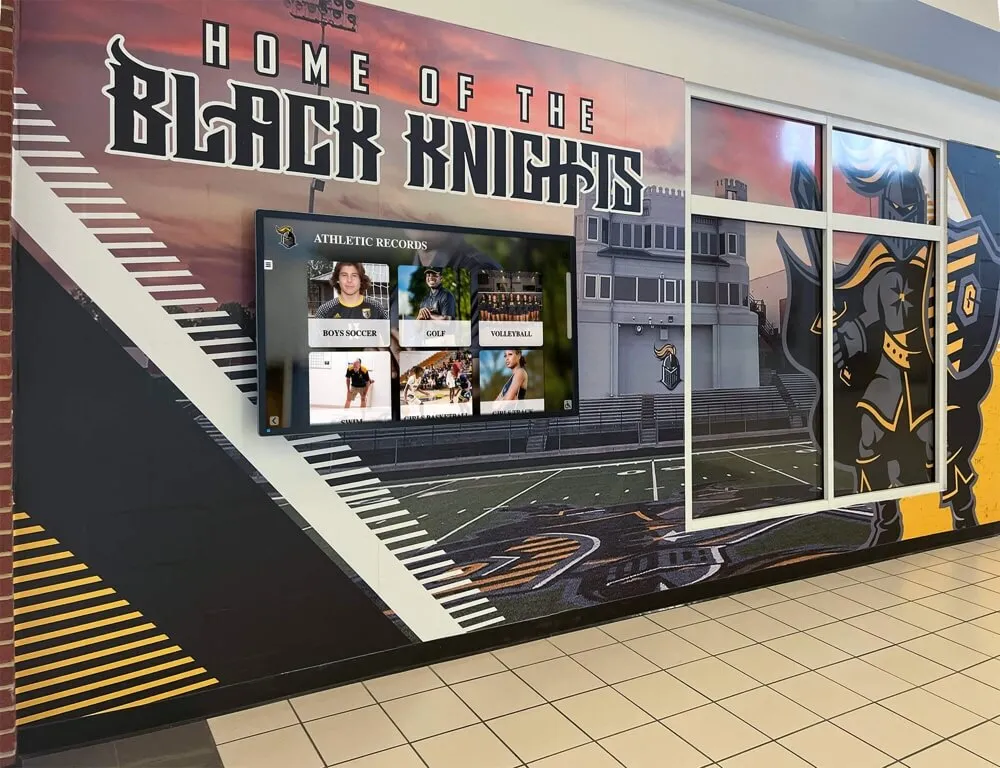
Athletic record displays in school hallways preserve a program's competitive legacy — championship banners installed in these spaces must pass rub resistance testing before hanging to ensure ink quality matches the permanence of the records they celebrate and remains legible through years of seasonal use
Connecting Rub Resistance Inspection to the School’s Installation Program
Championship banner installation in a school gymnasium is one component of a recognition environment that may include trophy cases, mounted plaques, murals, and digital recognition systems. Schools that develop systematic inspection and verification protocols — whether for physical banners or for digital display infrastructure — produce recognition spaces that hold their quality through years of use and continue to honor the athletes and teams whose records they carry.
The same methodical pre-installation verification that a rub resistance test applies to a physical banner applies to digital recognition display hardware. The recognition display cable continuity test and school installation checklist covers the equivalent pre-installation verification workflow for digital recognition display infrastructure — confirming signal continuity before a display goes live in the same way that a rub resistance test confirms ink integrity before a banner goes up. Both checklists protect the school’s investment in recognition programs that celebrate student athletes and team achievement.
For schools with networked digital recognition systems integrated into gymnasium and lobby environments, network infrastructure verification is part of the installation program. The recognition display loop guard compatibility test for uplink connections is relevant for schools integrating recognition displays with existing school switching infrastructure — the kind of network reliability that keeps digital recognition running alongside physical championship banners in a combined gymnasium recognition environment.
Display quality in gymnasium spaces involves physical and digital elements that must complement each other visually. The recognition display black level test for school lobbies and gyms covers how to verify that digital displays render dark tones correctly under the ambient light conditions of school lobbies and gymnasiums — important for schools where digital recognition panels and physical championship banners occupy the same installation environment and must maintain consistent color quality in the same lighting.
For programs that include digital hall-of-fame systems, content reliability across sessions matters as much as print quality matters for physical banners. Digital hall of fame deep link persistence testing covers how to confirm that digital recognition content remains consistently accessible across user sessions — the digital equivalent of confirming that a physical banner holds its ink quality through repeated handling.
Network resilience for digital recognition displays in school gymnasiums also benefits from pre-installation evaluation. Recognition display RSTP convergence testing for fast link recovery covers how switching protocol configuration affects digital recognition display uptime — the kind of technical verification that, like rub resistance testing for physical banners, prevents recognition program failures that would otherwise appear only during a ceremony or public event.
Schools building recognition programs that serve the full community, including visitors and alumni with accessibility needs, should also evaluate the accessibility of any digital recognition components. Digital hall of fame skip link testing and keyboard navigation covers how to confirm that digital recognition platforms are navigable for users with motor or vision accessibility needs — a quality standard that complements the physical durability standard a championship banner must meet to serve the same community over time.
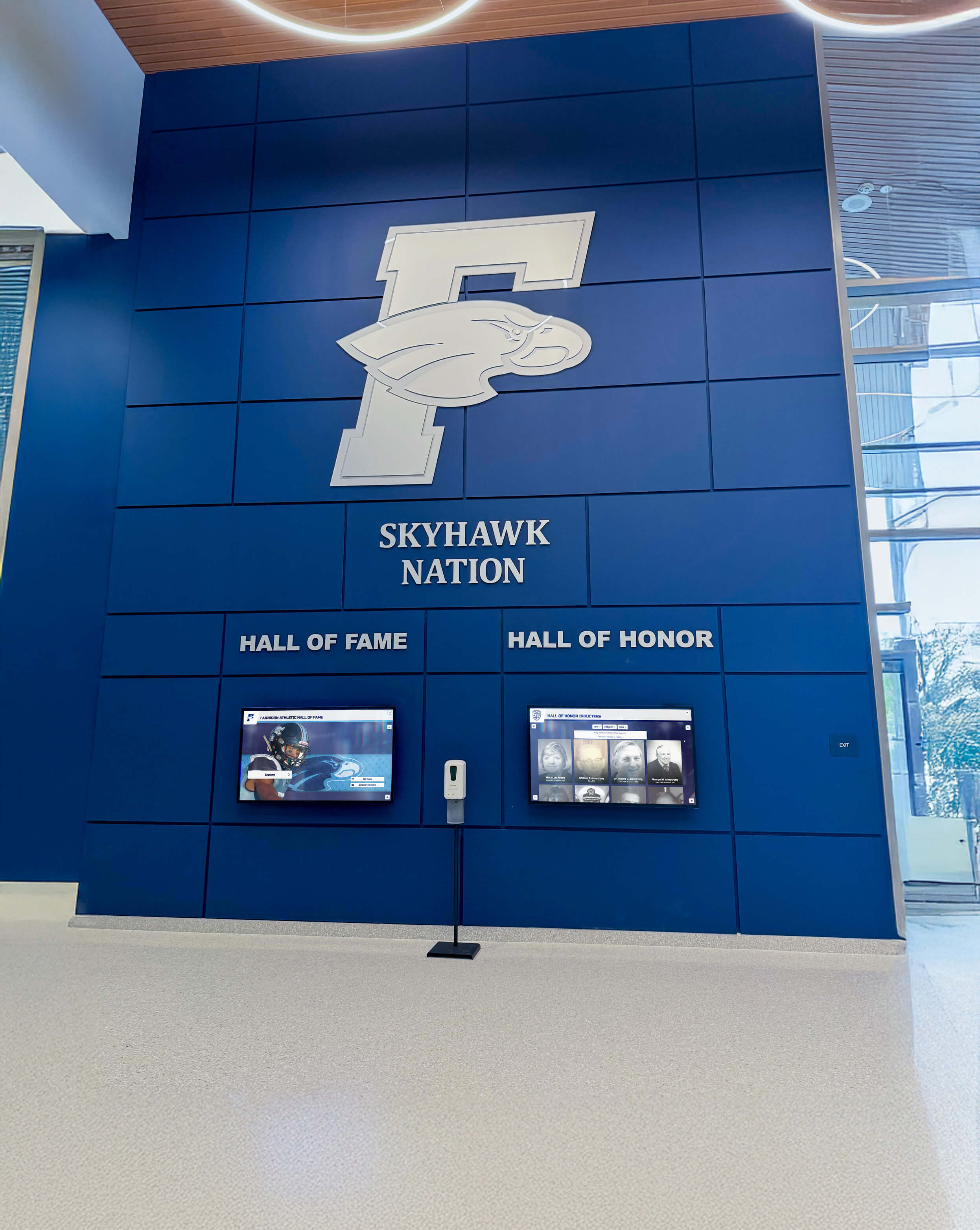
School recognition lobbies that combine championship banners, hall of fame wall displays, and honor designations require each element to hold its quality through years of use — rub resistance testing before gymnasium installation ensures the banner's ink remains sharp and legible as the centerpiece of the recognition environment
Frequently Asked Questions: Championship Banner Ink Rub Resistance
What is ink rub resistance in championship banner printing?
Ink rub resistance in championship banner printing is the ability of the printed ink to withstand mechanical friction — from handling, rolling, mounting hardware contact, and surface cleaning — without smearing, scuffing, or transferring to adjacent surfaces. It is determined primarily by how the ink bonds with the substrate: dye sublimation on polyester bonds dye within the fiber matrix and produces high native rub resistance, while solvent and latex inkjet inks form a surface film whose rub resistance depends on full curing before packaging and shipping.
How do you test a championship banner for ink rub resistance before gym installation?
To test a championship banner for ink rub resistance, lay a section on a clean, firm, flat surface and rub a clean white cotton cloth over a printed ink area with firm pressure for twenty complete passes. Inspect the cloth for visible ink transfer. If ink transfers clearly, or if the rubbed area shows dull streaking or surface disruption, the banner fails the rub resistance check and should not be installed until the vendor identifies and corrects the cause.
Which championship banner printing methods have the best rub resistance?
Dye-sublimation on polyester and UV-curable inkjet printing both produce high rub resistance when processing is completed correctly. Dye sublimation bonds dye within polyester fibers rather than forming a surface film. UV-curable inkjet cures to a hardened layer with excellent abrasion resistance. Latex and solvent inkjet printing produce good rub resistance after full curing but are more sensitive to premature shipping before the cure process is complete.
Can a championship banner with poor rub resistance be corrected?
A banner with rub failure caused by incomplete solvent outgassing may improve with additional ventilated cure time after delivery — retest before installing. However, a banner with inadequate ink adhesion to substrate or incompletely polymerized UV ink cannot be corrected outside the vendor’s production equipment. Those banners must be reprinted with corrected settings. Active ink instability — progressive transfer with each additional rub pass — indicates the banner is unsuitable for installation.
When should a school athletic director reject a championship banner for rub failure?
Reject a championship banner when the dry rub test produces clear visible ink transfer after twenty passes, when the banner surface shows dull streaking in the tested area, or when successive passes produce progressively more transfer. Document with photographs, and contact the vendor with the test method, pass count, pressure applied, and the specific areas where failure was observed.
Test Before the Banner Goes Up
Championship banner ink rub resistance is a practical acceptance standard — not a laboratory specification — that any school athletic department can apply at delivery and before gymnasium installation using a white cotton cloth and consistent hand pressure. The twenty-pass dry rub test, supplemented by a wet rub evaluation for banners in positions subject to moisture contact, provides a clear pass or reject result before the banner is committed to its permanent display location honoring the athletes and teams whose records it carries.
A championship banner that fails a rub resistance test is a production defect, not an artwork issue. The vendor owns the remediation. Testing at delivery — rather than after installation, when handling damage and vendor accountability are harder to separate — keeps the recognition program on track for the ceremony, the season, and the decades of gymnasium display that follow.
Championship Recognition Graphics Built for Production Quality
Rocket Graphics is an AI-powered school graphics platform for athletic departments and recognition programs. Design championship banner artwork with clean, production-ready color fields and vector-accurate boundaries — graphics specified to meet the quality standards your gymnasium installation demands.
Get notified when Rocket Graphics opens.