A championship banner fabric snagging report is a pre-production supplier document that a school athletic director or recognition coordinator can request, review, and evaluate before committing a banner order to a specific textile substrate. The report describes the results of testing conducted under ASTM D3939/D3939M — the Standard Test Method for Snagging Resistance of Fabrics (Mace) — and confirms whether the proposed woven or knitted substrate resisted pulled-thread distortion at a level the school and supplier agreed was acceptable before the banner entered production. Reviewing a snagging report before the order is placed is the only point in the procurement cycle when substrate alternatives are still available and acceptance criteria can still be negotiated in writing.
This guide is written for school athletic directors, recognition coordinators, and the purchasing, facilities, or vendor-review staff who support them. It explains what fabric snagging is and how it differs from ink rub resistance, color transfer, fabric tear strength, and seam slippage — four distinct conditions that are sometimes discussed in the same supplier conversation. It covers what ASTM D3939/D3939M measures, which fabric constructions it applies to, and which constructions require the testing laboratory to confirm method suitability before results can be relied on. It also covers what a complete supplier snagging report should contain, how to verify that the tested coupon matches the proposed substrate, and how to connect the snagging review to the banner design file and achievement data handoff before placing the order. No destructive testing of a delivered championship banner by school staff is described or recommended at any point in this guide.
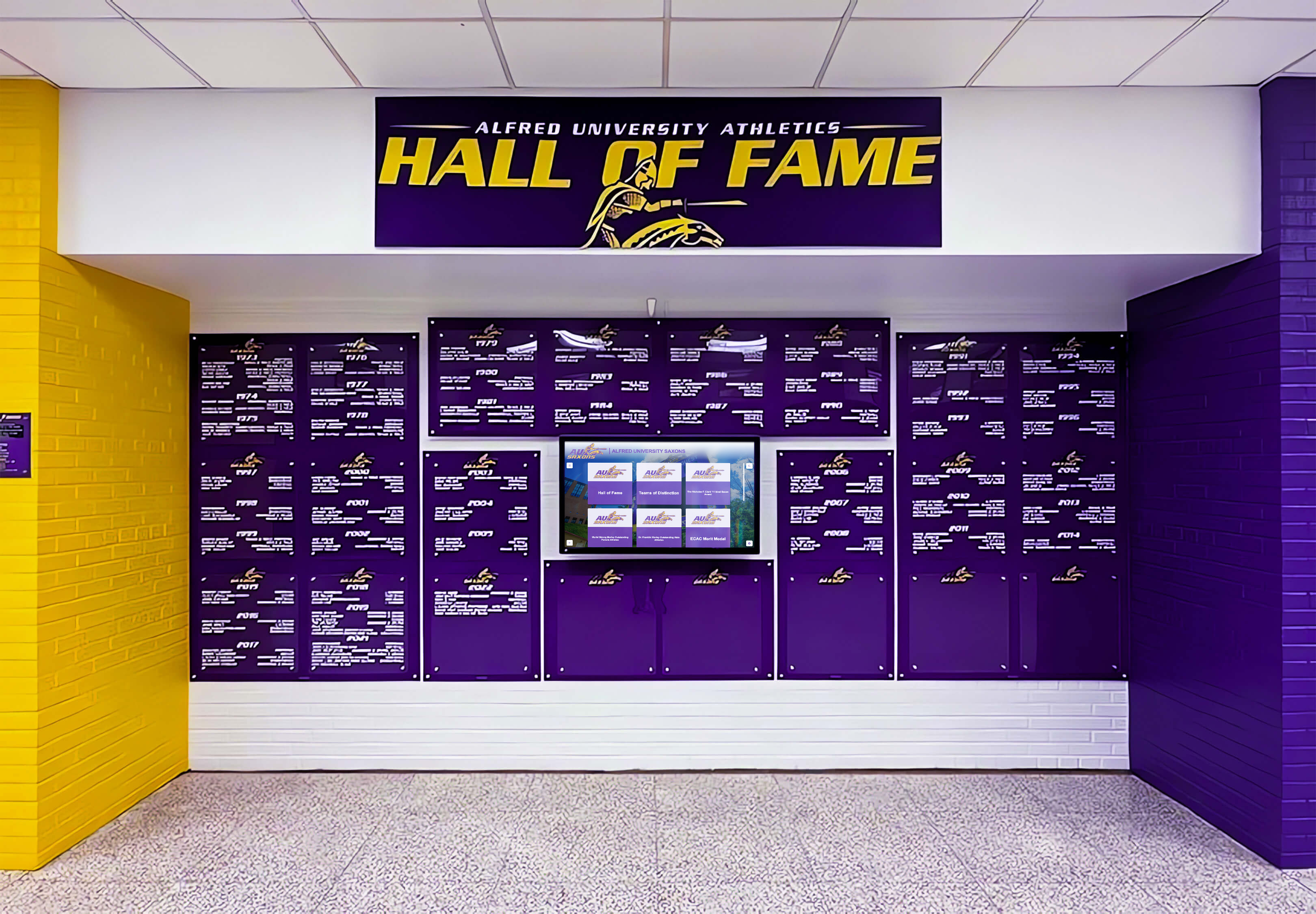
Championship recognition halls at school athletic facilities display fabric banners alongside shields and achievement records for years — reviewing a supplier's snagging report before committing to a substrate is the earliest and lowest-cost point to confirm the proposed material resists pulled-thread distortion at an agreed level
What Fabric Snagging Is — and What It Is Not
Fabric snagging is a surface distortion condition: when a protruding point or hook catches a yarn or group of yarns in the fabric surface and pulls them loose from the weave or knit structure. The pulled yarns may form a loop that stands above the fabric face, or they may cause the surrounding area to distort as the caught yarn is dragged. Either result is visible as a snag — a raised loop, a dimple, a pulled stitch, or a combination of these. On a finished championship banner, snagging distorts the printed surface in the affected zone, altering artwork that may include championship years, sport names, or athlete records.
Snagging is a surface-structural failure mode. Understanding what it is not is important for interpreting which supplier report applies to which concern:
Ink rub resistance measures how well the printed ink layer adheres to the fabric surface when abraded. An ink rub test evaluates the print system — ink chemistry, curing process, fabric coating, and print-process parameters — not the fabric’s structural integrity. A banner can have high ink rub resistance and poor snagging resistance, or vice versa. A snagging report and an ink rub resistance report address entirely different properties and are not substitutes for each other.
Color transfer describes the movement of colorant from the printed face to an adjacent surface. Like ink rub resistance, color transfer is a property of the print and finish system, not the underlying fabric construction. A snagging report does not provide evidence about color transfer behavior.
Fabric tear strength measures the force required to continue propagating an existing tear through a fabric specimen under controlled laboratory conditions — commonly using ASTM D2261 for woven fabrics by the tongue (single rip) procedure. Tear strength and snagging resistance are related in that both concern fabric response to applied force, but they describe entirely different failure modes. A high tear-strength result does not imply high snagging resistance, and a snagging report does not substitute for a tear-strength report.
Seam slippage is the migration of yarns through the fabric structure at a sewn seam under installation load, causing the seam opening to widen over time. Seam slippage affects structural integrity at the seam line; snagging affects the fabric surface at the point of contact with a snagging agent. These are distinct conditions measured by different methods — yarn slippage is addressed under ISO 13936 — and require separate supplier documentation.
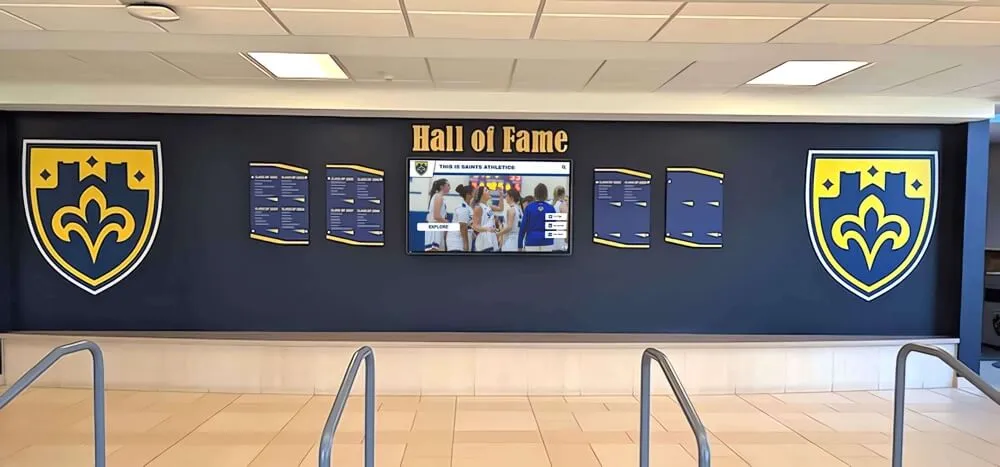
School athletic recognition walls accumulate championship banners across sports and seasons — a snagging report addresses one specific surface-structural property of the substrate, distinct from ink rub, tear strength, and seam quality, and should be reviewed alongside each of those separately
ASTM D3939/D3939M-26: Title, Scope, and What the Standard Covers
ASTM D3939/D3939M-26 — titled “Standard Test Method for Snagging Resistance of Fabrics (Mace)” — is the current active version of the standard, last updated January 15, 2026. It is published in Book of Standards Volume 07.01 under Subcommittee D13.59 of ASTM Committee D13.
Per the standard’s scope (Section 1.1), the test method determines the snagging resistance of a fabric. Section 1.2 states that studies of fabric snagging have shown the method is suitable for a range of woven and knitted fabrics made from textured or untextured filament yarns, spun yarns, or combinations of these yarn types. In the test, a mace — a ball equipped with metal points — tumbles against a fabric specimen mounted on a drum and felt pad; the resulting snags are evaluated visually using a rating approach.
The standard’s scope (Section 1.2) identifies three fabric types for which the method is not suitable:
- Open construction fabrics — such as a net — where the mace points snag the felt pad underlying the specimen rather than the fabric specimen itself, producing a result that does not reflect the fabric’s actual snagging behavior.
- Very heavy or very stiff fabrics that cannot be made to fit tightly on the drum and felt pad; poor specimen conformance to the apparatus produces unreliable results.
- Tufted or nonwoven fabrics — because the apparatus is designed for woven and knitted fabrics, tufted and nonwoven constructions behave differently under the mace and do not produce comparable results under this method.
For schools, this means that a D3939/D3939M report submitted for a banner substrate in any of these three categories should not be accepted as evidence without the testing laboratory confirming in writing that the specific material construction is within the method’s scope. Open construction, nonwoven, tufted, or very stiff substrates require the laboratory to assess and confirm method suitability before the results can be used as procurement evidence. Where the standard itself is found to be too severe for a specific fabric, Section 1.3 notes that an alternative method — such as BS 8479 Textiles, a rotating chamber method — may be considered; ask the supplier to identify which method was used and why if results were generated under an alternative procedure.
A critical note from the standard’s Significance and Use section (Section 5.1): ASTM D3939/D3939M is explicitly noted as not considered satisfactory for acceptance testing of commercial shipments of fabrics, because the between-laboratory precision of the test method is poor. This does not mean snagging reports are unusable for procurement purposes — Section 5.2 confirms the method may be used for quality control testing during manufacturing and for product comparisons by manufacturers, retailers, and users. What it does mean is that any acceptance criterion referenced in a supplier report is a buyer-supplier agreement established for this specific order and substrate — not a universally reproducible threshold that ASTM has certified. A supplier statement that a result “meets ASTM D3939/D3939M” describes compliance with the test procedure, not a minimum force or rating value the standard requires.
Section 5.3 notes the method may be used for most apparel and home furnishings fabrics, but that a different test method may be needed for different types of fabrics and different end-uses. Section 5.3.1 identifies alternatives for out-of-scope constructions: many open construction fabrics can be tested using AATCC TM65; pile floor coverings may be tested by D1335; and Test Method D5362 (Bean Bag) may be considered as an alternative for evaluating snagging resistance of fabrics where the mace method is not applicable. For championship banner substrates in an end-use context not directly addressed by apparel or home furnishings precedents, confirming that the proposed substrate’s construction is genuinely within the method’s practical scope is part of the supplier review process.
Section 5.6 notes that snags observed in worn materials vary in number and appearance, and that snag appearance depends on two factors beyond raw count: (1) the degree of color contrast between the snag and the surrounding area of the fabric, and (2) the presence of long distortions or long protrusions. The standard recommends that fabric evaluated in the laboratory be assessed with regard to the defects that may be observed visually, not rated solely on the number of snags developed, and that visual rating standards may be set up to provide a consistent basis for evaluation. For championship banner substrates — where snag visibility on a printed surface depends heavily on color contrast between the substrate and the snag — requesting the supplier’s visual rating standard comparison alongside the snag count is more informative than a numeric result alone.
Section 5.4 notes that fabric snagging can be affected by laundering or dry cleaning; if the banner substrate will be cleaned during its service life, it may be advisable to request testing before and after, or to ask the supplier whether the reported results reflect the treated or untreated condition.
Coupon Matching: Confirming the Report Applies to the Proposed Substrate
The most common gap in a supplier snagging report for a championship banner order is substrate mismatch: the coupon tested in the laboratory was not the same material that will be used to produce the banner. A report generated on a related product from the same supplier line — similar construction, similar weight — is not documentation of the snagging resistance of the specific substrate being ordered. Confirming coupon match is the first material verification step in any snagging report review.
When reviewing a supplier’s ASTM D3939/D3939M report, confirm all of the following before treating the results as procurement evidence for your banner:
Fiber content. The coupon fiber content — polyester filament, nylon, polyester-cotton blend, or other — should match the specified fiber content of the banner substrate. Fiber type affects how yarns behave when caught by a snagging agent; different fibers have different surface characteristics and different yarn-to-yarn cohesion properties that influence snag formation and visibility.
Yarn type. The standard scope identifies textured filament yarns, untextured filament yarns, and spun yarns as the construction types within its applicability. A report on a fabric with textured filament yarns is not directly comparable to a result on a flat, untextured filament substrate, and neither is directly comparable to a result on a spun-yarn construction. Confirm the yarn type in the report matches the banner substrate specification.
Fabric construction. Woven and knitted structures produce different snagging behaviors even with identical fiber and yarn specifications. For a woven banner substrate, confirm the report was generated on a woven fabric coupon with a comparable weave type and cover factor. For a knitted substrate, confirm the knit construction type. A test on a different fabric construction is not evidence for the ordered substrate.
Finish and coating. Many championship banner fabrics carry a finish — a flame retardant treatment, a print-adhesion coating, a moisture barrier, or a combination. Finishes can affect how yarns behave when caught by a snagging agent. A report generated on an uncoated base fabric coupon is not necessarily evidence for the coated or treated version of that substrate that will receive the printed artwork. Confirm that the coupon tested carried the same finish or coating specified for the ordered material.
Scope limitation for coated vinyl. If the proposed banner substrate is a coated vinyl or PVC-based material rather than a woven or knitted textile, ASTM D3939/D3939M textile snagging evidence does not apply to it. Coated vinyl behaves as a membrane, not as an interlaced yarn structure, and the snagging failure mode defined by this standard is not the relevant property. Request material-appropriate performance documentation from the supplier for vinyl substrates separately. The textile snagging report review described in this guide applies to woven and knitted fabric substrates only.
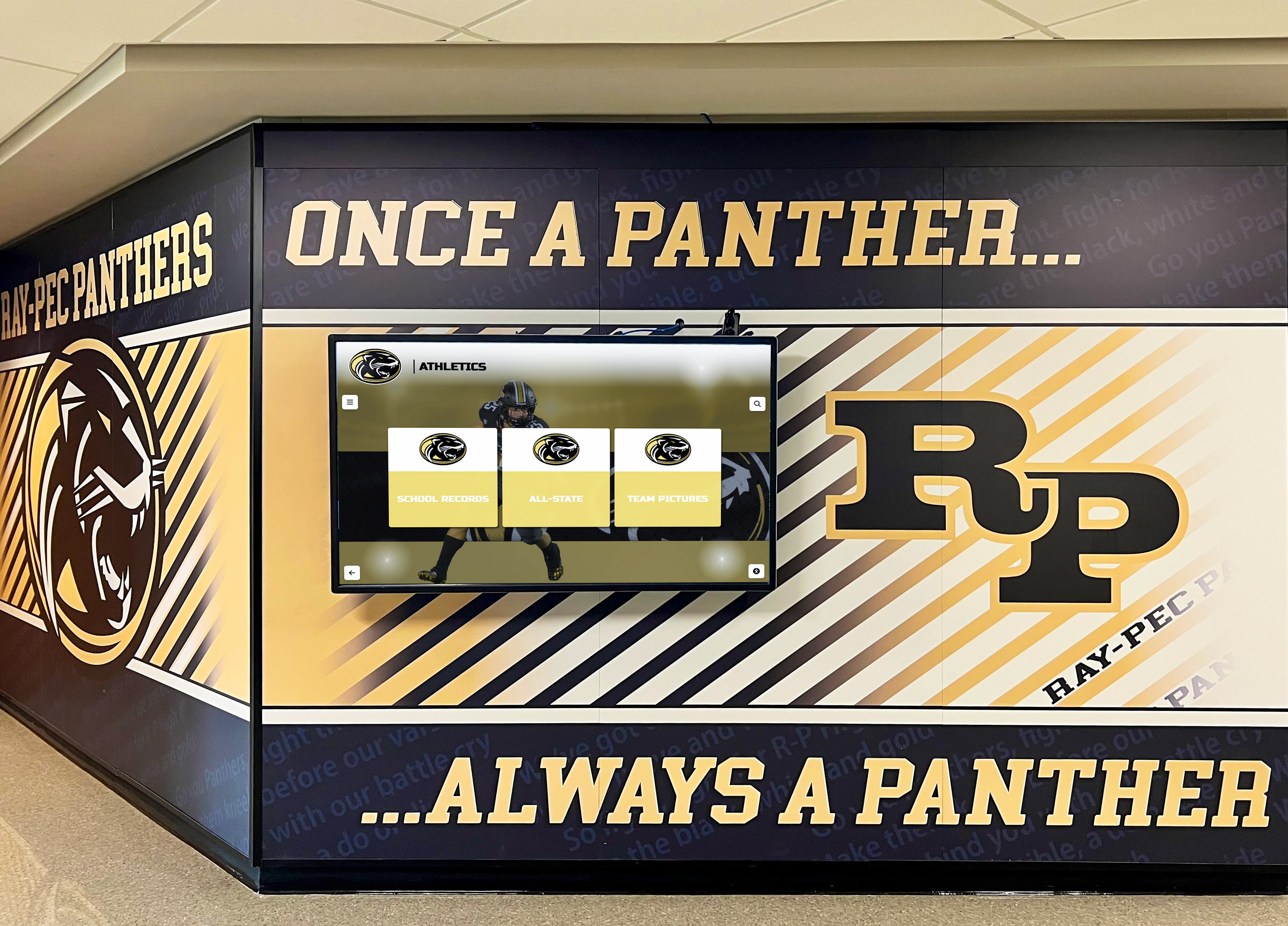
Championship banners in school athletic corridors carry printed artwork whose surface integrity depends on the substrate's snagging resistance — confirming that the supplier's test coupon matches the banner's proposed fiber content, yarn type, construction, and finish ensures the report is evidence for the material being ordered, not a similar one
What a Complete Supplier Snagging Report Should Contain
A supplier ASTM D3939/D3939M snagging report should allow a school buyer to confirm all of the following without ambiguity:
Standard designation and version. The report should cite the full ASTM D3939/D3939M designation including the version year. The designation D3939/D3939M-26 identifies the version last updated in January 2026. Knowing the version year confirms which procedure revision was followed and whether the report is based on the current active version.
Substrate identity. The report should identify the tested substrate by trade name, fiber content, yarn type, fabric construction, weight, and any finish or coating — matching the specific material named in the purchase order. A report that identifies the tested material only as “polyester flag fabric” or “banner material” without specifying construction and finish is insufficient for substrate-match verification.
Laboratory confirmation of method suitability. Because the standard notes limitations for open construction, very heavy or stiff, tufted, and nonwoven fabrics, the testing laboratory should confirm that the specific substrate tested was evaluated for suitability and falls within the method’s scope. This confirmation is particularly important for coated, treated, or structurally unusual substrates where the scope boundary is not immediately obvious.
Specimen preparation details. The report should describe how specimens were prepared, including specimen dimensions and any conditioning steps applied before testing. Specimen conditioning can affect how a fabric responds under the mace, and the preparation details allow a buyer to assess whether the test conditions correspond to how the banner will be stored and used.
Rating method and result. The report should describe the rating scale used and how the result was generated. Per the standard’s Significance and Use section (5.6), rating based solely on the number of snags may not fully reflect snag appearance; color contrast between the snag and the surrounding fabric area and the presence of long distortions or protrusions are also factors. Ask the supplier whether the evaluation included a visual reference standard comparison in addition to snag count, and whether the report notes any color contrast or protrusion characteristics observed on the rated specimens.
The agreed acceptance criterion. Because ASTM D3939/D3939M does not set a universal pass/fail threshold and is noted as not satisfactory for commercial shipment acceptance testing (Section 5.1), any acceptance criterion referenced in a supplier report is a buyer-supplier agreement that should have been established in writing before the test was run. The report should reference this agreed criterion by name or document reference.
Whether the result met the agreed criterion. The report should state the outcome: the reported snagging result compared against the agreed criterion and a clear determination of whether the substrate fell within the agreed range.
Testing laboratory identity. The report should name the laboratory that conducted the test. If the test was conducted by the supplier in-house rather than at an independent laboratory, note that for your procurement record, particularly in light of the between-laboratory precision limitations noted in the standard’s Significance and Use section.
Step-by-Step: Reviewing a Supplier Snagging Report
Request the snagging report in writing before the order enters production. Specify ASTM D3939/D3939M as the required method and identify the substrate — including fiber content, construction, and finish — at the time the purchase order is placed or the substrate is proposed. A snagging report is only actionable before production begins; once a banner is printed on a specific substrate, substrate alternatives are no longer available.
Confirm the standard designation cited in the report includes a version year. A report that cites “ASTM D3939” without a version year cannot be confirmed as current. Confirm the version year matches the method the purchase specification required.
Verify that the tested coupon matches the purchase order specification in fiber content, yarn type, construction, weight, and finish. If any parameter differs from the ordered substrate, request a corrected report on the specified material before proceeding.
Confirm the laboratory assessed method suitability for the substrate construction. For coated, finished, open construction, very stiff, tufted, or nonwoven substrates, request written confirmation from the testing laboratory that the method is applicable to the specific material. A general laboratory citation of D3939/D3939M on the report header is not scope confirmation for an unusual substrate.
Review the rating method, specimen preparation, and result. Confirm the report describes the rating scale used and how the result was generated. Note whether the evaluation included visual reference standard comparison and whether color contrast or protrusion/distortion characteristics were assessed in addition to snag count, per the standard’s Significance and Use guidance.
Compare the result against the agreed acceptance criterion. The agreed criterion should have been documented in the purchase specification before the test was run. If no criterion was agreed before the test, establish one now in writing and ask the supplier to confirm the result against it before production is authorized. Example values cited in supplier conversations should be labeled as specific to the agreed specification for that substrate and order — they are not universal benchmarks from the standard.
Request specimen photographs and the full report package. Ask the supplier to provide specimen photographs alongside the written report. Photographs allow the school’s review team to see the snag character — loop height, distortion zone, color contrast between snag and fabric ground — in addition to the numeric or visual rating. Agree in writing before purchase on what the report package will include: method version, specimen preparation details, specimen photographs, and the agreed criterion against which results are evaluated.
File the snagging report with the banner’s procurement record. Retain the supplier report, the agreed acceptance criterion, any scope confirmation from the laboratory, and the specimen photographs alongside the banner’s purchase order. This procurement file supports condition assessment, future reorders, and supplier conversations across the banner’s full service life.
Pre-Order Snagging Report Checklist
Complete all items before authorizing production on a championship banner order that includes fabric snagging resistance requirements.
- Snagging report requested in writing, with ASTM D3939/D3939M specified as the method and substrate identified by fiber content, construction, and finish, before production authorization
- Report cites ASTM D3939/D3939M with a version year (for example, D3939/D3939M-26)
- Tested coupon fiber content, yarn type, fabric construction, weight, and finish or coating confirmed to match purchase order specification
- Laboratory confirmation in writing that the specific substrate construction is within the method’s scope (required for coated, finished, open construction, very stiff, tufted, or nonwoven substrates)
- Rating method and scale described in the report; visual rating standard comparison noted if used
- Snag character assessment — color contrast and distortion or protrusion in addition to snag count — reported or requested from supplier per the standard’s Significance and Use guidance
- Agreed acceptance criterion documented in purchase specification before the test was run
- Reported result compared against agreed acceptance criterion and confirmed within the agreed range
- Specimen preparation details and any conditioning steps described in the report
- Specimen photographs requested and received, or agreed as part of the pre-purchase report package
- Laboratory identity stated in report; in-house vs. independent testing noted for procurement record
- Report filed with purchase order, acceptance criterion correspondence, and scope confirmation before production is authorized
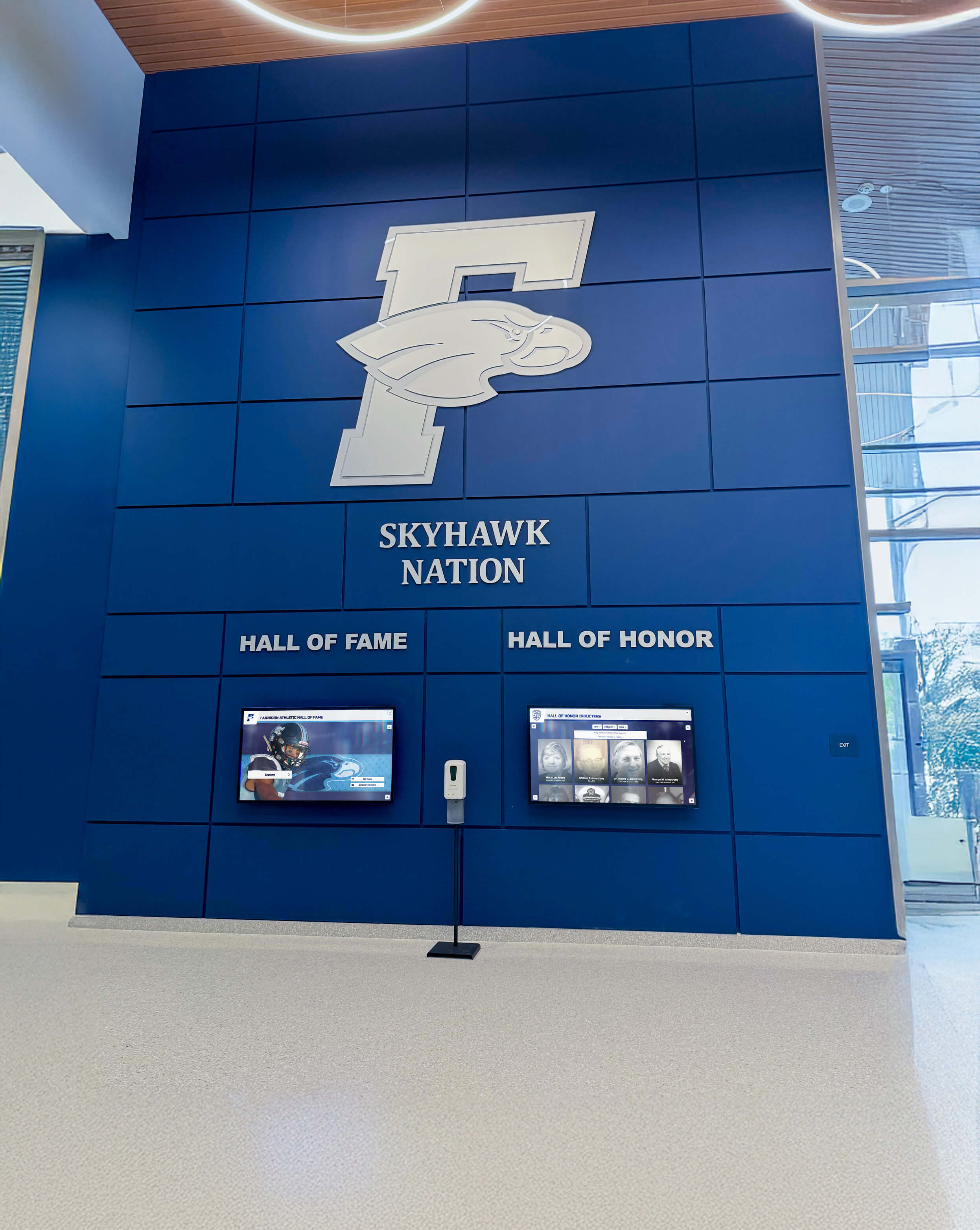
School athletic lobbies with championship recognition displays depend on each fabric banner maintaining its printed surface through years of installation — a complete pre-order snagging report checklist confirms the substrate met agreed criteria before the artwork was committed to it
Decision Table: What Each Report Finding Means
| Report Finding | Action |
|---|---|
| Designation with version year, coupon match, scope confirmation, rating method, result, and agreed criterion all confirmed; result within criterion | Accept — file report with procurement record |
| Report cites “ASTM D3939” without a version year | Request the full designation to confirm which version was followed |
| Tested coupon does not match purchase order specification in fiber, construction, or finish | Request corrected report on the specified substrate before proceeding |
| Substrate is an open construction fabric — no lab scope confirmation provided | Request written lab confirmation that method is applicable before relying on results; consider AATCC TM65 as an alternative for open constructions |
| Substrate is very heavy or very stiff — no lab scope confirmation provided | Request written lab confirmation; ask whether an alternative method such as the rotating chamber method in BS 8479 is more appropriate |
| Substrate is tufted or nonwoven — report cites D3939/D3939M | Method is not applicable per the standard scope; request a suitable alternative method with lab confirmation |
| Substrate is coated vinyl or PVC-based — report cites D3939/D3939M textile snagging | Textile snagging evidence does not apply to coated vinyl; request material-appropriate performance documentation separately |
| Rating based on snag count alone with no visual reference standard comparison or protrusion/color contrast note | Request visual evaluation documentation or specimen photographs per the standard’s Significance and Use guidance |
| Result stated without reference to an agreed acceptance criterion | Establish criterion in writing; confirm result against it before accepting |
| No acceptance criterion was documented in the purchase specification before the test was run | Document criterion now; ask supplier to confirm result against it before production authorization |
| Supplier cannot provide a D3939/D3939M report for the specified substrate | Do not proceed to production; consider an alternative substrate with available snagging test data or arrange independent pre-production testing |
Banner Design File and Achievement Metadata Handoff
A championship banner snagging report is a substrate procurement document. It confirms one material property of the proposed fabric before the banner is produced. It is one step in a complete pre-production review that also includes confirming the design file and achievement data before the artwork goes to the supplier.
Design file handoff. The artwork file that carries the championship year, sport, school name, and any other elements printed on the banner should be reviewed and cleared in a verified format — confirmed bleeds, correct color profile, correct resolution — before the substrate is committed. A substrate that passes the snagging review and an artwork file that clears preflight checks should be confirmed together, in writing, before production begins. Separating these two review streams creates a gap where a substrate-approved order can enter production with an artwork file that has not been independently verified.
Achievement metadata. The information printed on a championship banner — sport, season, division level, team name, individual names if included — should be verified against the school’s own athletics records before the banner file is finalized and submitted to the supplier. Championship names and seasons printed incorrectly on a fabric banner that will hang in a gymnasium for decades are difficult to correct after installation. Verify championship data against the school’s athletic department records before sign-off on the artwork.
Coordinating the full handoff. A complete pre-production handoff for a championship banner order includes: (1) substrate snagging report reviewed and filed; (2) design file preflight completed and documented; (3) achievement metadata confirmed against source records; (4) written acceptance criteria agreed with the supplier for snagging and any other fabric performance properties in the specification; and (5) all approvals documented in writing before production authorization is given. When these five elements are completed before the order enters production, the banner arrives with documentation that supports its first installation, its periodic condition reviews, and any future orders on the same substrate.
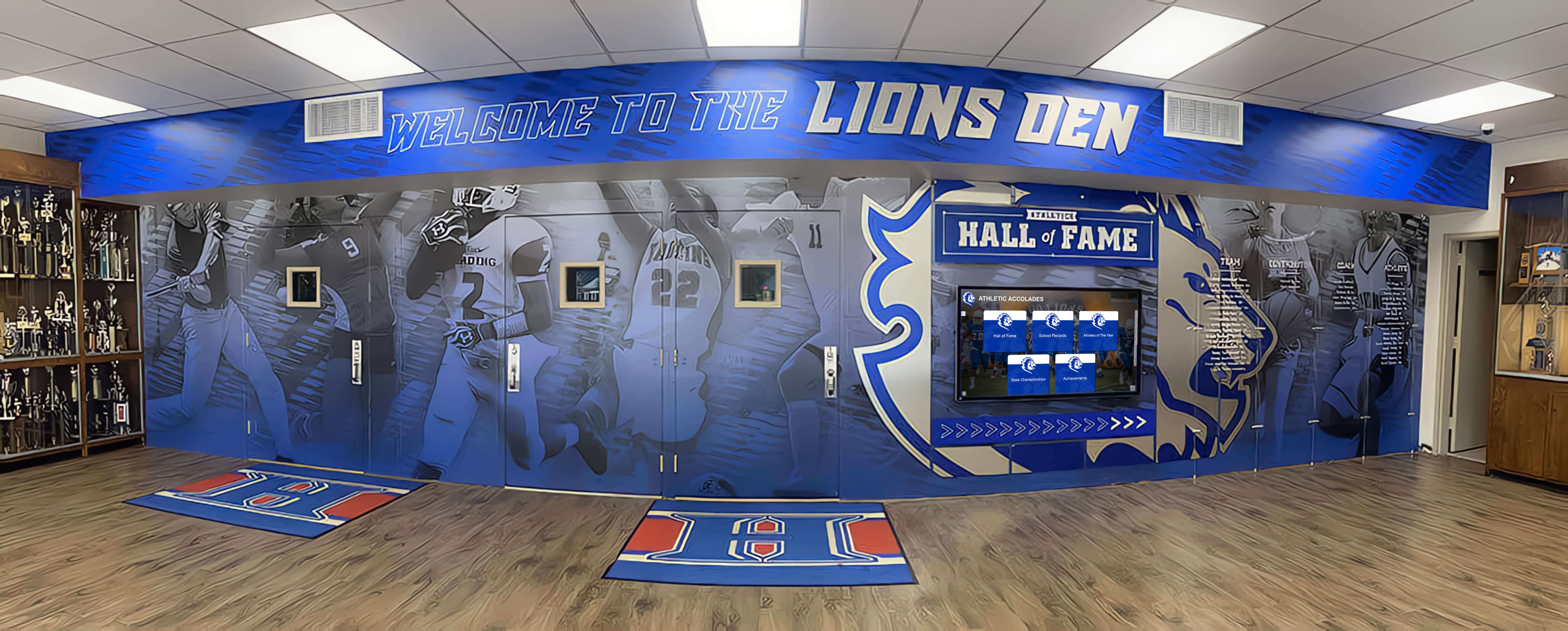
School athletic facilities that display championship banners alongside trophy cases and hall of fame murals carry the program's recognition record across many seasons — verifying achievement metadata and design files before production ensures each new banner is accurate before the substrate procurement review commits it to production
For schools that maintain formal intake records for physical athletic artifacts, the championship banner’s arrival after a complete pre-production review is a straightforward accession: the material is confirmed, the artwork is verified, and the achievement data is accurate. Schools that use a structured intake process for athletic artifacts entering a recognition collection — following the documentation approach described in the Athletic Hall of Fame Accession Form: Document Every Artifact Before Display guide at Touch Hall of Fame — benefit from treating a new championship banner as an artifact whose documentation begins before it is produced, not at the moment it arrives for display.
For programs managing multiple physical artifacts alongside championship banners — trophies, jerseys, photographs, and plaques — documenting the ownership history, display rights, and material specifications of each artifact is part of responsible recognition program management. The framework described in the Athletic Memorabilia Provenance Form: Document Ownership, History, and Display Rights guide at Hall of Fame Online applies to championship banners as well as individual memorabilia items: establishing who provided the artifact, what its material specification is, and what rights govern its display is as relevant for a new fabric banner as for any older athletic artifact.
For programs maintaining physical photographic records alongside championship banners, condition documentation practices vary by material type. The intake workflow described in the Albumen Team Photograph Intake: Document Cracking Before Athletic Archive Digitization guide at Digital Yearbook for assessing surface condition before digitization reflects the broader principle that material-specific assessment before display or archiving is standard practice across all physical recognition artifacts — a principle that the pre-production snagging report review applies to modern textile championship banners.
The same material-specific documentation principle extends to other physical recognition artifacts in the school’s collection. Schools handling historic trophy hardware with delicate surface inlays — such as those described in the Historic School Trophies With Mother-of-Pearl Inlays: A Condition and Handling Checklist at Digital Trophy Case — recognize that pre-display condition review and material-specific handling records protect artifact integrity across the full collection, whether the artifact is a century-old trophy or a newly ordered fabric banner.
For recognition programs that incorporate digital display components alongside physical championship banners, the digital system’s reliability is part of the overall recognition environment. Technical guidance on School Athletic Recognition Displays: Screen Wake Lock Release and Reacquisition Tests at Touchscreen Website addresses the display software layer of the recognition environment — a complementary operational concern to the physical procurement process described in this guide, relevant when new championship banners join a recognition space that also includes interactive or video display components.
Frequently Asked Questions
What does ASTM D3939/D3939M measure for championship banner fabric?
ASTM D3939/D3939M — the Standard Test Method for Snagging Resistance of Fabrics (Mace) — measures the snagging resistance of a fabric. In the test, a mace with metal points tumbles against a fabric specimen mounted on a drum and felt pad, and the resulting surface distortions are evaluated visually using a rating approach. The standard applies to woven and knitted fabrics made from textured or untextured filament yarns, spun yarns, or combinations. It does not measure ink rub resistance, color transfer, fabric tear strength, or seam slippage — those are distinct properties requiring separate test methods and supplier reports.
Which banner fabric constructions are not suitable for ASTM D3939/D3939M testing?
Per the standard’s scope (Section 1.2), three fabric types are not suitable: open construction fabrics such as nets, where the mace snags the underlying felt pad rather than the specimen; very heavy or very stiff fabrics that cannot fit tightly on the drum and felt pad; and tufted or nonwoven fabrics, because the apparatus is designed for woven and knitted structures. For any of these construction types, the testing laboratory must confirm in writing that the method is applicable before the report results can be used as procurement evidence. For open construction fabrics, AATCC TM65 may be a more suitable alternative, per the standard.
How is fabric snagging different from ink rub resistance and tear strength?
Snagging is a surface-structural failure mode: a protruding point catches a yarn or group of yarns and pulls them loose from the weave or knit structure, distorting the fabric surface and any printed artwork on it. Ink rub resistance measures how well the printed ink layer adheres to the fabric surface under abrasion — a property of the print system, not the fabric structure. Tear strength measures the force required to propagate an existing tear through the fabric under controlled laboratory conditions. All three describe different aspects of banner performance and require separate supplier reports. A snagging report does not confirm ink rub resistance or tear strength, and the converse applies as well.
Does ASTM D3939/D3939M set a universal passing threshold for championship banner fabric?
No. The standard does not establish a universal pass/fail threshold for any end use. Its Significance and Use section (Section 5.1) explicitly notes that the method is not considered satisfactory for acceptance testing of commercial shipments because its between-laboratory precision is poor. Any acceptance criterion in a supplier snagging report is a buyer-supplier agreement that must be established in writing before the test is run — not a value set by ASTM. A supplier statement that a result “meets ASTM D3939/D3939M” describes compliance with the test procedure, not compliance with a minimum value the standard requires.
Should school staff test a delivered championship banner for snagging?
No. ASTM D3939/D3939M requires fabric specimens prepared under controlled laboratory conditions and tested in specialized equipment. It is a pre-production supplier qualification and comparison tool, not a field test for delivered banners. School staff should not apply any physical snagging test — including needle, mace, or other pointed instruments — to a delivered championship banner. If a delivered banner shows visible surface distortion, pulled yarns, or snag loops, document the condition with photographs and contact the supplier, who can assess the finding against the original material specification and agreed acceptance criteria.
Championship Graphics Built for School Recognition Programs
Rocket Graphics is building AI-powered tools to help school athletic programs create championship recognition graphics — from artwork files ready for fabric production to recognition content that connects physical banners with the school's broader athletic legacy.
Get notified when Rocket Graphics opens.