A championship banner fabric pilling report is a pre-production supplier document that describes results from testing conducted under ASTM D4970/D4970M — the Standard Test Method for Pilling Resistance and Other Related Surface Changes of Textile Fabrics: Martindale Tester Method — and tells a school athletic director or recognition coordinator whether the proposed woven or knitted textile substrate resisted fiber-ball surface formation within the conditions and rating scale specified for that test. Reviewing a championship banner fabric pilling report before placing an order is the only point in the procurement cycle when substrate alternatives are still available and written acceptance criteria can still be negotiated with the supplier before production begins.
This guide is written for school athletic directors, recognition coordinators, and the purchasing or facilities staff who support them. It explains what fabric pilling is and how it differs from snagging, seam slippage, abrasion lifespan, tear strength, fire compliance, UV durability, and weather resistance — conditions that often arise in the same supplier conversation but require entirely separate documentation. It covers the scope of ASTM D4970/D4970M, which fabric constructions the method applies to, which constructions sit outside scope, and what a complete pilling report must contain before it can serve as procurement evidence. No destructive testing of a delivered or installed championship banner is described or recommended anywhere in this guide.
Championship recognition halls with fabric banners installed in school lobbies display athletic titles for years — reviewing a supplier's pilling report before the order enters production is the earliest point to confirm the proposed substrate holds its printed surface within an agreed performance range
What Fabric Pilling Is — and What It Is Not
Fabric pilling is a surface degradation condition: as a textile is abraded during handling, installation, or sustained contact with adjacent surfaces, fibers at the yarn surface are worked loose, migrate along the fabric face, and entangle with adjacent loose fibers to form small anchored balls — called pills — that project above the fabric surface. On a finished championship banner, pills form a textured, uneven layer over the printed artwork in the affected areas, scattering light differently than the flat substrate and reducing the visual sharpness of printed championship years, sport names, and recognition text over the course of the banner’s service life.
Championship banners carry school athletic history — program titles, sport designations, coaching records, and in many cases athlete names — on substrates that hang in gymnasiums, corridors, and lobbies for decades. Schools planning gym lobby recognition environments for banners alongside trophy cases and digital displays depend on those physical banners maintaining their printed surface across years of installation. The fabric pilling report is the pre-order document that confirms the substrate’s surface holds within an agreed performance range before a single championship title is printed on it.
Pilling is a surface-structural condition. Understanding what it is not is equally important for interpreting which supplier document applies to which concern:
Snagging is a distinct mechanical event: a protruding hook or point catches a yarn and pulls it from the weave or knit structure, forming a loop or pucker above the fabric face. Snagging is measured under ASTM D3939/D3939M — a separate standard with its own apparatus, specimen requirements, and rating approach. A pilling report provides no evidence about snagging resistance, and a snagging report provides no evidence about pilling resistance.
Seam slippage is the migration of yarns through the fabric structure at a sewn seam under installation load, progressively widening the seam opening. Seam slippage affects structural integrity at the seam line — pilling affects the fabric face. These are distinct conditions requiring separate supplier documentation.
Abrasion lifespan describes the durability of a fabric over extended, high-cycle wear — a property measured by tests such as ASTM D4966, which runs specimens to breakdown rather than rating surface-change stages at intermediate intervals. A pilling report under ASTM D4970/D4970M describes the fabric surface condition at specified cycle counts; it does not project service life, predict wear-out, or provide an abrasion durability guarantee.
Tear strength is the force required to propagate an existing tear through a fabric specimen under controlled conditions. High pilling resistance does not imply high tear strength, and a pilling report provides no evidence about a substrate’s tear behavior.
Fire compliance, UV durability, and weather resistance are installation-environment properties relevant to gymnasium hanging and long-term display contexts. A pilling report under ASTM D4970/D4970M addresses none of these. A supplier referencing a pilling report in response to fire performance or outdoor durability questions is presenting unrelated evidence for those concerns — and those concerns require their own documentation from the applicable standards.
School athletic recognition walls display championship banners alongside shield panels and digital screens for decades — a pilling report addresses a narrow surface-quality property of the substrate, distinct from the seam, structural, and installation-environment properties each covered by their own separate documentation
ASTM D4970/D4970M-22R26: Title, Scope, and What the Standard Covers
ASTM D4970/D4970M-22R26 — titled “Standard Test Method for Pilling Resistance and Other Related Surface Changes of Textile Fabrics: Martindale Tester Method” — is the current active version of the standard. The “22” in the designation indicates the standard was last revised in 2022; “R26” indicates reapproval in 2026, confirming the standard remains active without procedural change as of the date of this guide.
The standard’s title identifies three defining elements of its scope:
Pilling resistance. The primary property the test measures is the fabric’s tendency to form surface pills — small, anchored fiber balls — under the specified Martindale test motion. A report under D4970/D4970M is principally a surface pill-formation rating at defined cycle intervals.
Other related surface changes. The scope extends to associated surface alterations that occur during pilling evaluation — including fuzzing and surface distortion that accompany or precede visible pill formation. The rating step evaluates these changes alongside pilling at each test interval.
Martindale Tester Method. The apparatus and motion pattern that define this test. The Martindale tester is the specific instrument that distinguishes D4970/D4970M from other pilling-related test approaches; results generated on a different apparatus are not covered by this designation.
Scope limitations that directly affect championship banner procurement:
Coated fabrics are excluded from the standard’s scope. A coating or laminate applied to the fabric surface changes how that surface responds to the Martindale motion. The relevant surface-change property for a coated substrate is not textile pilling in the sense this standard addresses, and requires a different test approach. A supplier presenting an ASTM D4970/D4970M report for a coated banner substrate is providing documentation outside the standard’s defined applicability. Ask the supplier to identify what performance evidence applies to the coated surface, and do not treat a D4970/D4970M letter as scope-applicable evidence for a coated material. Many vinyl, PVC, and coated-membrane championship banner products fall outside the scope of textile pilling standards entirely — request material-appropriate documentation from the supplier for those substrates rather than using a textile lab report to waive the exclusion.
Nonwoven applicability has not been determined. If the proposed banner substrate is a nonwoven rather than a woven or knitted textile, ask the testing laboratory directly whether the Martindale method is appropriate for that specific construction before treating a D4970/D4970M result as procurement evidence.
A supplier coupon tested under ASTM D4970/D4970M before production is not acceptance testing of the finished, delivered banner. Pre-production coupon testing confirms the proposed substrate’s surface behavior under specified test conditions. It does not serve as acceptance documentation for the finished banner once it arrives for installation — any acceptance procedure for the delivered banner is a separate agreement established in advance with the supplier, and does not substitute for the pre-production report review described here.
Athletic hall of fame installations display championship records through a mix of fabric banners, wall signage, and display cases — confirming the supplier's pilling report applies to the specific woven or knitted substrate being ordered, and not a related product outside the standard's scope, is the first step in using the document as procurement evidence
The Martindale Tester: What the Method Measures
The Martindale tester moves a fabric specimen against a standard abradant — typically a specified woven wool fabric — in a Lissajous figure motion: an overlapping, multi-directional pattern that distributes abrasion across the specimen face rather than applying a single linear stroke. This motion is designed to simulate the multi-directional surface contact that fabrics experience in use.
Testing proceeds at defined cycle intervals — specified points at which the test is paused and specimens are evaluated. The cycle counts used in a given test are agreed between buyer and supplier before testing begins; D4970/D4970M does not prescribe a single universal cycle count applicable to all substrates and end uses. The cycle count in the supplier’s report must match the interval established in the purchase specification; a result at a different cycle count is not equivalent to a result at the agreed interval and should not be accepted as substituting for it.
After each evaluation interval, the specimen is rated visually against photographic reference standards. The rating scale runs from 1 to 5:
| Rating | Surface Condition |
|---|---|
| 5 | No change |
| 4 | Slight surface fuzzing or slight pilling |
| 3 | Moderate surface fuzzing or moderate pilling |
| 2 | Significant surface fuzzing or significant pilling |
| 1 | Dense surface fuzzing or severe pilling |
Higher ratings indicate better surface stability; rating 5 indicates no visible change; rating 1 indicates severe pilling. The standard defines the rating scale and the test procedure — but it does not establish a universal minimum acceptable rating. The rating level that constitutes a pass for a specific substrate and end use is an agreement between buyer and supplier, established in writing before the test is run, not a threshold the standard mandates.
This distinction is important for championship banner procurement. A supplier report that states the fabric “meets ASTM D4970/D4970M” confirms the test was conducted per the standard’s procedure. It does not state the result met any universally mandated performance floor, because no such floor is established by the standard. A complete procurement report must identify the agreed acceptance criterion — the specific rating at a specific cycle count that the parties agreed before the test would constitute a pass — and state explicitly whether the reported result met it.
Coupon Matching: Confirming the Report Applies to the Proposed Substrate
The most common gap in a supplier pilling report for a championship banner order is substrate mismatch: the coupon tested in the laboratory was not the exact material specified for the banner. A report generated on a related substrate from the same supplier line — similar weight, similar construction — is not documentation of the pilling resistance of the ordered material. Confirming coupon match is the first material verification step in any pilling report review.
When reviewing an ASTM D4970/D4970M report for a championship banner substrate, verify all of the following before treating the results as procurement evidence:
Fiber content. The tested coupon’s fiber composition should match the banner substrate specification precisely. Different fibers produce fiber balls with different characteristics under the Martindale motion; a result on one fiber type is not directly applicable to a different-fiber substrate, and a report on one should not be used as evidence for the other.
Fabric construction. Woven and knitted fabrics exhibit different pilling behaviors because their yarn-interlacement structures differ. A result on a woven fabric does not serve as evidence for a knitted substrate, and vice versa. Confirm that the construction type and variant described in the report match the banner substrate specification.
Finish and coating. Many championship banner fabrics carry finishes — flame retardant treatments, print-adhesion coatings, or surface treatments applied after weaving or knitting. A finish affects how the specimen responds under the Martindale motion and how pills or surface changes are rated visually. A result on the unfinished base fabric is not evidence for the treated version of that substrate that will receive the printed artwork. Confirm that the coupon in the report carried the same finish as the material specified in the order.
Printing state. If the banner fabric will be dye-sublimated or inkjet-printed before installation, ask whether the tested coupon was in the printed or unprinted state. A print layer applied to the fabric surface may affect how that surface responds under Martindale test conditions. The relevant procurement evidence is for the substrate in the state it will be in when the finished banner enters service.
Method edition. The report should identify which edition of D4970/D4970M was followed. If the supplier’s documentation references an earlier version, ask whether the current active designation (D4970/D4970M-22R26 as of this guide) uses the same procedure and rating approach, and whether a current-edition test is available for the substrate being ordered.
For athletic departments managing championship banner orders across multiple sports, seasons, and facilities, coordinating supplier reports alongside purchase orders, design files, and substrate samples is a recurring records task. Reviewing an athletic department management software stack can help clarify which record types — supplier reports, approved artwork files, achievement data — belong in which system category, and how procurement documents integrate with the broader records and recognition infrastructure.
Championship recognition panels and fabric banners in school athletic halls represent the program's history across seasons — substrate mismatch between the tested coupon and the ordered material is the most common gap in a supplier pilling report, and confirming the match is the first step in using the document as procurement evidence
What a Complete Supplier Pilling Report Should Contain
A complete ASTM D4970/D4970M pilling report for a championship banner order should allow a school buyer to verify all of the following without requiring additional clarification from the supplier:
Standard designation and edition. The report should cite D4970/D4970M with the version year — not an abbreviated reference that omits the edition date. D4970/D4970M-22R26 identifies the current active version; a report citing only “ASTM D4970” without an edition date cannot be confirmed as current without further inquiry.
Substrate identity. The report should identify the tested fabric by trade name, fiber content, construction type, weight per unit area, and any finish or coating — matching the exact material named in the purchase order. A substrate description that omits construction type or finish cannot be verified against the order specification and should not be accepted without correction.
Laboratory confirmation that the substrate falls within the standard’s scope. Because the standard explicitly excludes coated fabrics and identifies nonwoven applicability as undetermined, the testing laboratory should confirm that the specific substrate tested falls within the method’s defined scope for woven and knitted fabrics. For unusual or boundary constructions, this written confirmation protects the buyer from relying on a report generated outside the standard’s intended application.
Cycle counts evaluated. The report should identify the number of Martindale test cycles completed at each rating interval. A result at an unstated or non-agreed cycle count cannot be compared against the purchase specification and should not be accepted as meeting it.
Rating scale used. The report should identify the photographic reference rating scale applied, including its source and edition, so the numerical rating can be interpreted consistently and compared across reports from different test dates or laboratories.
Reported rating values at each interval. The report should state the numerical rating on the 1–5 scale at each evaluated cycle count, for the specimen population evaluated.
The agreed acceptance criterion. Because D4970/D4970M sets no universal passing threshold, the report must reference the buyer-supplier acceptance criterion — the specific rating at a specific cycle count agreed in writing before the test was run. A report that provides a rating without identifying the agreed criterion leaves the pass/fail determination open to post-test disagreement.
Whether the result met the agreed criterion. The report should state explicitly whether the reported rating fell within the agreed acceptance range.
Testing laboratory identity and test date. The laboratory that conducted the test should be named, and a test date should confirm the report is current and pertains to the substrate batch being ordered — not a prior or unrelated production lot.
Preserving Pilling Documentation and Championship Records Separately
A championship banner is a permanent component of a school’s athletic record: it carries titles, sport identities, coaching credits, and in many cases roster names across decades of display in gymnasiums, lobbies, and corridors. The pilling report is a procurement document. It belongs in the substrate procurement file — linked to the banner it supports but kept distinct from the athletic achievement record the banner commemorates. Keeping these two categories of documentation in separate but linked files ensures both can be retrieved and interpreted accurately as staff turns over.
Schools developing organized school record board ideas for athletic programs handle achievement data — championship year, sport, division, conference, coach, and roster — distinctly from physical substrate documentation. A fabric pilling report describes a material property; it does not represent the athletic accomplishment the banner commemorates, and mixing these in a single file creates a record that is harder to interpret for both facilities staff and program historians.
For athletic departments assigning catalog references to physical recognition artifacts, an athletic archive accession numbering system provides a traceable method to link the physical banner to its procurement and production records — including the pilling report, purchase order, and approved design file — without encoding procurement details in the athletic record itself. This linkage supports future procurement reviews, warranty inquiries, and substrate-consistency decisions across multiple banner orders without conflating two distinct record categories.
A controlled vocabulary for athletic archives provides consistent tagging for substrate records, artwork files, and achievement data across sports and seasons so that records from different banner orders can be organized and retrieved without ambiguity — including when the staff who managed the original order has since changed.
One critical preservation rule applies regardless of how documentation is organized: never subject a delivered, installed championship banner to destructive testing of any kind. Once a banner is raised in a gymnasium or recognition corridor, it is an athletic artifact and a recognition record. If surface-quality questions arise after installation, consult the pre-production pilling report retained in the procurement file and any sample coupons preserved from the production run. Do not cut, abrade, or otherwise test the installed banner.
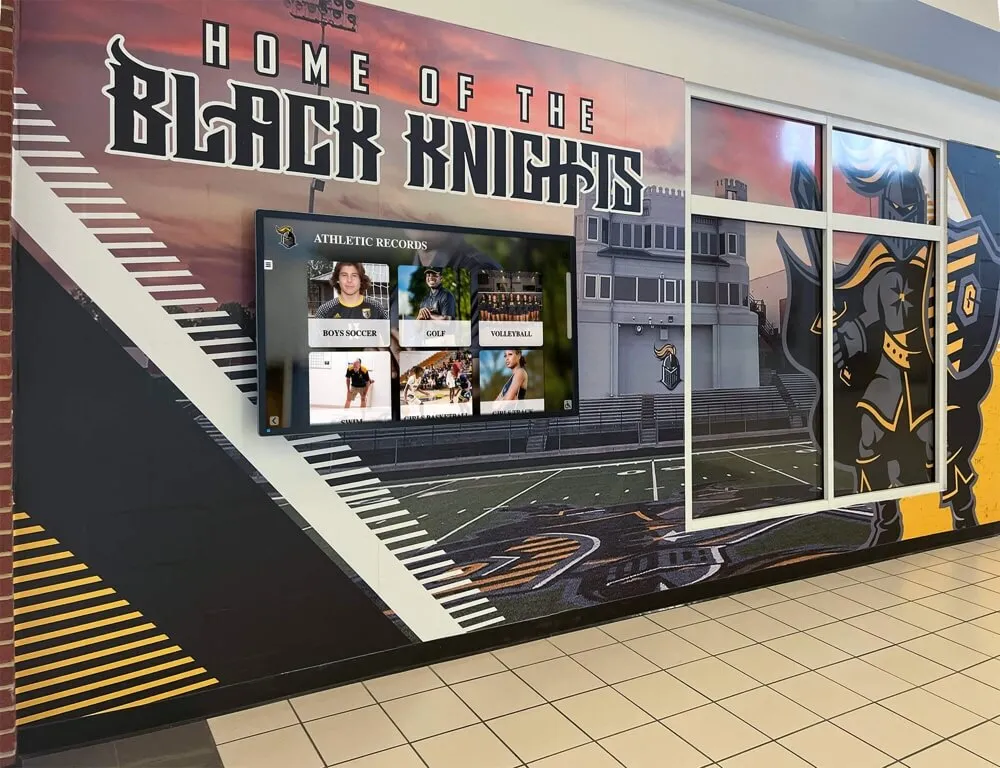
School athletic corridors display championship banners alongside mural artwork and records displays as permanent institutional history — preserving the pilling report in the procurement record, linked to but separate from the achievement data the banner commemorates, ensures both documents can be retrieved and interpreted independently across years of staff turnover
Frequently Asked Questions
What is a championship banner fabric pilling report?
A championship banner fabric pilling report is a pre-production document from a supplier or testing laboratory that describes results of pilling resistance testing on the proposed banner substrate under ASTM D4970/D4970M. It records how the fabric’s surface responded to Martindale test conditions at one or more specified cycle intervals, rated against a 1–5 photographic reference scale. Reviewing the report before ordering confirms that the substrate’s surface behavior falls within the acceptance range agreed between buyer and supplier before production begins.
Does ASTM D4970/D4970M apply to all championship banner fabrics?
No. ASTM D4970/D4970M applies to woven and knitted textile fabrics. Coated fabrics are explicitly excluded from the standard’s scope, and the applicability of the method to nonwoven fabrics has not been determined. Vinyl, PVC, and coated-membrane banner substrates fall outside the scope of this textile pilling standard. For those materials, request performance documentation appropriate to the specific substrate type rather than accepting a textile pilling report as evidence for a coated material.
Does a passing pilling rating guarantee how long a championship banner will last?
No. A pilling report at a specific cycle count describes the fabric’s surface condition under controlled laboratory test conditions at that interval. It does not project service life, predict performance under gymnasium installation conditions, or guarantee fire compliance, UV durability, color fastness, or weather resistance. Those properties require separate testing and documentation, each under the applicable standard for that property.
Is there a universal minimum passing grade under ASTM D4970/D4970M?
No. ASTM D4970/D4970M defines the test method and the 1–5 rating scale; it does not establish a minimum acceptable rating that applies to all substrates and end uses. The rating that constitutes acceptance for a specific banner order is a buyer-supplier agreement established in writing before the test is conducted. A supplier report stating the fabric “meets ASTM D4970/D4970M” confirms the procedure was followed correctly — not that the result met any standard-mandated performance floor.
Can the championship banner be tested after installation to verify the supplier’s pilling report?
No. Once a championship banner is installed in a gymnasium or recognition corridor, it must not be subjected to destructive testing of any kind. The installed banner is a permanent athletic artifact and a recognition record. If surface-quality questions arise after installation, consult the pre-production pilling report and any sample coupons preserved from the production run. Do not cut, abrade, or otherwise test the installed, finished banner.