A championship banner fabric bow skew inspection is how school athletic directors and recognition coordinators confirm, before a woven or knitted textile banner is raised in a gymnasium, that the fabric’s crosswise threads and the printed design are both straight — and that any deviation falls within the tolerance range agreed in writing with the supplier. Bow and skew are structural conditions of the base fabric, not print defects and not artwork rotation errors. They require a different inspection approach than the checks applied to PVC vinyl substrates or welded-seam finishing. The only moment when bow and skew can be measured accurately, documented with scale photography, and resolved without disrupting a staged installation is when the banner lies flat and unstretched on a receiving surface, before any mounting hardware is attached.
This guide is written for school athletic directors, facilities coordinators, and recognition staff who receive finished woven or knitted fabric championship banners from a print supplier and need a practical process for acceptance or rejection. It is not a guide for textile manufacturing inspectors operating under a production quality system. The numbered steps help school buyers understand what bow and skew are, how to distinguish them from related defects, how to establish supplier tolerances in writing before delivery, and how to document findings in a way that supports vendor resolution when a banner falls outside the agreed range.
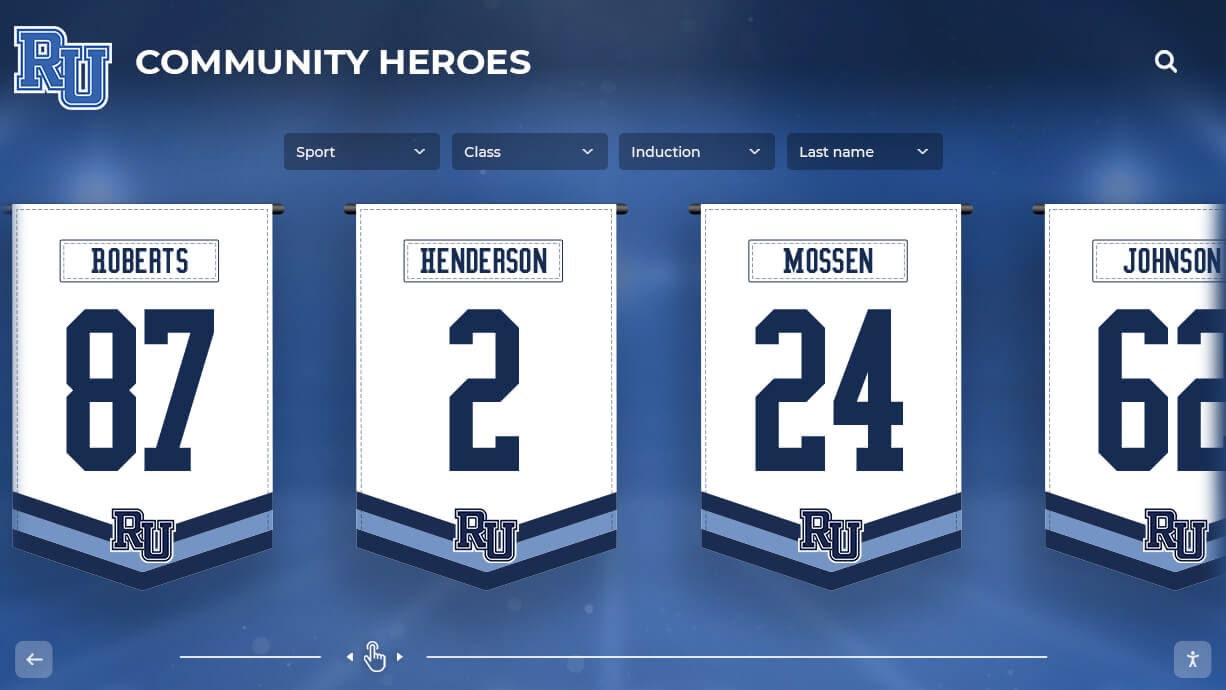
School championship banners hanging from gymnasium mounts are viewed at close range by athletes and families for years — a fabric bow and skew inspection performed at the receiving stage, before any mounting hardware is attached, confirms that the printed design is correctly aligned with the fabric grain
What Are Bow and Skew in Printed Woven and Knitted Fabric Banners?
Bow and skew are two distinct geometric deviations of the crosswise threads — the weft, or filling — from true perpendicular alignment with the selvedge edge of a woven or knitted textile. Both conditions originate in the fabric manufacturing and finishing process and can be carried through dyeing, coating, and printing without correction if the supplier’s workflow does not account for them.
Bow is a condition in which the filling threads curve from the selvedge edges toward the center of the fabric width — or from the center toward the selvedge — rather than running in a straight line perpendicular to the warp. When a fabric exhibits bow, the crosswise threads form an arc across the fabric width. On a printed championship banner, bow appears as a visible curve in any element that was designed to run horizontally in the artwork file: a championship year in a straight line will appear to arc upward or downward at the center relative to the banner’s left and right edges.
Skew is a condition in which the filling threads run at an angle across the fabric width instead of perpendicular to the selvedge. The threads are straight — not curved — but they are not square to the banner edge. On a printed championship banner, skew produces a diagonal shift in the design: a year or team name printed as a horizontal element in the artwork file will appear to tilt upward from one side to the other across the banner face.
Both conditions are independent of the artwork design file and the print registration process. A banner can pass all digital preflight checks — color accuracy, resolution, bleed, font embedding — and still exhibit bow or skew if the base fabric was not within tolerance before printing. Both conditions can also be partially masked by hanging tension: a banner mounted at the grommets under longitudinal load may appear straighter than it actually is, which is why inspection must be performed flat and unstretched.
ASTM D3882, titled “Standard Test Method for Bow and Skew in Woven and Knitted Fabrics,” is the standard that defines how bow and skew are measured and how percentage values are calculated. The standard addresses measurement methodology; it does not specify a single universal tolerance that applies to all textile applications. Acceptable tolerance for a school championship banner — what percentage of bow or skew both parties agree is acceptable for the specific end use — is a buyer/supplier agreement that must be established at the time of order. Performing a visual receiving inspection informed by the concepts in ASTM D3882 is useful and actionable, but it is not a substitute for formal testing conducted by a qualified textile testing laboratory under the standard’s controlled conditions.
How Bow and Skew Differ from Artwork Rotation, Seam Defects, and Hanging Tension
These four conditions can each produce what looks like a misaligned design on a delivered banner. They have different causes, different inspection methods, and different vendor resolution paths. Correctly identifying the actual condition is essential before contacting the supplier.
Artwork rotation is a print file or press setup error: the artwork was placed in the print queue at an angle relative to the substrate’s machine direction, or the design file was saved with a rotation offset that was not corrected before processing. Artwork rotation affects the printed image only — the fabric grain is correctly aligned, but the image sits tilted on it. A banner with artwork rotation will show misalignment between the printed image and a physical reference drawn perpendicular to the selvedge, while the fabric’s own crosswise threads remain correctly oriented. Artwork rotation is resolved by reprinting with a corrected file, not by re-tensioning or re-hemming.
Seam defects — misaligned panel joins, stitch failures, or a hem applied at an angle — affect the banner’s structural edges or panel joins, not the grain of the base fabric. A panel seam joined at a slight angle can make the two halves of a printed image appear misaligned without any bow or skew being present in either panel. Seam inspection requires a separate procedure and is outside the scope of this checklist, which addresses fabric grain conditions only.
Hanging tension is not a defect — it is a physical force. A banner mounted under appropriate longitudinal tension will pull the fabric into a flatter, more square presentation than it shows when lying flat on a receiving table. A banner with mild bow that looks acceptable when hung may still have structural bow that causes the printed design to arc when tension is released or when the banner is stored and rehung in a future season. Acceptance based on how a banner looks under installation tension — rather than how it measures when flat and unstretched — creates risk in future seasons. The flat, unstretched inspection described in this checklist measures the banner’s actual structural state, not the apparent state under load.
Before the Inspection: Establish Tolerances in Writing with the Supplier
A receiving inspection is only actionable if the buyer and supplier have agreed in advance on what deviation is acceptable. Without a pre-agreed written tolerance, a rejection has no clear contractual basis, and the supplier has no documented obligation to acknowledge the defect. Establish the following before the banner enters production:
- Bow tolerance: State a maximum bow percentage. The buyer and supplier agree on this number based on end-use requirements and the supplier’s process capability for the specific fabric. This guide does not set that number — it depends on the fabric construction, printing process, and the school’s visual standards for the installed banner.
- Skew tolerance: State a maximum skew percentage across the full banner width using the same mutual agreement process.
- Measurement method reference: Reference ASTM D3882 as the measurement basis so both parties share a definition of how percentages are calculated, even if formal laboratory testing is not part of the receiving process.
- Sampling scope: Agree on whether the full banner will be inspected or a representative area, and who will perform the measurement.
- Acceptance documentation: Agree that the receiving party will photograph any deviations against a scale reference before contacting the supplier, and that photographs will be provided as part of any warranty claim.
Establishing these terms in writing before production begins — in the purchase order confirmation, production specification, or a separate written agreement — is the single step that makes the rest of the acceptance checklist enforceable.
Printed recognition banners carry specific names, seasons, and championship years — bow or skew in the fabric substrate shifts the printed design away from the correct visual alignment with the banner edges, an error that is only visible and measurable before the banner is raised to a mount point
Championship Banner Fabric Bow and Skew Acceptance Checklist
Perform this inspection on a clean, flat surface large enough to support the full unstretched banner — a gymnasium floor or a large level table. Do not attach grommets, eyelets, or mounting hardware before completing the inspection. Do not apply tension to the banner at any point during the inspection.
Allow the banner to relax flat for at least 30 minutes after unboxing. A woven or knitted textile banner that has been folded or rolled for shipping carries stress in the fabric structure that can temporarily distort the grain alignment. Allowing the banner to rest flat at room temperature before measuring reduces transport-induced distortion.
Identify the selvedge edges and the machine direction of the fabric. The selvedge is the finished, woven edge of the fabric running parallel to the warp direction. On a fabric championship banner, the selvedge typically runs along the banner’s longest dimension. If the supplier has not labeled the selvedge direction, request this identification at the time of order; correct identification is essential to measuring bow and skew accurately.
Establish a straight reference line perpendicular to the selvedge. Using a non-marking straight edge or a chalk line, establish a reference line across the full banner width that is exactly perpendicular to the selvedge edges. This reference line represents what a correctly aligned filling thread would look like if no bow or skew were present.
Inspect for bow by observing the filling threads relative to the reference line. Looking across the banner width, observe whether the visible crosswise threads of the fabric curve away from the perpendicular reference line at the center or at the edges. If the filling threads follow the reference line across the full width, bow is not present above visible detection. If the threads arc away from the reference line at any point, bow is present. Note the direction and the distance of the maximum deviation from the reference line, measured at the point of greatest deflection.
Calculate bow percentage. Bow percentage is calculated by dividing the maximum deviation of the filling threads from the reference line by the total width of the banner, then multiplying by 100. For example: if the filling threads deviate 1.5 inches at their furthest point from the reference line, and the banner is 48 inches wide, the bow percentage is (1.5 ÷ 48) × 100 = 3.1%. Compare this result to the pre-agreed supplier tolerance. Note: this calculation applies the same approach described by ASTM D3882, but performing it during a receiving inspection does not constitute certified testing under that standard.
Inspect for skew by observing the filling threads at both selvedge edges. Skew is visible as a diagonal displacement of the filling threads from one selvedge to the other. Place the perpendicular reference line across the banner width and observe whether the filling threads enter at the same point on both selvedge edges. If the threads are offset — entering the left selvedge at a point visibly higher or lower on the banner than where they enter the right selvedge — skew is present. Note the offset distance measured along the selvedge direction between the two entry points.
Calculate skew percentage. Skew percentage is calculated by dividing the lateral displacement between the filling thread’s entry point at one selvedge versus the other (measured along the selvedge direction) by the banner width, then multiplying by 100. Compare this result to the pre-agreed supplier tolerance.
Verify that observed deviations are bow or skew, not artwork rotation. If you observe that the fabric filling threads are correctly aligned perpendicular to the selvedge but the printed design appears tilted on the fabric, the condition is artwork rotation — not bow or skew. Document the relationship between the fabric grain direction, the selvedge edge, and the printed design elements separately so that the vendor resolution path addresses the actual cause.
Check whether any deviation is consistent along the banner length. Bow and skew typically appear consistently across the fabric — a bow present at one point in the banner height is usually present at similar locations across the full length. A deviation that appears in one localized zone but not across the full banner may indicate a crease, a fold from shipping, or a substrate handling issue rather than a fabric-structural condition. Localized distortions that relax after 30 minutes of flat rest are not bow or skew.
Photograph all deviations against a scale reference before contacting the supplier. Photograph any identified bow or skew with a measuring tape placed parallel to the reference line and adjacent to the filling threads showing the deviation. Include one photograph showing the full banner width with the reference line visible and one close-up of the maximum deviation point with a ruler placed at that location. Both photographs should be taken with the camera parallel to the surface at a consistent height, to avoid perspective distortion. Scale photographs taken while the banner is flat and unstretched are the most useful evidence for supplier review.
Acceptance Decision Table
| Condition Observed | Measurement | Compare To | Decision |
|---|---|---|---|
| Filling threads follow the perpendicular reference across full width | Bow % at or below agreed tolerance | Pre-agreed bow tolerance | Accept |
| Filling threads curve away from reference at center or edges | Bow % calculated per step 5 | Pre-agreed bow tolerance | Accept if within; reject if outside |
| Filling threads offset diagonally from selvedge to selvedge | Skew % calculated per step 7 | Pre-agreed skew tolerance | Accept if within; reject if outside |
| Printed image appears tilted but fabric grain is square to selvedge | Artwork rotation — not bow or skew | Artwork alignment specification | Contact supplier; different defect type, different resolution path |
| Design shifts at a panel join but fabric grain is correct | Seam alignment issue — not bow or skew | Seam specification | Inspect seam separately; outside scope of this checklist |
| Banner appears square when hung but shows bow when laid flat | Hanging tension masking fabric bow | Flat unstretched measurement only | Apply flat inspection result; do not accept based on hung appearance |
| Localized distortion relaxes after 30 minutes of flat rest | Transport crease or handling fold | Observe after relaxation period | Re-inspect after 30 minutes; if resolved, not a fabric structural defect |
Scale Photography and Digital Asset Records
Every championship banner receiving inspection should produce a documentary record that includes scale photography. A photograph of a fabric deviation without a scale reference is significantly less useful for supplier resolution than one taken with measurement context visible in the frame.
At-receiving scale photography. Before contacting the supplier, photograph the banner flat on the inspection surface with a tape measure running parallel to the reference line and adjacent to the area of maximum deviation. Include a photograph showing the full banner width and a close-up of the maximum deviation point with a ruler placed at that location. Keep the camera parallel to the surface and at a consistent height above the inspection area to avoid perspective distortion in the record.
Digital artwork file retention. Retain a copy of the approved artwork file — the file as submitted for production, including all preflight corrections — alongside the inspection photographs. If a dispute involves a question of whether the printed image is rotated on the fabric or the fabric grain is out of square, comparing the printed banner to the digital artwork file confirms which element is misaligned. Storing the artwork file and the receiving photographs together in a named folder, keyed by order number and delivery date, makes this comparison straightforward if a question arises months after delivery.
Long-term preservation of digital athletic records — including format migration and file integrity verification — is covered in the athletic archive bit rot detection fixity and recovery checklist at Digital Yearbook, which addresses how to keep digital files verifiable over time. Applying those practices to banner order documentation protects the records that support warranty claims and future reorders.
Fabric banner storage between seasons also affects whether bow or skew observed at receiving appears again when the banner is reinstalled. Humidity and temperature fluctuations can cause woven and knitted textiles to relax or shift over time. The guidance on controlling humidity in school trophy cases and recognition display areas at Digital Trophy Case addresses the environmental conditions that affect stored fabric items, including championship banners stored between active display seasons.
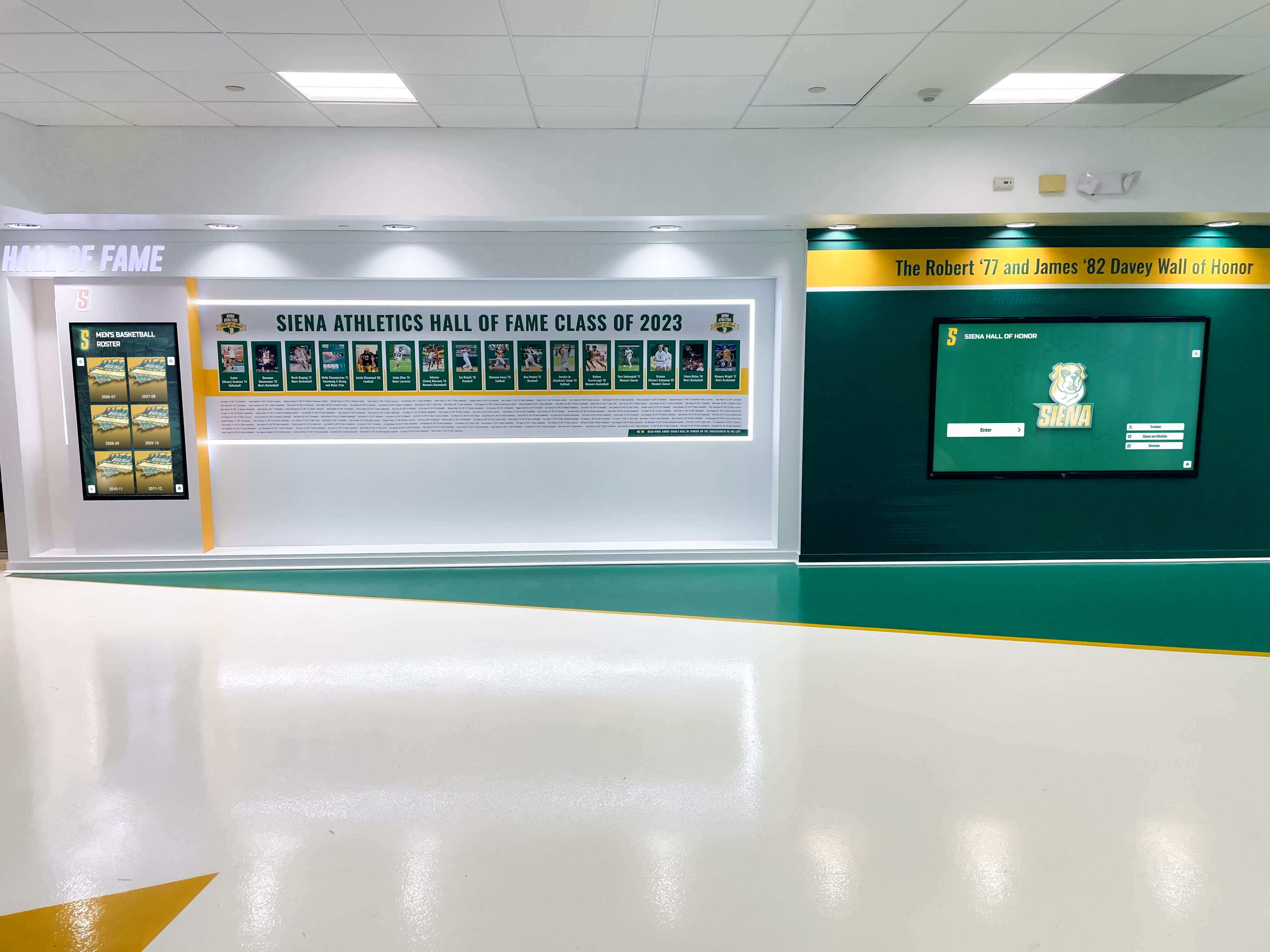
Championship and hall of fame recognition displays in school athletic facilities carry the program's history across many years of installation — fabric bow and skew acceptance inspections at receiving protect the visual integrity of those records before each banner becomes part of the permanent display
Vendor Resolution Steps When a Banner Falls Outside Tolerance
If the inspection determines that a delivered banner exceeds the pre-agreed bow or skew tolerance, the resolution process should follow a defined path:
Do not install the banner before resolution. Once a fabric banner has been mounted and subjected to grommet stress, longitudinal tension, and gymnasium environmental conditions, its flat-unstretched bow and skew measurements change. Post-installation measurement is not a reliable basis for a warranty claim. Hold the banner flat in storage until the supplier has reviewed the documentation.
Send the supplier the inspection documentation package. Include the scale photographs, the recorded measurements (bow percentage and skew percentage), the calculation method used, the reference line method, and the pre-agreed tolerance from the order confirmation. Ask the supplier to respond with their own assessment of the delivered banner against the agreed specification.
Request a determination of cause. Ask the supplier whether the deviation was present in the base fabric before printing, whether the fabric lot was checked for bow and skew before production, and whether the deviation falls within their production capability specification for that fabric type. Understanding cause informs the resolution: a fabric lot issue may require a different substrate source; a process issue may require a different straightening step before printing.
Agree on resolution options before committing to a timeline. Resolution options may include a reprint on a confirmed-compliant fabric lot, a written tolerance amendment if the deviation is minor and both parties agree it does not affect the banner’s installed appearance, or a credit against a future order. Confirm the agreed resolution in writing before any reprint begins.
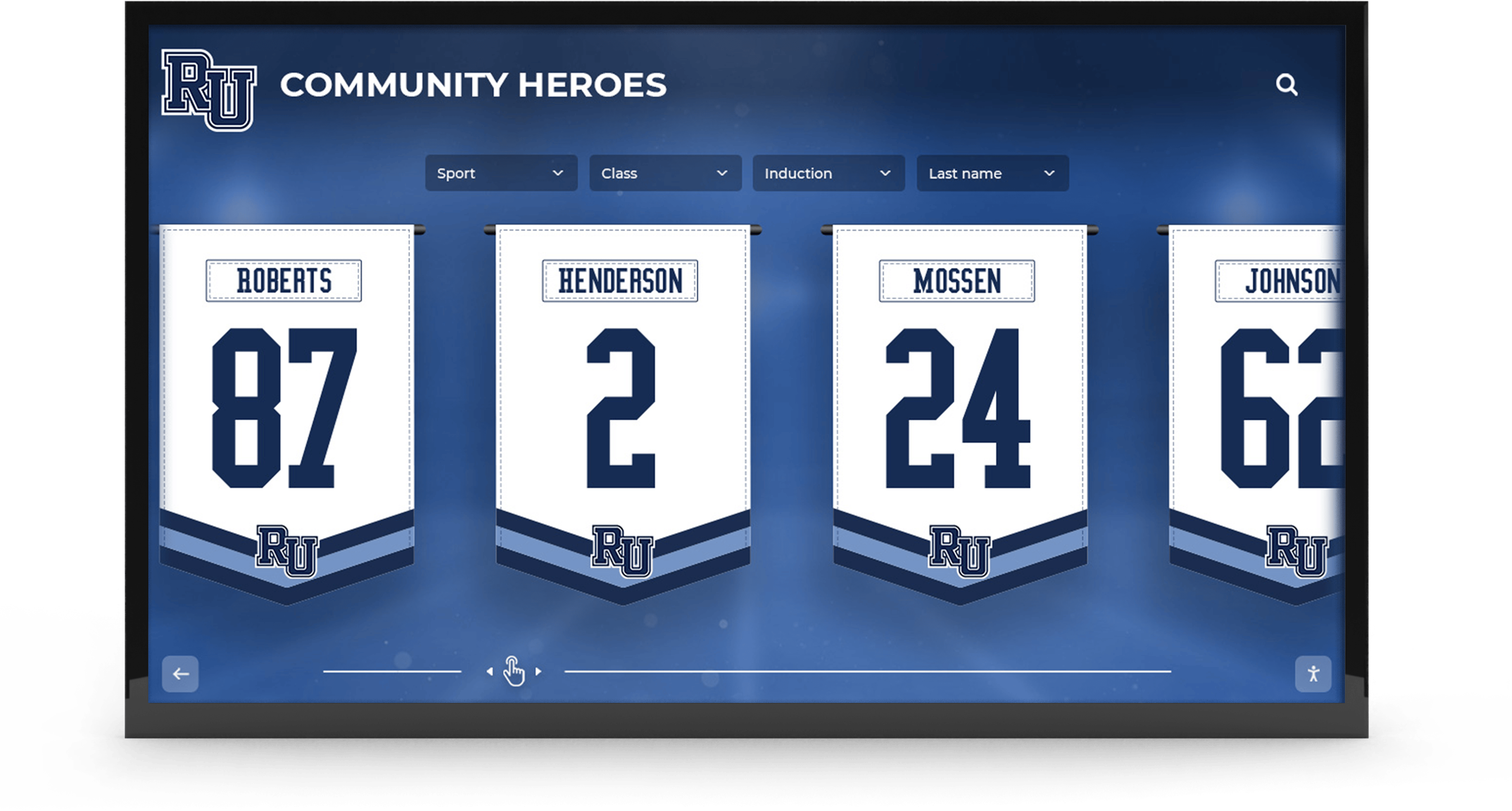
Recognition banner displays that include jersey numbers, name lists, and championship details are read at close range — fabric bow or skew in the base textile shifts those elements out of alignment, a defect that is preventable with a flat-inspection receiving check before any mounting hardware is staged
Comparing Receiving Inspection to Vendor-Managed Fabric Quality Control
Schools receiving championship fabric banners have two general options for confirming bow and skew compliance: performing a receiving inspection as described in this checklist, or relying on the vendor’s own internal quality control process.
A school-performed receiving inspection measures the actual delivered banner against the pre-agreed specification. Its advantage is that it catches deviations that passed through the vendor’s process undetected. Its limitation is that it requires staff who know what bow and skew look like, a flat space large enough for the full banner, and time at the receiving stage before the installation date. The accuracy of a field receiving inspection is also different from that of a formal laboratory measurement — a school inspection is useful and actionable but should not be represented as equivalent to formal ASTM D3882 testing conducted by a textile testing laboratory.
A vendor-managed fabric quality control program relies on the supplier to verify bow and skew in the base fabric before printing — typically by reference to a measurement method such as ASTM D3882 — and to confirm that the specific lot used for each order was within the agreed tolerance. Its advantage is that it catches fabric issues before they enter production, when the substrate can be replaced without wasting print time. Its limitation is that it requires the buyer to verify that the vendor’s program covers the specific fabric lot used for each order, not just that a QC program exists in general.
For school programs ordering woven or knitted fabric banners, the most reliable approach combines both: require the vendor to confirm pre-print bow and skew compliance for the specific fabric lot used, and perform a structured flat inspection at receiving as a final confirmation before installation is staged. The written tolerance agreement established before production makes both steps enforceable.
The athletic awards rubric for scoring leadership, sportsmanship, and display eligibility at Awards Display situates championship banners within a broader framework of how schools decide what to recognize and how those decisions are reflected in physical displays. A recognition display that includes a banner with a fabric quality defect presents the program’s history incorrectly — and that gap is avoidable when the acceptance process matches the care that went into the recognition decision itself.
How Rocket Graphics Compares to Static Specification Documents
School athletic directors managing championship banner orders often work from a static vendor specification document — a list of requirements prepared once and then referenced for each future order. Static specification documents require the school to track and update them independently as supplier capabilities, fabric types, and printing processes change. When a fabric lot issue arises, the school’s specification may reference a fabric type or tolerance the current supplier no longer uses.
A managed approach to championship banner specifications — one that keeps the specification current with each order cycle and confirms fabric lot compliance as part of each production confirmation — reduces the gap between what the written specification says and what arrives at receiving. Keeping that specification current also supports the school’s ability to communicate recognition decisions through formal announcement processes, as described at halloffame-online.com: when the physical banner is known to be correct before the announcement is made, the recognition event can proceed without a last-minute quality hold.
Schools expanding championship recognition across both physical and digital formats can find additional context on how schools are integrating digital recognition into their athletic display programs in the digital trophy case transition guide at Touch Hall of Fame, which covers why schools are moving portions of their recognition infrastructure to digital formats that do not carry the same substrate and grain defect risks as printed fabric.
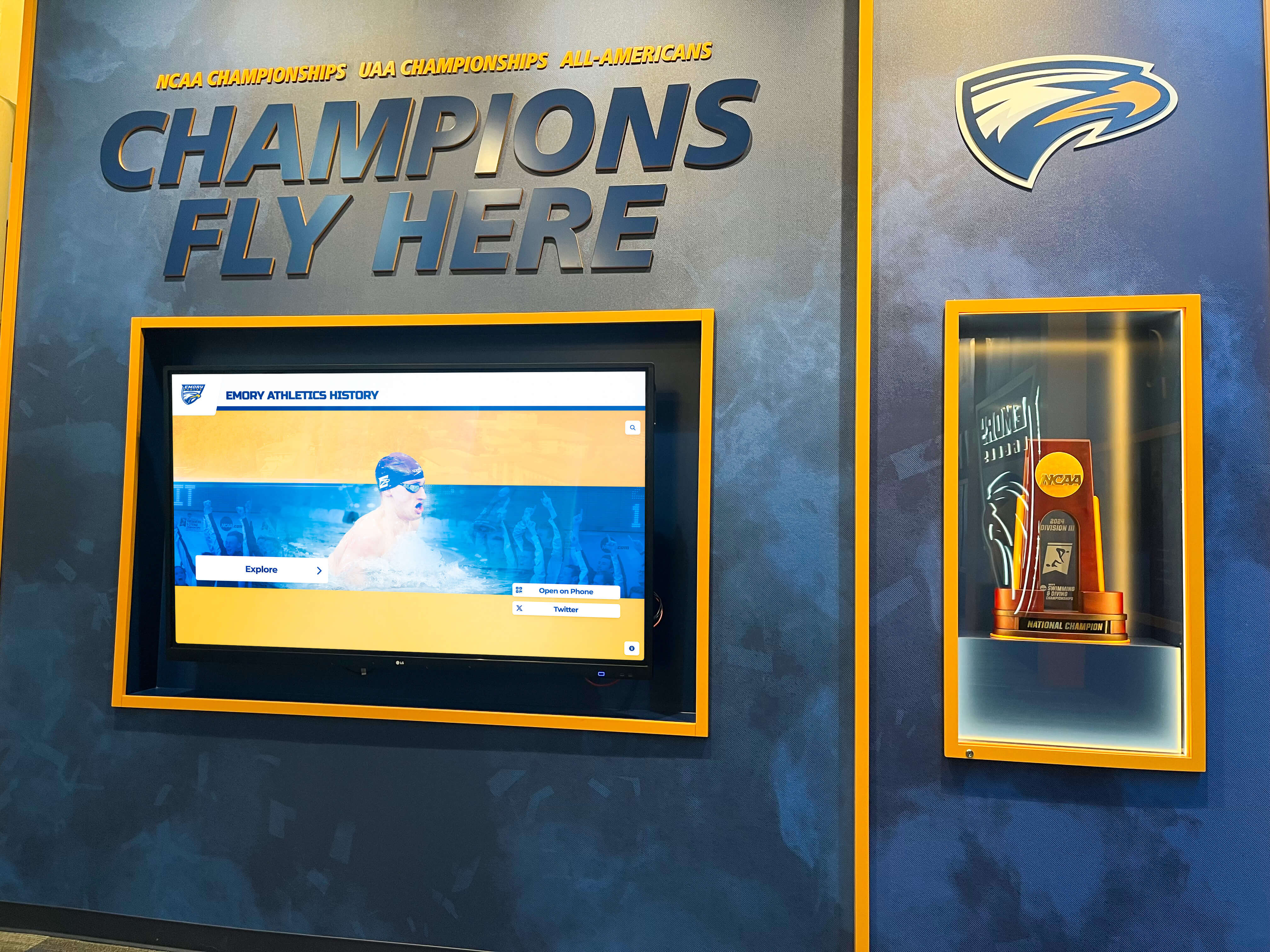
School athletic champions walls display specific team records, individual achievements, and championship seasons — fabric bow and skew in a printed textile banner shift those specific details out of alignment in ways that are only visible and measurable before the banner is raised to a permanent mount point
Frequently Asked Questions
What is the difference between fabric bow and artwork rotation on a championship banner? Bow is a structural condition of the base fabric: the crosswise threads curve away from perpendicular alignment with the selvedge. Artwork rotation is a print file or press setup error: the design was placed at an angle on the fabric during production. To distinguish them, observe whether the fabric grain itself is out of square relative to the banner edge. If the filling threads are correctly aligned perpendicular to the selvedge but the printed design appears tilted on them, the condition is artwork rotation — not bow.
Can I inspect for bow and skew while the banner is hanging? No. Hanging tension pulls the fabric into a shape that can mask structural bow or skew, making the installed banner appear straighter than it actually is. The inspection must be performed with the banner lying flat and unstretched on a level surface. A banner that looks acceptable under installation tension may show bow or skew when removed, stored, and re-hung in a future season.
Does ASTM D3882 specify acceptable bow and skew percentages for school championship banners? No. ASTM D3882 is a test method — it describes how to measure bow and skew and calculate percentage values. It does not specify what percentage is acceptable for a particular application. Acceptable tolerance for a school championship banner is a buyer/supplier agreement established in writing at the time of order, not a universal limit set by the standard.
Is a visual receiving inspection the same as certified ASTM D3882 testing? No. A structured visual inspection at receiving, informed by ASTM D3882 measurement concepts, is a practical tool for school buyers and is more useful than no inspection at all. Formal ASTM D3882 testing is conducted by qualified textile testing laboratories under controlled conditions. Representing a field receiving check as certified testing would overstate what the visual process can confirm.
What documentation should I retain from a championship fabric banner receiving inspection? Retain the scale photographs taken on the flat inspection surface with a measuring tape adjacent to any deviation, your recorded bow and skew percentage calculations, the pre-agreed tolerance from the order confirmation, and a copy of the approved artwork file. Keyed by order number and delivery date, this package supports warranty claims and provides an accurate record if the same banner is inspected again in a future season.
Reader questions:
- Does your current supplier confirm bow and skew compliance for the specific fabric lot used in each championship banner order — or only for their product category in general?
- Have you encountered a fabric banner where the printed design appeared curved or tilted after installation, and if so, did you measure it flat before mounting?
- What documentation does your school currently retain for championship banner orders alongside the digital artwork files, and where is that documentation stored between seasons?