Intent: decide. Championship banner dye migration is the movement of disperse dyes through a polyester substrate after printing — visible at proof stage as a halo or soft gradient where a dark school color borders a white or light field, and visible on a finished gymnasium banner as blurry text edges, muddied school colors, and mascot outlines that appear shadowed rather than sharp. The direct answer: before approving any polyester championship banner proof, confirm that every color boundary holds a clean, hard line at 1:1 magnification on a digital proof or under a 10× loupe on a physical proof. Any boundary that shows bloom, halo, or an unintended gradient that was not in the source artwork fails the dye migration check and must return to the vendor before the file enters production.
This checklist is written for school athletic directors, purchasing administrators, and recognition coordinators who receive and must approve championship banner proofs — not for press operators who run sublimation equipment daily. It covers what dye migration looks like at the proof stage, a step-by-step inspection protocol for both digital and physical proofs, a go/revise/reject decision table by defect type and severity, and the specific questions to ask a print vendor when a proof fails.

Polyester championship and recognition banners must hold sharp color boundaries between school colors across years of gymnasium display — dye migration discovered on a finished banner requires reorder at full cost, while the same defect detected at proof stage allows correction before production is committed
What Is Dye Migration and Why It Matters for Championship Banners
Dye migration is the continued movement of disperse dyes through a polyester substrate after the initial printing event. In dye-sublimation printing — the most common method for polyester school championship banners — disperse dye particles convert to gas under heat and penetrate the polyester fiber matrix, re-solidifying as the substrate cools. That process is designed to be permanent. Migration occurs when residual unfixed dye, or dye that was fixed near the substrate surface rather than deep in the fiber matrix, continues to move laterally in response to subsequent heat, solvent exposure, or prolonged contact with adjacent materials during storage, shipping, or finishing.
For championship banner proofs, migration produces three visible defects: a halo or bloom effect around colored text or logo elements — particularly dark-on-light artwork; gradient bleeding at the boundary between two adjacent solid color fields; and ghosting where a dark element appears to cast a faint shadow into a neighboring white or light area. All three defects reduce the legibility of mascot names, year lettering, and sport identifiers at gymnasium viewing distances of thirty to sixty feet.
The substrate determines the baseline migration risk. Standard uncoated polyester fabric offers no barrier to lateral dye movement. Polyester banner materials with an anti-migration surface coating — applied by the substrate manufacturer to interrupt lateral dye movement — produce sharper, more stable prints and are the appropriate substrate for championship banners where exact school color reproduction is required. Requesting a proof on the specific substrate the production order will use is therefore not optional; it is the only way to confirm whether migration is present under actual production conditions.
For context on how substrate selection interacts with production cost and vendor capability, the high school championship banner printing costs, materials, and vendor comparison guide covers how polyester substrate type and ink system affect both price and print quality for school athletic programs.
Digital Proof Inspection: Step-by-Step Checklist
A digital proof reviewed on screen is the first inspection gate — and the easiest place to identify artwork that is structurally at risk for migration before a physical print is made. Digital proofs do not show the actual migration behavior of the substrate, but they reveal artwork problems that will be amplified by any migration: thin strokes, tight color adjacencies, and light text on dark fields where ghosting will be most visible.
Perform this inspection at 100% magnification on a calibrated monitor. Do not approve a digital proof reviewed on a phone screen or at reduced zoom.
Set the proof to 100% (1:1) magnification. Zoom below 100% blurs soft edges that would be unacceptable on a finished banner. If your PDF viewer does not display a 1:1 view at the physical banner dimensions, use the output-resolution zoom — typically 200–400% for a high-resolution file displayed at screen resolution.
Inspect every color boundary in the artwork. Advance through the proof systematically — top to bottom, left to right — pausing at every location where two different solid colors meet. The boundary should appear as a single crisp pixel row or vector edge with no softening, gradient, or halo on either side. Pay particular attention to: school name lettering on a contrasting background, year numerals in a different color from their surrounding field, mascot outline elements, and any thin ruled line or border separating color zones.
Check dark colors bordering white or light fields first. The highest-risk adjacency for dye migration is a saturated dark color — navy, dark red, forest green, black — directly bordering a white or near-white background. On a digital proof this boundary should be a hard stop. Any softening indicates that the raster image was rendered with anti-aliasing at the color boundary, which will be amplified by substrate migration on the production banner.
Verify that light text on dark backgrounds meets minimum stroke weight. Reversed-out text — white or light lettering on a dark background — is the element most frequently damaged by dye migration on a finished gymnasium banner. If the lettering in the proof appears crisp, confirm with the vendor that the stroke weight meets their minimum recommended width for the ink system and substrate. Most polyester dye-sublimation vendors specify a minimum of 1 point for condensed sans-serif text.
Compare school color fields against the color specification on file. Pull the school’s official color specification alongside the proof and compare each solid field visually. A Pantone-to-process conversion that places a school’s navy slightly warmer or cooler than the official specification will show the difference more clearly on a polyester substrate that has experienced migration — because migration spreads color laterally rather than keeping it in registration at the original edge.
Document all failed boundaries before returning the proof. Record each failed location with the zone reference and a screenshot. A vendor cannot address a vague note of “color bleeding” — a specific list of which text element, which boundary, and which color pair is failing allows the vendor to isolate whether the cause is artwork rasterization, ink loading, or substrate.
Physical Proof Inspection: Step-by-Step Checklist
A physical proof on the actual production substrate is the only way to confirm that dye migration behavior is acceptable under real printing and finishing conditions. Request a physical proof for any championship banner order where exact school color accuracy is required, and for any order where dark colors border white or near-white fields in the artwork.
Verify the proof substrate matches the production order. Ask the vendor to confirm in writing that the physical proof was printed on the same substrate — same manufacturer, same product code, same coating — that the production banner will use. A proof on premium coated polyester does not represent what an uncoated polyester production substrate will do.
Inspect under a daylight-balanced light source. View the proof under a D65 or D50 standard illuminant at approximately 500–1000 lux. Warm incandescent lighting shifts apparent color and makes it harder to assess whether a warm halo is ink or lighting. Photograph the proof under consistent lighting for your approval records.
Use a 10× loupe at each color boundary. At each boundary flagged in the digital proof review — and at every other hard color boundary — examine the edge under 10× magnification. A clean boundary appears as an abrupt transition with no visible dye outside the intended color zone. A migration-affected boundary shows a visible gradient or halo extending 0.5 mm or more into the adjacent color field, with dye particles visible in the fiber matrix of the receiving color zone.
Apply a heat test to the proof. If the banner will be finished with heat processes — sewn hem with a heat press, or grommets set with a heat tool — simulate that finishing heat on a corner of the physical proof before approving. Lay the proof face-down on a clean surface, place a pressing cloth over the back, and apply a household iron at the polyester setting (approximately 275°F / 135°C) for 10 seconds on a non-critical corner. Compare the heated corner to the unheated proof. If the color boundaries show additional spreading after the heat test, the ink system or substrate carries elevated migration risk during the finishing process.
Photograph and document each defect. Photograph each defect under the daylight source at both overview scale and close-up — with a ruler placed beside the defect as a reference scale. These photographs are the basis for your vendor return request and your comparison check when the corrected proof arrives.
The championship banner condition assessment checklist covers a parallel inspection framework for evaluating banner condition on existing installed banners — many of the same defect categories appear in both a proof inspection and a long-term condition assessment, including color fading, edge integrity, and substrate damage.
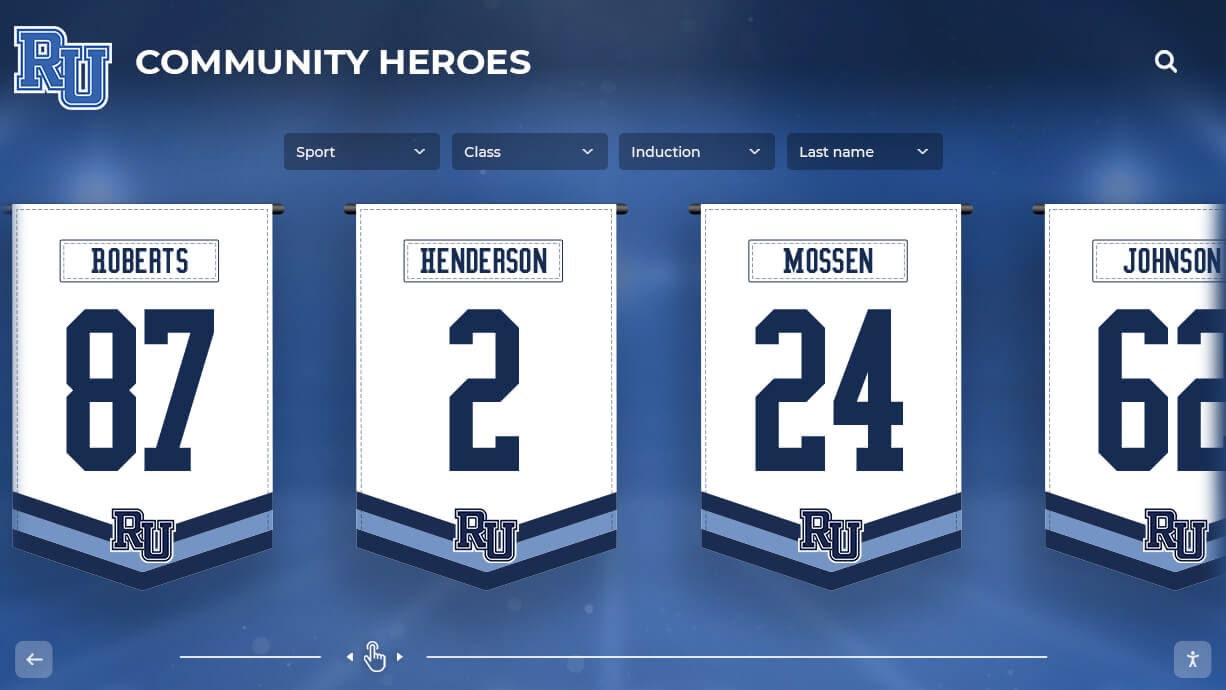
Recognition banners hanging in a school lobby represent a long-term display investment — polyester banners that passed a pre-production dye migration inspection maintain sharp color boundaries and accurate school colors through years of seasonal display and reinstallation
Dye Migration Decision Table: Approve, Revise, or Reject
Use this table when evaluating both digital and physical proof results. Record the decision and the supporting observation before contacting the vendor.
| Defect Type | Severity Criteria | Decision | Required Action |
|---|---|---|---|
| No visible color bleed at any boundary | All boundaries hold hard edge at 1:1 digital / 10× physical | Approve | Proceed to production — no changes required |
| Minor softening at one or two boundaries, text fully legible | Halo under 0.5 mm on physical proof; not visible at normal viewing distance | Approve with note | Document location; confirm within tolerance with program stakeholders before signing |
| Visible halo around text or logo element; edges soft at viewing distance | Halo 0.5–1.0 mm on physical proof; visible at 10 feet or closer | Revise | Return to vendor specifying whether the fix requires: (1) artwork stroke-weight increase, (2) substrate upgrade to anti-migration coating, or (3) ink loading reduction |
| Color bleed crossing from one solid field into an adjacent field | Gradient visible at any magnification, crossing into adjacent color zone | Revise | Return to vendor — request substrate upgrade and revised proof before approving production |
| Dark color contaminating white or near-white field | Any visible tint in white areas adjacent to dark colors on physical proof | Revise | Return to vendor — substrate upgrade required; white-field contamination is not correctable in post-processing on polyester |
| School color appears significantly different from PMS specification | Visible hue shift under standard illuminant comparison | Reject / re-specify | Request vendor recalibrate ICC profile for the substrate or test an alternate substrate before placing production order |
| Heat test shows additional migration after simulated finishing temperature | Color boundaries spread visibly after pressing at 275°F | Reject | Substrate or ink system not suitable for this finishing process — request alternate substrate rated for heat finishing |
Vendor Questions to Ask When a Proof Fails
Returning a proof that fails a dye migration check is more effective when the return communication specifies the likely cause rather than just describing the symptom. These questions help a school athletic director have a productive conversation with a print vendor about a migration failure.
About the ink system:
- Is this banner printed with dye-sublimation, solvent, eco-solvent, UV-curable, or latex ink?
- What is the maximum ink loading (total area coverage) specified for this substrate and color profile?
- Has this ink and substrate combination been tested for migration at long-term display temperatures?
About the substrate:
- Does the polyester substrate used for this order have an anti-migration surface coating?
- What is the substrate manufacturer and product code?
- Is an anti-migration coated alternative available for this order, and what is the cost difference?
About the artwork:
- Were the color boundaries in the artwork rendered as vector edges or rasterized?
- Were anti-aliasing or soft edge settings applied at color boundaries during RIP processing?
- Can the problematic boundaries be reproduced as hard vector transitions in the output file?
About remediation:
- If a substrate upgrade is required, can a revised physical proof on the new substrate be provided before the production order is placed?
- What is the vendor’s warranty or reprint policy if migration defects appear on the finished banner that were not present on the approved physical proof?
Schools building comprehensive championship recognition programs benefit from tracking proof approval history as part of the overall program inventory. Championship banner inventory tracking for titles, years, sports, and display locations covers how schools maintain records across an entire banner program history — which makes retrieving proof approval documentation easier when a production question arises seasons later.
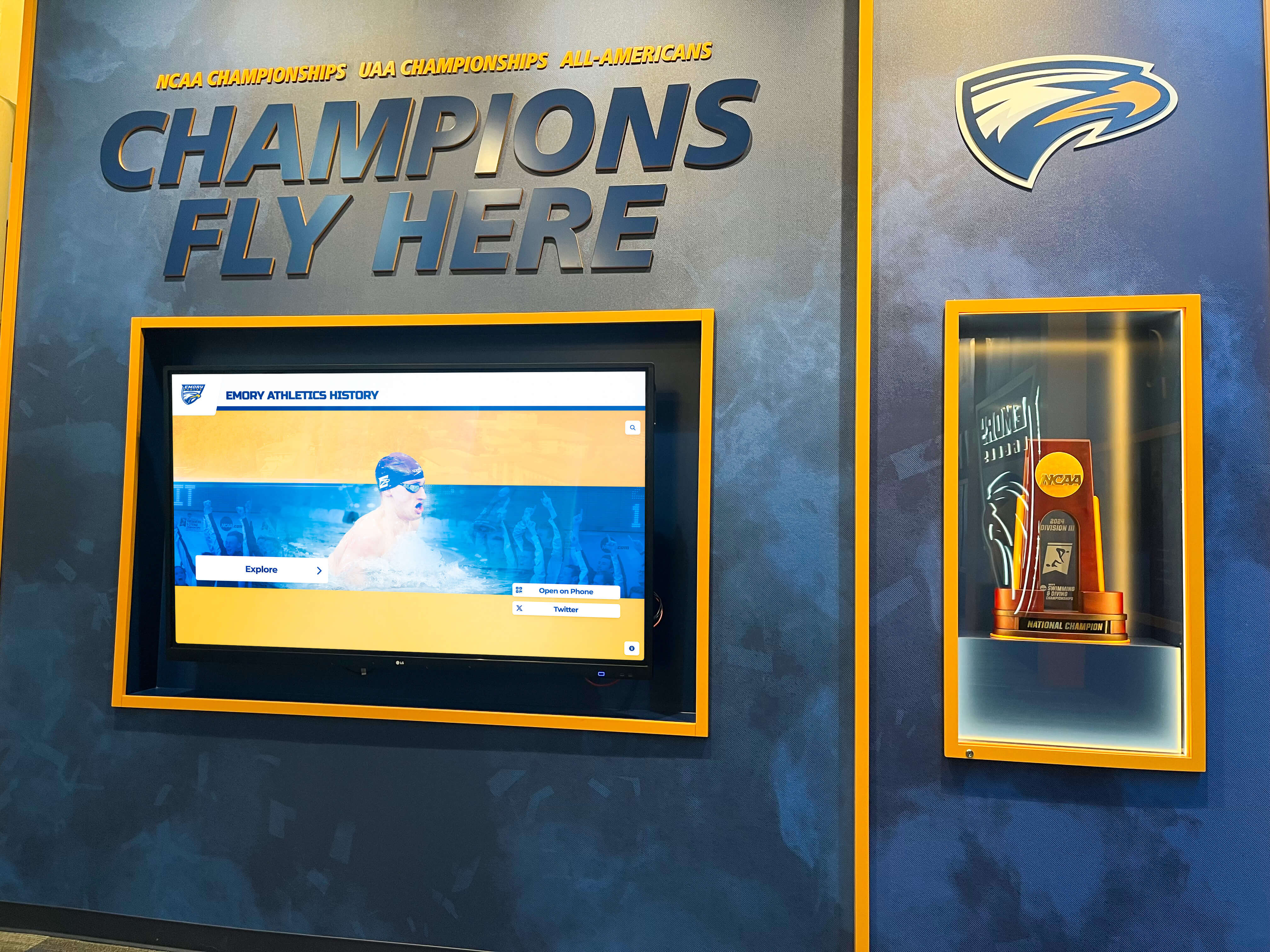
Championship recognition walls accumulate banners across multiple sports and years — each new polyester banner must pass a dye migration proof inspection to maintain consistent color quality and legibility across the entire display program
How Dye Migration Affects Specific School Color Combinations
Not all school color combinations carry equal migration risk on polyester substrates. Understanding which combinations require the closest proof inspection allows athletic directors to focus their review time where defects are most likely.
High risk — saturated dark color bordering white or near-white: Navy blue on white, cardinal red on white, forest green on white, and black on white are the highest-risk adjacencies. The dark color contains high concentrations of disperse dye with strong affinity for polyester fiber; the white field has no competing dye to mask incoming contamination. Even 0.3 mm of migration in these combinations is visible at gymnasium viewing distances because the dark dye shows as a distinct halo against the uncontaminated white field.
Moderate risk — two saturated colors bordering each other: Combinations like red-and-navy, green-and-gold, and purple-and-gold involve two saturated colors where each color’s dye can migrate into the adjacent field. The defect appears as a muddy, desaturated transition zone rather than a clean school-color boundary. Mascot logos that contain multiple saturated colors in close proximity — common in school championship banner artwork — benefit from physical proof inspection at 10× to confirm that multi-color transitions hold throughout the design.
Lower risk — light or pastel colors: Lighter school colors such as sky blue, light gold, and silver contain lower concentrations of disperse dye and present lower migration risk. However, a light color bordering white still warrants inspection — even low dye concentration migrating into a white field produces a visible tint when the white area is large and the gymnasium lighting is bright.
Special case — metallic and fluorescent ink accents: Some championship banner vendors offer metallic or fluorescent ink options for school color accents. These specialty inks have different dye chemistry and different migration behavior than standard disperse dyes. Request a physical proof for any banner that includes metallic or fluorescent inks adjacent to standard colors, even if the school’s standard color combination is otherwise low-risk.
For school programs evaluating the design decisions that most affect finished banner quality — including color placement, font selection, and border design — the sports championship banners guide for designing and displaying team pride covers how artwork decisions interact with polyester substrate and production method to determine final print quality.
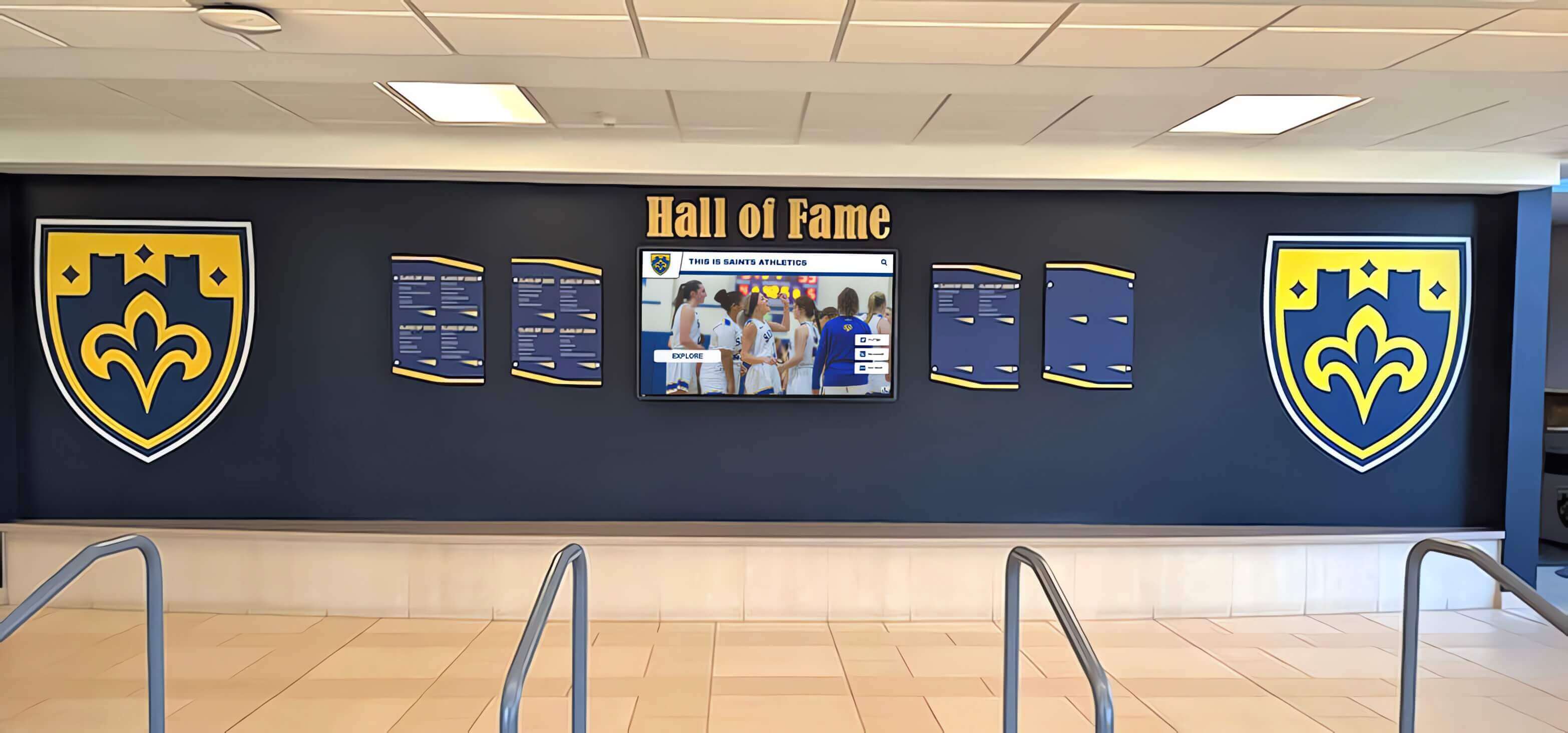
School recognition displays involving multiple saturated school colors — like the blue and gold combination in this lobby wall — require careful dye migration proof inspection of each color boundary, because both colors carry migration risk and a muddy transition zone at the boundary will be visible across the full display environment
Connecting Proof Approval to the Broader Recognition Program
Championship banner proof approval is one step in a longer process that begins with the award of a title and ends with a banner hanging in a gymnasium that will represent the program for decades. Schools that document standards at each step — artwork specification, proof inspection, production approval, finishing review, installation verification — produce recognition materials that maintain their quality through repeated seasonal reinstallation and long-term display.
For programs evaluating whether new championship titles should be recognized with physical polyester banners, with digital display alternatives, or with a combination of both, the championship banner versus digital trophy case comparison for school wall space provides a framework for making that decision based on available wall space, program budget, and recognition goals.
Schools with active gym banner programs adding new designs or updating existing artwork can find design inspiration and practical display guidance in gym banner ideas for custom designs and school pride — a useful reference for what color combinations and design approaches work in gymnasium display environments, which directly informs proof evaluation standards.
A print vendor that produces banner artwork approved through a rigorous proof process — including a dye migration inspection — delivers the same graphic quality that athletic programs require across physical and digital recognition media, because the same color accuracy standards apply whether the design hangs from a gymnasium rafter or appears on a digital hall-of-fame display.
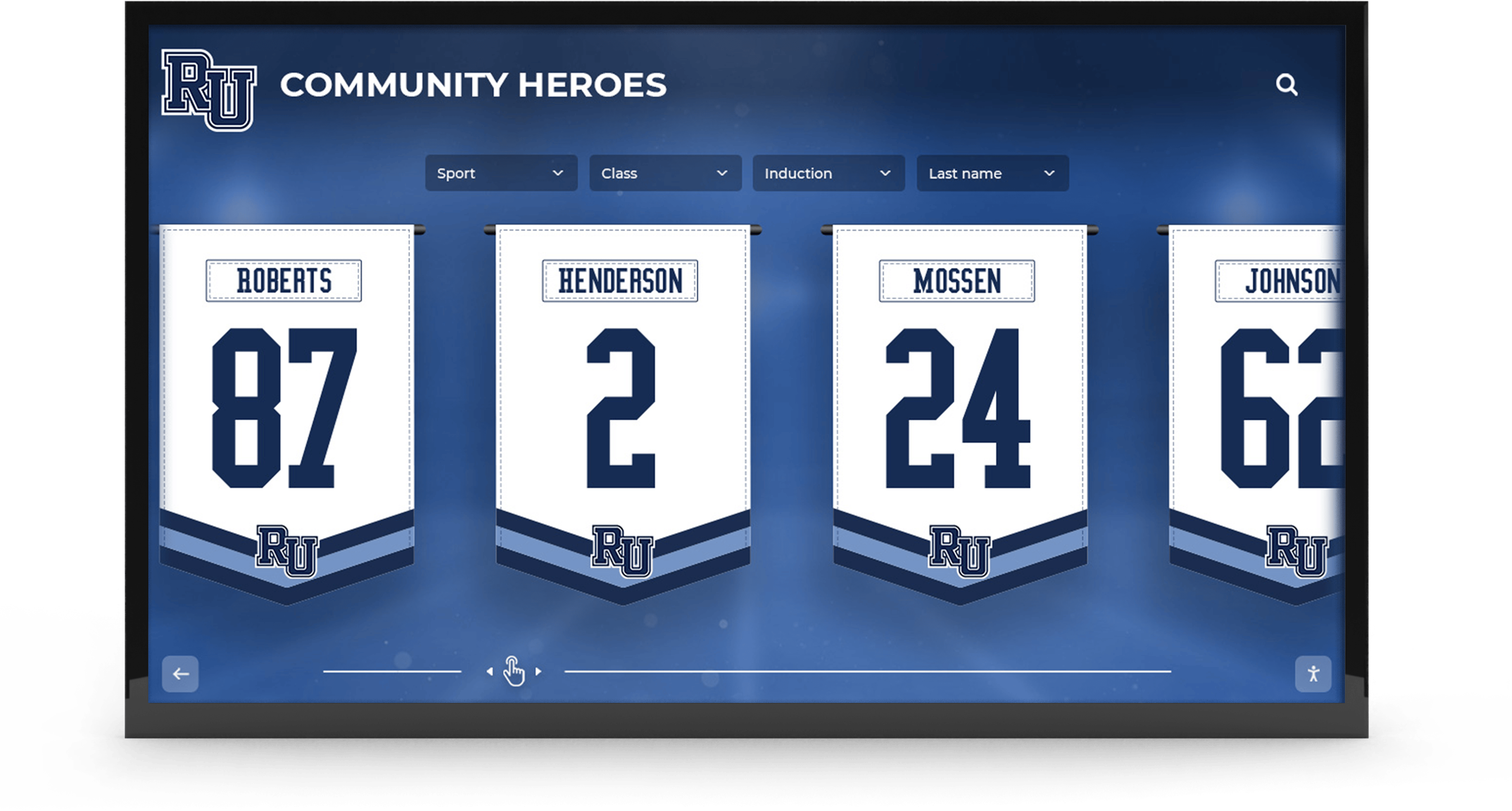
School recognition programs that combine physical polyester banners with digital display elements require consistent color accuracy across both media — dye migration inspection at proof stage ensures that banner colors match the school's brand standards applied throughout the recognition environment
Frequently Asked Questions: Championship Banner Dye Migration
What is dye migration in championship banner printing?
Dye migration in championship banner printing is the movement of disperse dyes through a polyester substrate after the initial print event, producing visible halos, gradients, or bleed at color boundaries in the finished banner. It most often occurs when residual unfixed dye continues to move through the polyester fiber matrix in response to heat, solvents, or prolonged contact with adjacent materials. On a school gymnasium championship banner, the most visible result is soft text edges around mascot names or year numerals, and a gradient halo where a dark school color borders a white or light background field.
How do I inspect a championship banner proof for dye migration?
To inspect a digital proof, view it at 100% (1:1) magnification on a calibrated monitor and examine every location where two different solid colors meet — looking for any softening, gradient, or halo at the boundary that was not in the source artwork. To inspect a physical proof, use a 10× loupe at each color boundary under a daylight-balanced light source and look for any dye spread extending 0.5 mm or more into the adjacent color field. Apply a heat test on a non-critical corner to simulate any finishing heat used during banner production.
What causes dye migration on polyester championship banners?
Dye migration is caused by a combination of disperse dye properties, substrate characteristics, and environmental conditions. Disperse dyes have inherent affinity for polyester fiber and continue to move through the fiber matrix when heat, solvents, or time provide the energy for lateral movement. An uncoated polyester substrate offers no barrier to this movement; a substrate with an anti-migration surface coating interrupts it. High ink loading and heat-applied finishing processes both increase migration risk.
Can dye migration be fixed after a championship banner is printed?
Dye migration cannot be corrected on a finished championship banner. Once disperse dye has migrated into the polyester fiber matrix of an adjacent color zone, it is permanently bonded to those fibers and cannot be removed without damaging the substrate. The only corrective options — substrate upgrade, artwork revision, or ink loading adjustment — all require a new proof and must occur before production approval.
Should a school request a physical proof for every polyester championship banner order?
A physical proof on the production substrate is warranted any time the order involves exact school color matching on polyester, dark colors bordering white or near-white fields, fine text at small stroke weights, or a vendor or substrate combination not previously approved. For repeat orders on the same vendor, substrate, and artwork already cleared through a prior physical proof, a digital proof at 1:1 magnification may be sufficient.
Inspect the Proof Before the Banner Goes to Production
Championship banner dye migration is a production-stage problem with no post-production fix. The inspection protocol in this checklist — digital proof review at 1:1 magnification, physical proof inspection under a daylight source with a 10× loupe, heat test on a corner before approving finishing, and a documented approval or return before the file enters the production queue — applies to every polyester championship banner where school color accuracy and text legibility are requirements.
The return on proof inspection is straightforward: a failed proof caught before production costs the school time. A dye migration defect discovered on a finished banner costs the school a full reorder — plus the delay, which in a championship recognition context often means a banner that is not ready for the ceremony where it was intended to hang.
Championship Recognition Graphics — Color Accurate, Production Ready
Rocket Graphics is an AI-powered school graphics platform built for athletic departments and recognition programs. Create championship banner artwork with correctly specified color fields, vector-clean boundaries, and school-brand accuracy — graphics designed for polyester production without the migration risks that come from poorly specified artwork.
Get notified when Rocket Graphics opens.