A championship banner CIEDE2000 color-difference proofing checklist is the structured measurement and approval process that uses Delta E 2000 (ΔE₀₀) numerical tolerances to determine objectively whether a printed banner proof matches a school’s approved colors closely enough to authorize the full production run. The direct answer: CIEDE2000 is the color-difference formula published by the International Commission on Illumination (CIE) in CIE 142:2001, and it calculates a single number — the ΔE₀₀ value — that describes the perceptual distance between two colors measured in the CIE L*a*b* color space. For championship banner proofing, a ΔE₀₀ value below 3.0 for each primary school color is the target threshold used by commercial print vendors working to G7 and ISO 12647 standards; a value above 5.0 is an unambiguous fail that requires the vendor to adjust ink, ICC profile, or substrate before production begins. Using CIEDE2000 tolerances replaces subjective visual comparisons — “does this look close enough?” — with a documented, repeatable measurement that protects the school’s color standard and provides a written approval record that survives staff turnover.
This guide is written for school administrators, athletic directors, facilities managers, and recognition-program coordinators who authorize championship banner orders — not for prepress specialists who configure spectrophotometer software daily. No prior color science background is required.
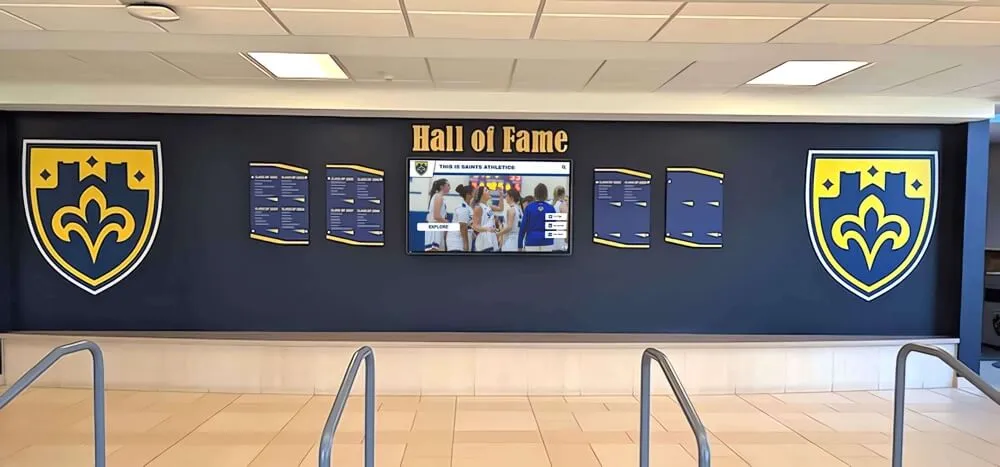
Championship banners installed near permanent recognition displays are visually compared against existing school-color references daily — a CIEDE2000 proofing checklist provides the numerical threshold that confirms the new banner matches the established standard before production is authorized
Delta E 2000 at a Glance: Plain-Language Tolerance Table
The CIEDE2000 tolerance table below translates ΔE₀₀ values into plain-language approval decisions for championship banner proofing. Use this table as the first reference when reviewing a spectrophotometer measurement report from a vendor or color lab.
| ΔE₀₀ Value | Perceptual Interpretation | Approval Decision for School Colors |
|---|---|---|
| < 1.0 | Imperceptible — virtually identical to the reference | Pass: excellent match |
| 1.0 – 2.0 | Perceptible only to trained color observers | Pass: exceeds commercial print standard |
| 2.0 – 3.0 | Visible to attentive observers under controlled conditions | Pass: meets G7 / ISO 12647 commercial target |
| 3.0 – 4.0 | Visible to most observers under direct comparison | Conditional: acceptable for secondary colors, review primaries |
| 4.0 – 5.0 | Clearly visible to most observers in side-by-side comparison | Conditional: borderline — request vendor explanation before approving |
| > 5.0 | Visible to any observer without direct comparison | Fail: reject proof, require corrected resubmission |
How to use this table: When the vendor supplies a color measurement report, locate the ΔE₀₀ column (some software labels it “dE00,” “ΔE 2000,” or “Delta E 2000”). Read the value for each school color patch — primary field color, secondary accent color, and any neutral elements. Apply the table’s decision row to each measurement independently. A banner with a primary school navy at ΔE₀₀ = 2.4 and a secondary gold at ΔE₀₀ = 3.8 has a passing primary color and a borderline secondary that warrants a vendor conversation before full production begins.
What CIEDE2000 Measures That Earlier Delta E Formulas Do Not
CIEDE2000 is the color-difference formula to use for championship banner proofing because it accounts for the way human vision perceives color differences non-uniformly across the color space — and those non-uniformities matter for the specific colors schools use most.
The original CIE Delta E formula from 1976 (ΔE76, also written ΔE*ab) treated all color space regions equally: a difference of 1 unit in lightness (L*) was considered perceptually equivalent to a difference of 1 unit in the red-green axis (a*) or the yellow-blue axis (b*). That assumption is inaccurate. Human vision is not equally sensitive to color differences in all directions and at all chroma levels. A ΔE76 value of 3.0 for navy blue does not represent the same perceptual visibility as a ΔE76 value of 3.0 for a light gray neutral.
CIEDE2000 corrects for three known perceptual non-uniformities:
Lightness non-uniformity. Human vision perceives lightness differences more sensitively at very dark values (low L*) than at mid-range lightness. School colors like navy blue, maroon, and forest green — which all have low L* values — require a smaller ΔE₀₀ threshold than lighter colors to produce the same perceptible visual difference. CIEDE2000’s lightness weighting function (SL) adjusts for this: a ΔE₀₀ = 2.5 for a dark school navy represents a larger perceptual difference than a ΔE₀₀ = 2.5 for a light cream or silver accent color.
Chroma non-uniformity. Highly saturated colors — the vivid blues, reds, and greens common in school color palettes — tolerate larger ΔE₀₀ values before the difference becomes perceptible, while low-chroma neutrals require tighter tolerances. CIEDE2000’s chroma weighting function (SC) implements this adjustment so that the numerical threshold reflects actual perceptibility rather than a uniform mathematical distance.
Hue non-uniformity in the blue region. CIEDE2000 includes a rotation term (RT) specifically for colors in the blue and violet region of the color space — hue angles between approximately 225° and 315° in a*b* space. Human vision is particularly sensitive to hue shifts in this region, and the rotation term adjusts the ΔE₀₀ calculation to produce a larger numerical difference for a given blue-region hue shift than the earlier formulas would. For schools whose primary color is a navy, royal blue, or violet, this correction is the single most important technical reason to use ΔE₀₀ rather than ΔE76 or ΔE94 as the proofing tolerance metric.
ISO 12647, the international standard family for process color printing, references CIEDE2000 in its tolerance specifications for commercial print production. G7 methodology, the gray-balance and color-accuracy specification used widely in North American commercial print, also uses ΔE₀₀ values for process control targets and proof verification. A championship banner vendor working to either standard already uses CIEDE2000 as the measurement basis — the checklist below aligns with that workflow.
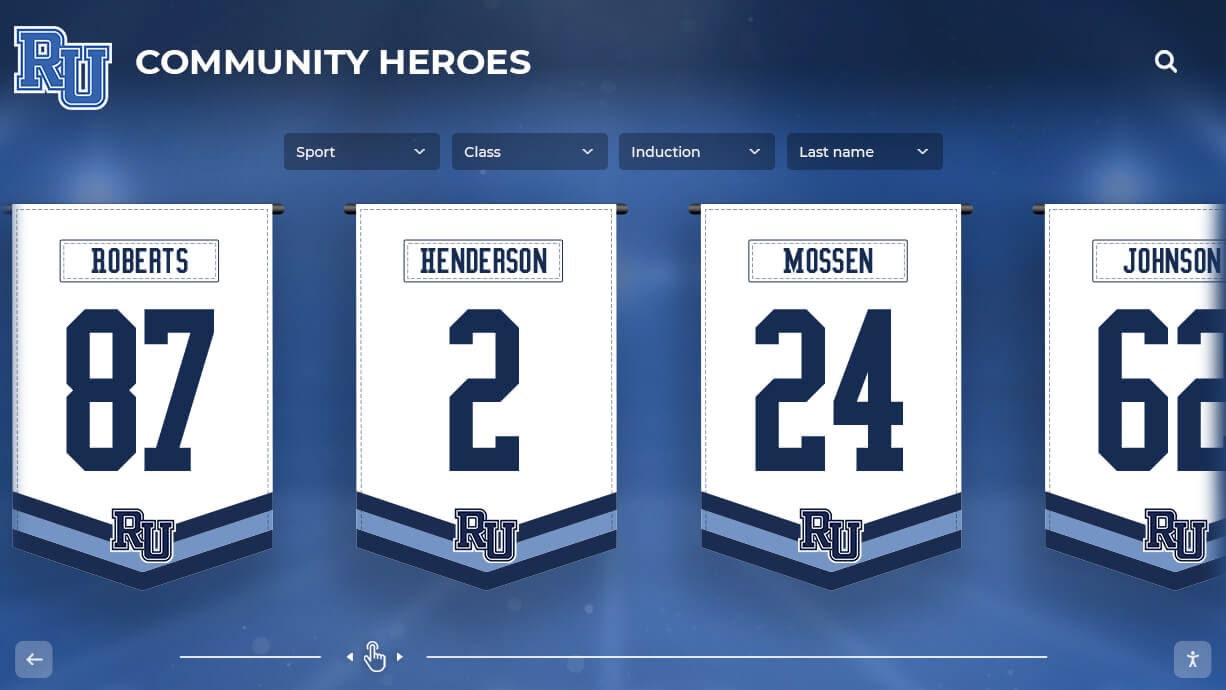
Recognition corridors accumulate championship banners from multiple production years — CIEDE2000 proofing documentation for each run creates a color consistency record that ensures new banners match the established standard without requiring a full visual comparison on-site at installation
How to Obtain Lab* Values for Championship Banner Proofing
A CIEDE2000 calculation requires two L*a*b* color measurements: the reference value (the school’s approved color) and the sample value (the printed proof being evaluated). Before the checklist steps below can be applied, those values must be obtained.
Reference L*a*b* values come from the school’s established color standard. Sources, in order of reliability:
- Pantone spectral data. If the school’s colors are specified with PMS numbers, Pantone publishes L*a*b* values for each ink formula under standard illuminant conditions (D50, 2° observer). These values appear in Pantone’s digital tools and in the X-Rite ColorMunki or i1Studio software. A school using Pantone 2955 C for navy blue has a published reference L*a*b* value that is authoritative and vendor-independent.
- Spectrophotometer measurement of an approved reference. The most recently approved and installed championship banner, a current uniform piece, or a physically approved ink drawdown can be measured with a calibrated spectrophotometer to obtain L*a*b* reference values. This method is appropriate when Pantone values do not exist or when the school’s color standard has been established empirically through prior production rather than by a PMS specification.
- Vendor’s color library. Some large-format vendors maintain a measured L*a*b* record for their customers’ school colors based on prior approved production runs. Ask the vendor for the L*a*b* values on file for your school’s colors — this is the most direct path to establishing the reference if prior measurements exist.
Sample L*a*b* values are obtained by measuring the physical proof with a calibrated spectrophotometer, using the same measurement conditions as the reference (same illuminant, same observer angle, same aperture geometry). The most common measurement conditions for graphic arts proofing are M1 (D50 illuminant, UV included) per ISO 13655, though some vendors measure under M0 or M2 — verify that the reference and sample are measured under the same condition before comparing them.
A championship banner spectrophotometer calibration check before each measurement session is essential: an uncalibrated instrument produces L*a*b* readings that cannot be trusted for CIEDE2000 comparison regardless of which formula is applied.
Championship Banner CIEDE2000 Color-Difference Proofing Checklist
Step 1: Document the School’s Approved L*a*b* Reference Values Before Requesting a Proof
Before any proof is ordered, establish the L*a*b* reference values for every school color that will appear on the banner and record them in the banner production file.
For each color:
- Record the Pantone PMS number and its published L*a*b* values (D50, 2° observer), or measure an approved reference sample with a calibrated spectrophotometer and record the L*a*b* triplet.
- Identify the illuminant condition (M0, M1, or M2) used for the reference measurement so the vendor measures the proof under the same condition.
- Record which physical object the reference measurement was taken from — which banner season, which uniform piece, or which fan deck chip — so the reference is traceable and can be remeasured if the original reading is questioned.
Schools that maintain consistent documentation for athletic recognition programs — the same discipline that supports accurate team roster records and multi-year achievement displays — benefit from treating L*a*b* reference values as part of the same institutional record.
Step 2: Specify CIEDE2000 Tolerances in the Proof Request
When submitting the artwork file and proof request to the vendor, include the school’s L*a*b* reference values and the ΔE₀₀ tolerance thresholds the proof must meet for each color.
Include in the written proof request:
- L*a*b* reference values for each school color (primary, secondary, any accent)
- ΔE₀₀ tolerance: ≤ 3.0 for each primary school color; ≤ 4.5 for secondary and accent colors
- Measurement condition: M1 (or whichever condition matches your reference measurement)
- Request that the vendor supply a color measurement report with ΔE₀₀ values alongside the physical proof
Providing tolerances in the proof request before the proof is made serves two purposes: it gives the vendor a numerical target rather than only a visual impression, and it creates a documented specification against which the proof can be evaluated objectively rather than through subjective visual comparison.
Step 3: Calibrate the Spectrophotometer and Measure Color Patches on the Proof
When the physical proof arrives, perform a white calibration on the spectrophotometer before measuring — regardless of when the instrument was last calibrated. Measure each school-color patch on the proof at least three times, average the L*a*b* readings, and record the average.
Measurement procedure:
- Place the spectrophotometer on a color patch with no specular highlight from overhead lighting.
- Trigger the measurement and record L*, a*, and b* values.
- Lift and reposition the instrument slightly and repeat twice more.
- Average the three readings.
Measure both the proof patch and, if available, the reference material patch under identical conditions to confirm the reference L*a*b* values have not drifted since they were originally recorded.
Step 4: Calculate ΔE₀₀ for Each School Color
CIEDE2000 calculations are performed by color measurement software rather than manually. Spectrophotometer software from X-Rite (ColorMunki, i1Profiler), Konica Minolta (ColorWorks), and free tools including the Colour Science for Python library and several online ΔE calculators perform the calculation automatically when two L*a*b* triplets are entered.
To calculate manually or verify:
- Enter the reference L*a*b* triplet (the approved school color) as the “standard” or “reference” value.
- Enter the sample L*a*b* triplet (the measured proof patch) as the “sample” or “batch” value.
- Select “CIEDE2000” or “ΔE 2000” as the formula (not ΔE76, not ΔE94, not CMC).
- Record the resulting ΔE₀₀ value.
Repeat for each school color. A banner proof with four distinct color elements — navy field, gold text, white background, and black outline — requires four separate ΔE₀₀ calculations and four separate tolerance decisions.
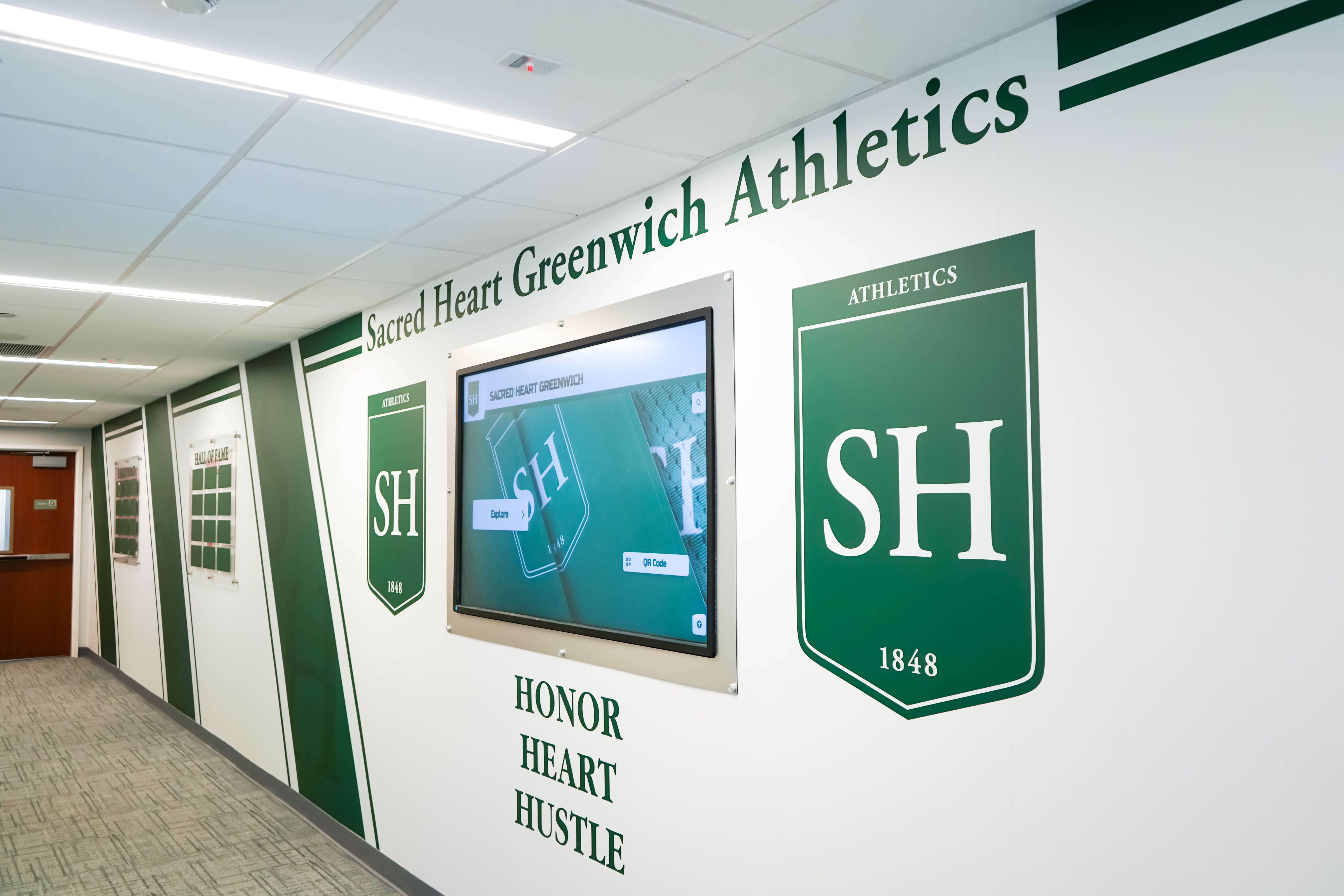
Permanent recognition panels installed in school corridors serve as a daily visual reference for every championship banner produced after them — CIEDE2000 proofing before each new banner production run confirms the new banner's colors remain within tolerance of the established display's standard
Step 5: Apply the Tolerance Decision Table to Each Measurement
With ΔE₀₀ values in hand for each color, apply the plain-language table from the opening section to each measurement:
- ΔE₀₀ ≤ 3.0 for all primary school colors: Proof passes. Authorize production.
- ΔE₀₀ 3.0–5.0 for a primary color: Request the vendor’s explanation of why the value is elevated before authorizing production. The vendor should identify whether the deviation is in lightness (L*), chroma (a*, b*), or hue direction, and whether an ink or profile adjustment is feasible.
- ΔE₀₀ > 5.0 for any primary school color: Reject the proof. Issue a corrected proof request with the specific ΔE₀₀ value, the direction of deviation (too dark, too blue-shifted, too green, etc.), and the maximum acceptable tolerance.
- ΔE₀₀ ≤ 4.5 for all secondary and accent colors: Proof passes.
- ΔE₀₀ > 4.5 for a secondary color: Review case by case; authorize if the color is a minor element not directly compared against reference materials in the installation space.
Need championship banner artwork with school colors built in from the first draft?
Rocket Graphics is building an AI-powered platform to help school staff generate championship banner graphics with accurate school colors — reducing the number of proof iterations required before ΔE₀₀ tolerances are met.
Get notified when Rocket Graphics opens.Step 6: Document Out-of-Tolerance Colors and Issue a Corrected Proof Request
When a proof color fails the ΔE₀₀ threshold, document the failure before communicating with the vendor. Record:
- The color that failed (e.g., “school navy primary field”)
- The reference L*a*b* values
- The measured sample L*a*b* values
- The calculated ΔE₀₀ value
- The direction of deviation: is the proof color too light or too dark (ΔL* positive or negative)? Too saturated or too muted (ΔC* direction)? Shifted in hue (ΔH* direction and approximate color direction — more greenish, more purplish, etc.)?
The direction of deviation is the most useful information the vendor needs to correct the proof. A school navy that measures ΔE₀₀ = 6.2 with a ΔL* of +4.5 (too light) is a different correction than a school navy at ΔE₀₀ = 6.2 with a ΔH* shift toward violet — the first requires more ink density, the second may require a profile adjustment or spot-color formula correction.
For schools whose banner production spans multiple athletic facility recognition installations across a campus, maintaining a written record of proof correction requests and vendor responses creates a quality audit trail that supports consistent color reproduction across buildings and production years.
Step 7: Archive the ΔE₀₀ Measurement Report Before Authorizing Production
Before signing off on the production run, archive the following in the banner production file:
- Reference L*a*b* values for each school color measured
- Sample L*a*b* values from the approved proof
- ΔE₀₀ values for each color, with the formula version (CIEDE2000) and measurement condition (M0, M1, or M2)
- Approval decision per color and the staff member who authorized production
- Vendor measurement report (if the vendor supplied one alongside the proof)
- Date and instrument used for measurements taken in-house
This archive becomes the production record for the school’s color standard. The athletic director who approves a banner five years from now can compare the new proof’s measurements against the historical record rather than relying on visual memory or informal descriptions.
Athletic programs that maintain alumni welcome areas and long-term recognition environments with championship banners installed for ten or more years benefit from this documentation — it is the only way to verify that a banner produced by a new vendor matches those installed by the prior vendor without conducting a fresh color standard negotiation from scratch.
Which School Colors Are Most Sensitive to CIEDE2000 Thresholds
The CIEDE2000 formula’s blue-region rotation term makes it more stringent for navy, royal blue, and violet colors than earlier formulas. This means a ΔE₀₀ value that appears modest — say, 3.5 — can represent a visible hue shift for a school blue or purple that ΔE76 would have classified as borderline acceptable.
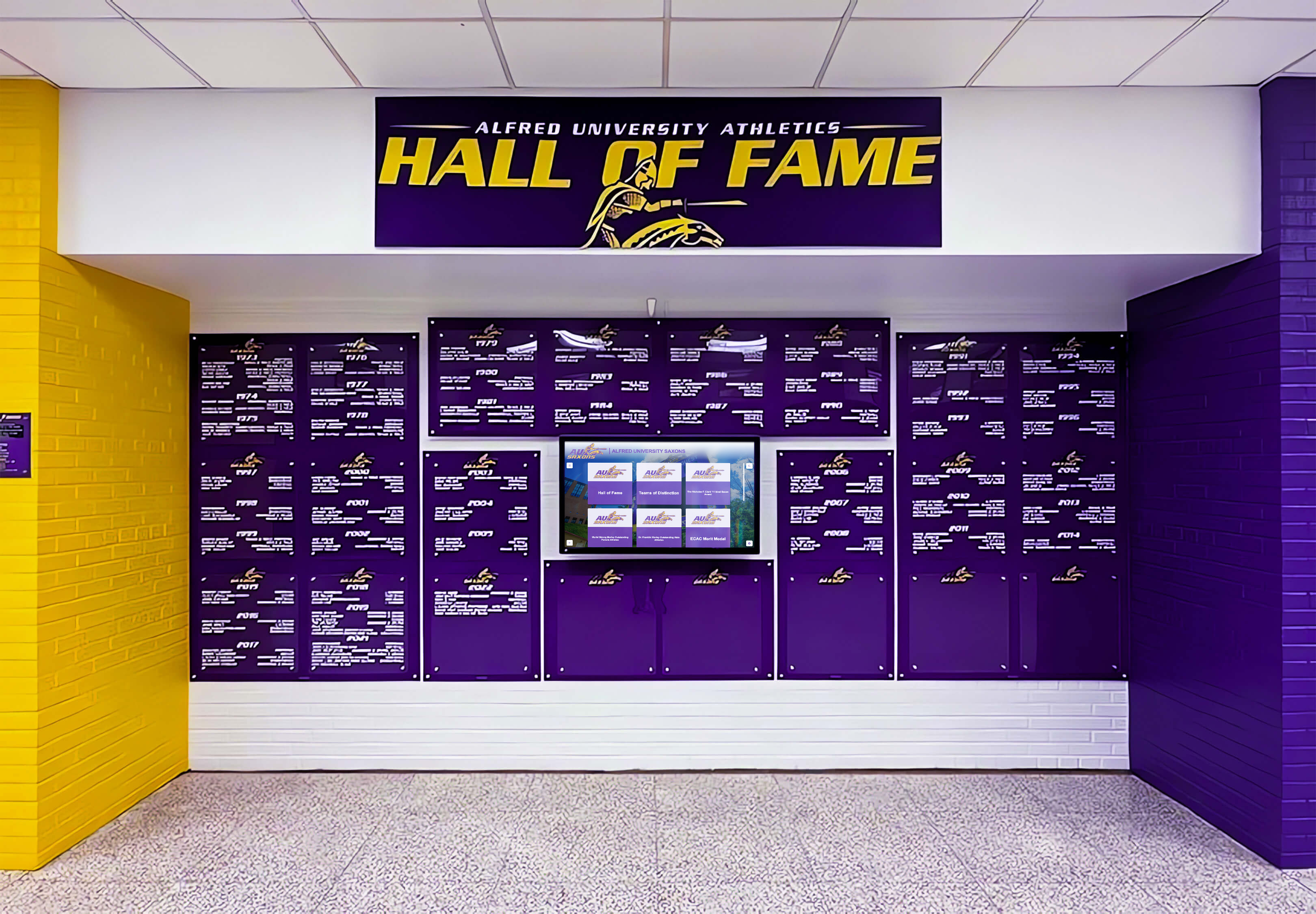
Purple and violet school colors sit in the hue-angle region where CIEDE2000 applies its rotation correction — a ΔE₀₀ value of 3.0 for a purple school color represents a more perceptually significant difference than the same value for a mid-range green or gold, making tighter tolerance targets appropriate for purple primary colors
Navy and royal blue. The CIEDE2000 rotation term applies directly to these hue angles (approximately 240°–290° in a*b* space). Navy and royal blue proofs should be held to ΔE₀₀ ≤ 2.5 where possible — one unit tighter than the commercial standard — because the formula’s perceptual correction means a ΔE₀₀ of 3.0 in this region is more visually apparent than the same value for other hues.
Maroon and cardinal red. These colors sit outside the blue rotation zone but occupy a region of low L* where the lightness weighting function (SL) increases sensitivity. A maroon proof with ΔE₀₀ = 3.5 concentrated in the ΔL* dimension — too light or too dark — will be more perceptible than a ΔE₀₀ = 3.5 difference in the hue direction. Evaluate ΔL* and ΔC* separately when maroon or cardinal proofs approach the 3.0 threshold.
Forest and kelly green. Green hues sit near the peak of human visual sensitivity. The eye detects small hue shifts in green — toward olive or toward teal — very readily. Forest green proofs should meet ΔE₀₀ ≤ 3.0, with particular attention to the ΔH* component: even a small hue rotation in green toward yellow or blue is visible against a uniform reference field.
Purple and violet. These colors combine the blue rotation term and the high-chroma sensitivity, making them the hue family that benefits most from CIEDE2000 measurement rather than visual comparison or ΔE76. Purple proofs at ΔE₀₀ = 3.5 are typically visible when compared against a reference panel in the same corridor under institutional lighting. Hold purple primary colors to ΔE₀₀ ≤ 2.5 and document any deviation by direction before approving production.
Gold and amber. Yellow-adjacent colors present a different sensitivity profile: lower chroma discrimination at high lightness, but significant hue sensitivity to green-versus-orange shifts. A gold proof that reads ΔE₀₀ = 4.0 concentrated entirely in the hue direction — more orange than the reference — will be visible against existing gold shield panels or uniform trim. Evaluate gold by ΔH* direction specifically.
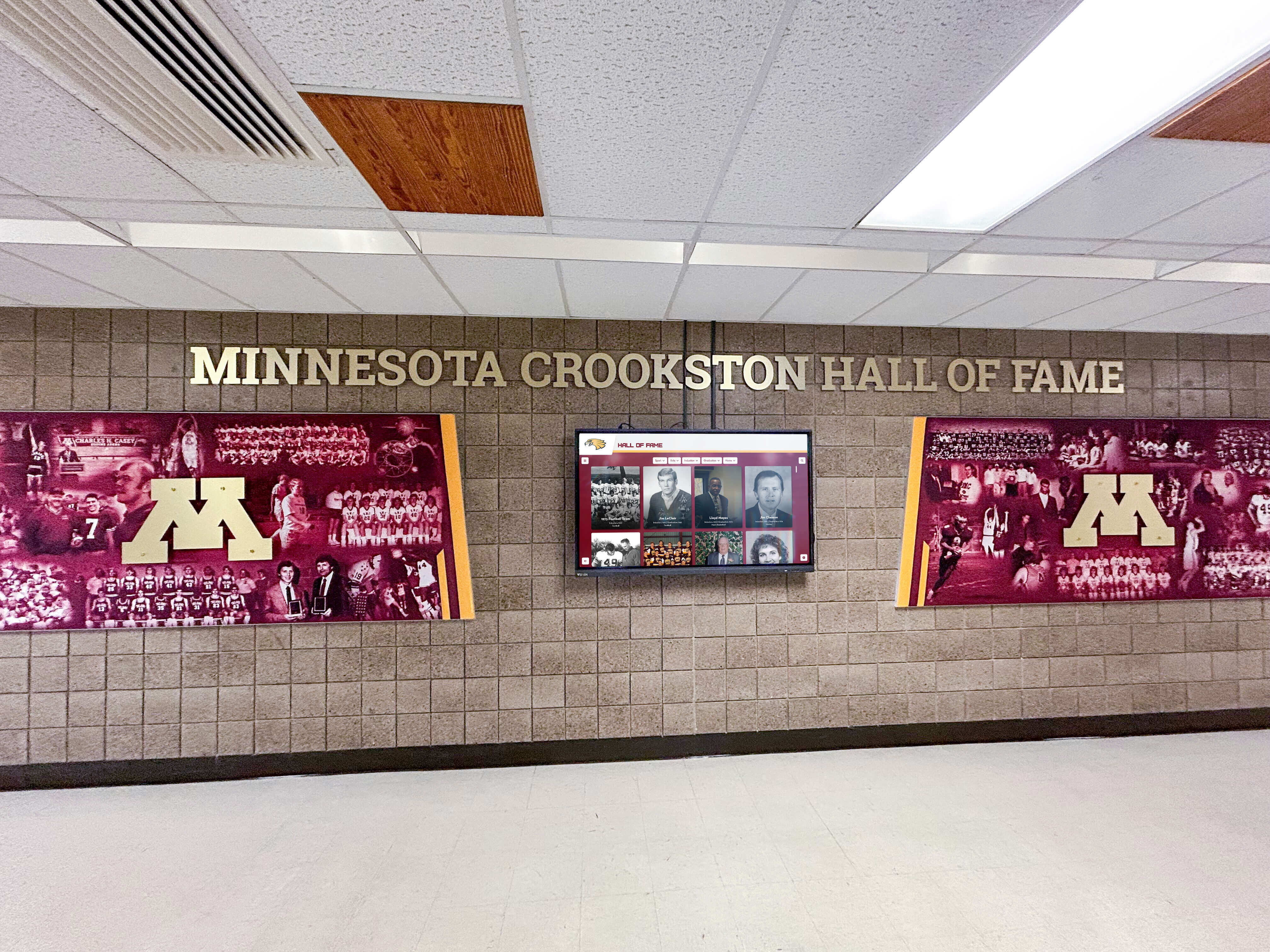
Maroon and dark-red school color families occupy a low-lightness region where CIEDE2000's SL weighting function increases sensitivity to lightness differences — a proof evaluation that includes per-component analysis (ΔL*, ΔC*, ΔH*) catches the direction of deviation and gives the vendor actionable correction guidance
CIEDE2000 Proofing in the Broader Championship Banner Preflight Workflow
CIEDE2000 color-difference proofing is the quantitative color verification step; it depends on and complements several other preflight disciplines that address different failure modes in the same production workflow.
Spectrophotometer calibration is a precondition: an uncalibrated instrument produces L*a*b* readings that make CIEDE2000 calculations meaningless. A spectrophotometer calibration check before color proofing takes fewer than two minutes and is required at the start of every measurement session.
Spot color setup defines the color standard that CIEDE2000 measures against. A spot color setup for championship banner files that assigns correct PMS values and converts them to an accurate L*a*b* target ensures the reference values entering the CIEDE2000 checklist are authoritative rather than estimated.
Metamerism proofing addresses a failure mode CIEDE2000 does not: a proof that measures ΔE₀₀ ≤ 3.0 under standard illumination may still show a visible color shift under the gymnasium’s specific fluorescent or LED fixture. A championship banner metamerism proofing checklist evaluates the physical proof under the actual installation illuminant, supplementing the numerical CIEDE2000 result with an on-site perceptual evaluation.
Rendering intent affects how out-of-gamut school colors are mapped to the printable range. A rendering intent preflight for championship banners confirms the correct rendering intent is applied in the production ICC profile so that saturated school colors are reproduced as accurately as the output device allows — giving the CIEDE2000 measurement the best possible starting point.
For school programs managing digital recognition displays alongside printed championship banners — a common configuration in schools that have added digital signage adjacent to banner installations — CIEDE2000 measurement establishes the printed banner’s color numerically so that the digital display can be calibrated to match the same L*a*b* target. This is the only way to achieve color consistency between a reflective print and an emissive display in the same corridor without side-by-side visual adjustment.
Schools that extend their recognition programs beyond athletics into honor roll, academic achievement, and community recognition benefit from the same CIEDE2000 documentation discipline: a structured approach to honor roll and award display categories that includes printed recognition materials can use the same color tolerance records established for championship banners to keep printed certificates, plaques, and displays visually consistent with the school’s color standard across every recognition format.
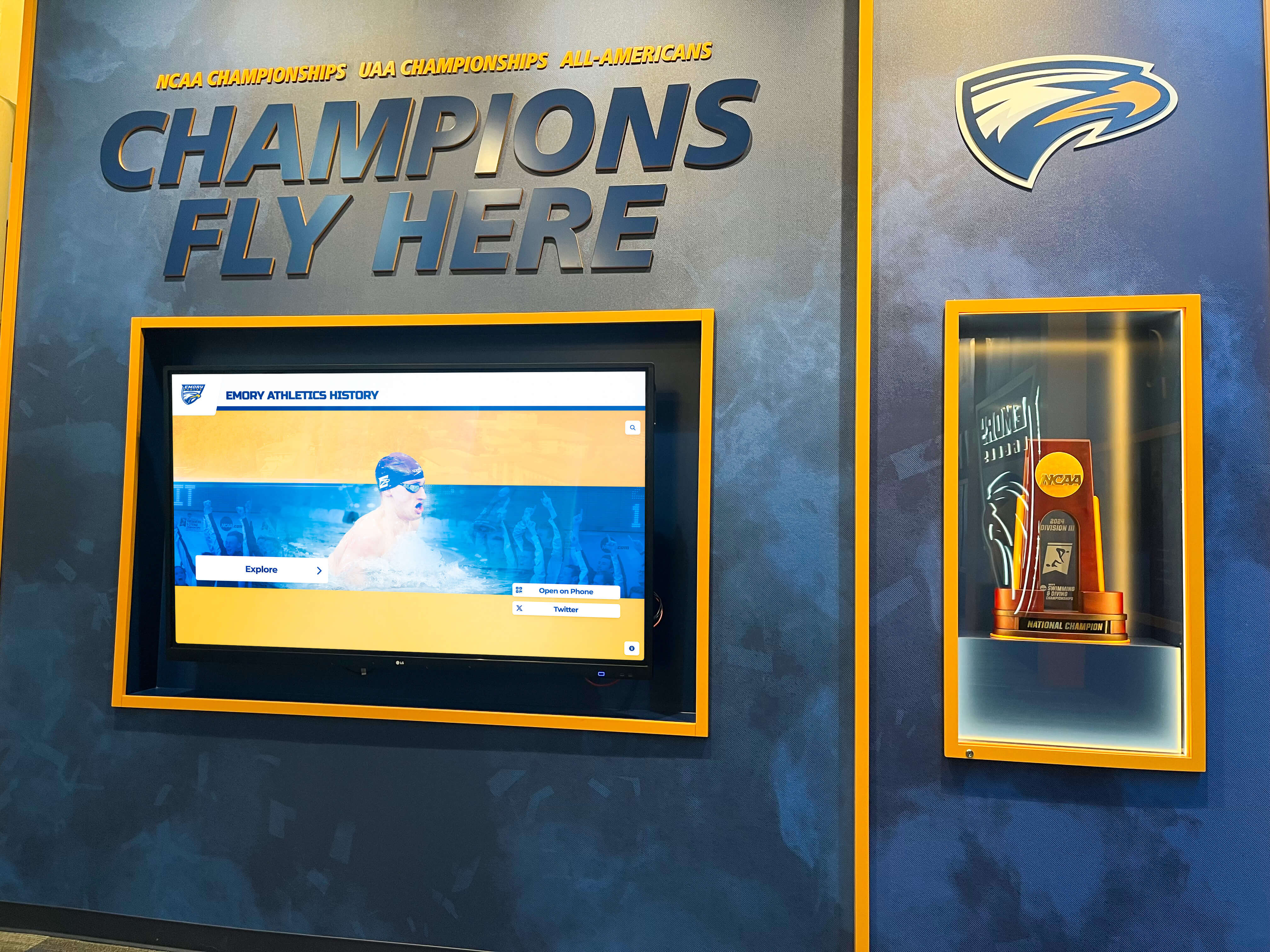
Multi-sport championship recognition programs accumulate banners from many vendors and production years — a CIEDE2000 measurement record for each approved proof creates the quantitative color standard that ensures visual consistency across the full installation regardless of when or by whom each banner was produced
Schools that have invested in digital recognition environments alongside their printed banner programs — digital art gallery displays, alumni portraits, and multi-format recognition content — can apply the same ΔE₀₀ measurement framework to verify that printed and digital elements reproduce the school’s colors within a consistent tolerance across all output types. A school navy measured at L* = 22, a* = −1, b* = −28 on a calibrated banner proof can be specified as a target for the adjacent digital display calibration, eliminating the guesswork of visual matching between reflective and emissive formats.
Institutions building long-term campus recognition environments — including letterman jacket traditions, hall of fame displays, and multi-decade athletic archives — benefit from the same CIEDE2000 documentation practice that serves championship banner production: a numerical color standard recorded at each production milestone creates a historical color record that connects each future recognition output to the school’s established visual identity.
Frequently Asked Questions: Championship Banner CIEDE2000 Color-Difference Proofing
What is CIEDE2000 and why is it used for championship banner color proofing?
CIEDE2000 (ΔE₀₀) is a color-difference formula published by the International Commission on Illumination in CIE 142:2001. It calculates a single number representing the perceptual difference between two colors measured in CIE L*a*b* space, accounting for known non-uniformities in human color perception across different hue regions, lightness levels, and chroma levels. For championship banner proofing, it is preferred over earlier formulas (ΔE76, ΔE94) because it is more sensitive to shifts in blue and violet school colors and matches the tolerance thresholds used in ISO 12647 and G7 commercial print standards.
What ΔE₀₀ value is acceptable for approving a championship banner proof?
A ΔE₀₀ value of 3.0 or below for each primary school color is the standard pass threshold for championship banner proofing. Values between 3.0 and 5.0 are borderline and require vendor explanation before production is authorized. Any primary school color measuring ΔE₀₀ above 5.0 is an unambiguous fail — the proof should be rejected and a corrected proof requested. Secondary and accent colors may be evaluated at a relaxed threshold of ΔE₀₀ ≤ 4.5.
How do I get L*a*b* reference values for my school’s colors?
L*a*b* reference values can be obtained from three sources: Pantone’s published spectral data (if your school’s colors are defined by PMS numbers), spectrophotometer measurement of an approved physical reference — such as an existing championship banner, current uniform, or Pantone fan deck chip — or the vendor’s color library if they have measured your school’s colors in prior approved production runs. All reference measurements should be taken under a consistent illuminant condition (typically M1, D50) and documented with the measurement date and source material.
Do I need a spectrophotometer to do CIEDE2000 color proofing for championship banners?
Yes — a CIEDE2000 calculation requires L*a*b* color measurements that can only be obtained with a spectrophotometer or colorimeter. Alternatively, many championship banner vendors will provide a color measurement report with ΔE₀₀ values alongside the physical proof if the school includes L*a*b* reference values and tolerance requirements in the proof request. Requesting this report from the vendor is the most practical option for schools that do not have in-house color measurement equipment.
Can CIEDE2000 proofing replace visual color evaluation for championship banners?
No — CIEDE2000 proofing and visual evaluation serve different purposes and should both be completed. CIEDE2000 provides an objective, repeatable numerical threshold independent of lighting conditions and observer variation. Visual evaluation under the gymnasium’s actual illuminant catches illuminant metamerism shifts — cases where a proof within ΔE₀₀ tolerance under standard illumination shows a visible shift under the gymnasium’s fluorescent or LED fixtures. A complete championship banner color proofing workflow includes both CIEDE2000 measurement for numerical pass/fail and on-site visual evaluation for illuminant metamerism.
Every Championship Banner Proof Deserves a Numerical Color Standard
A championship banner CIEDE2000 color-difference proofing checklist replaces “close enough” visual judgment with a documented, repeatable measurement — one that survives staff turnover, vendor changes, and multi-year banner programs where each new banner must match those installed a decade earlier. The workflow is straightforward: establish L*a*b* reference values from Pantone data or an approved physical reference, include tolerance specifications in the proof request, measure the physical proof with a calibrated spectrophotometer, calculate ΔE₀₀ for each school color, apply the tolerance table, and archive the measurement report before authorizing production.
The athletes recognized on each championship banner earn a color standard that holds across every production run. A ΔE₀₀ record for each approved proof is how that standard is documented, communicated to vendors, and maintained across the full life of the recognition program.
Generate Championship Banner Artwork with School Colors Already Set
Rocket Graphics is building an AI-powered platform to help school staff create championship banner graphics with accurate school colors from the first draft — reducing proof iterations and giving your vendor a color-accurate file to measure against from the start.
Get notified when Rocket Graphics opens.