Every championship banner starts as a blank one — a set of decisions about what information to include, how to present it, where it hangs, and what happens to the context that doesn’t fit on fabric. Schools that approach a blank championship banner as a design-and-print task often discover too late that the harder work is upstream: gathering accurate historical data, standardizing field formats, and deciding which championships belong on a physical banner versus a digital display. This guide covers the planning decisions that determine whether a banner documents program history the way it deserves to be documented.
Why Filling a Blank Championship Banner Requires Decisions, Not Just Data Entry
A championship banner template with blank fields looks like a simple form. In practice, filling it accurately requires several decisions that, once printed in vinyl or fabric, cannot be changed without reordering:
- Which championship types earn a banner (district, regional, state, national, conference)?
- Does each sport get its own banner series, or does the gymnasium display a unified year-by-year format?
- Are coach names included? What about records?
- How do you handle titles won before official records were kept?
- What team levels are included — varsity only, or JV and freshman titles as well?
These decisions are almost never documented formally before a school orders its first run of banners. The result is inconsistency: a gymnasium where some banners include coach names and others do not, where some show the final season record and others show only the year, where banner dimensions vary by decade because each era’s athletic director made different choices.
Championship banners for gyms represent some of the most permanent communications a school produces — planning the fields before printing prevents errors that hang on the wall for thirty years.
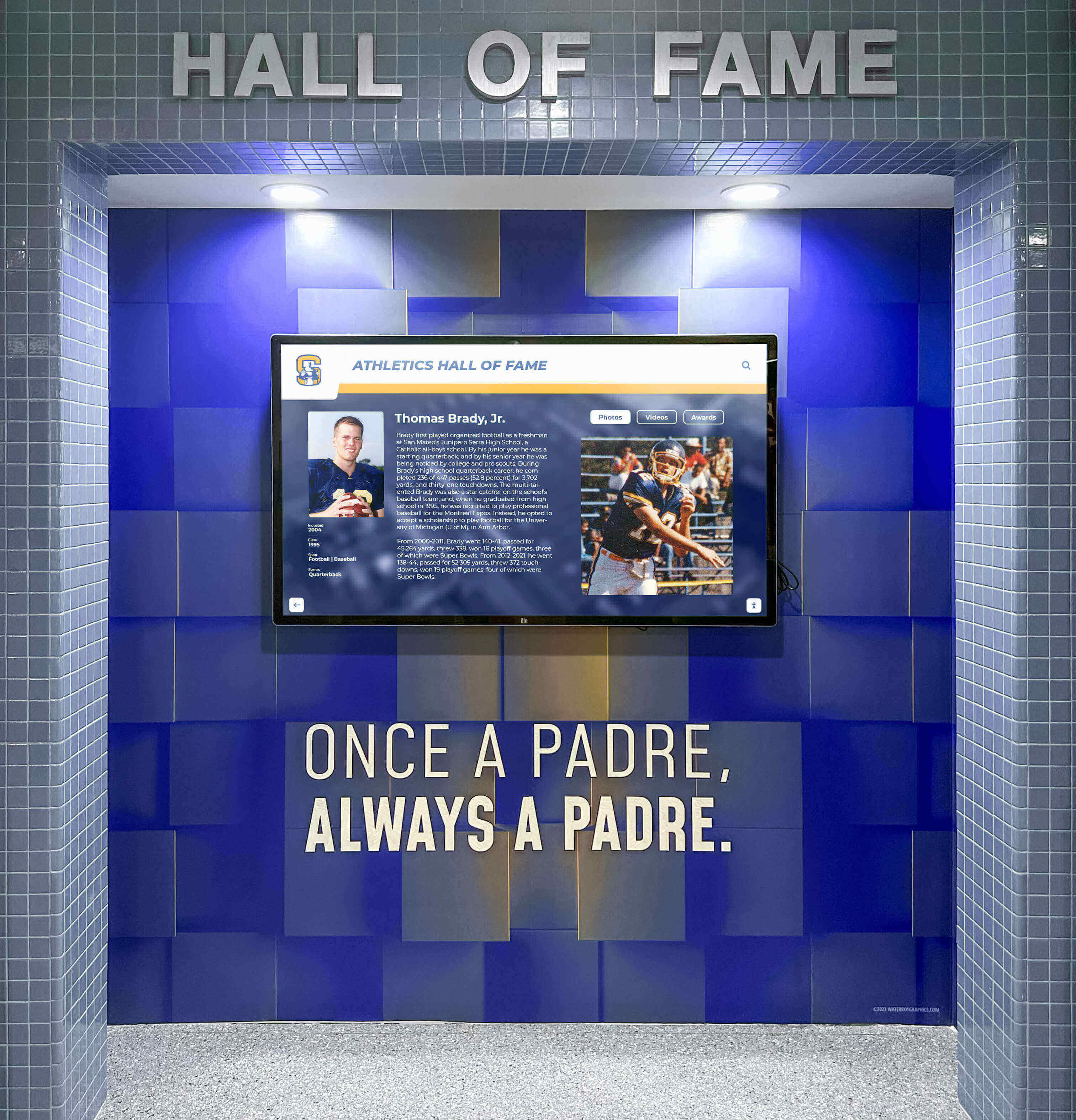
A digital display alongside physical recognition surfaces creates the planning question every school must answer: what belongs on the physical banner, and what belongs in the digital environment where information can expand over time?
The Fields That Belong on a Championship Banner: A Reference Table
Before ordering or designing a blank championship banner, every school should document which fields will appear on every banner in the series — and which are optional or excluded. The table below covers the standard and optional fields for physical gymnasium championship banners.
| Field | Standard | Optional | Notes |
|---|---|---|---|
| Sport name | ✓ | Include gender and team level: “Varsity Girls Basketball” | |
| Championship type | ✓ | District / Regional / State / Conference / National | |
| Year (four-digit) | ✓ | Primary data point — largest text on the banner | |
| School name or mascot | ✓ | Mascot logo version often preferred over full school name | |
| School colors | ✓ | Use official brand hex codes, not vendor defaults | |
| Final season record | ✓ | Common on state and national championship banners | |
| Coach’s name | ✓ | Decide once for the series — include on all or none | |
| Conference / organization | ✓ | IHSA, NFHS regional classification, conference name | |
| Classification / division | ✓ | For state championships that separate by enrollment size | |
| Number of consecutive titles | ✓ | “4 Consecutive State Titles” if relevant to the banner |
The most common planning mistake is deciding field by field on each new banner rather than locking in the field set for the entire series. A state championship banner with no coach name next to a state championship banner with a coach name hanging in the same gymnasium forces visitors to ask which is the “right” format — and the answer is that neither is, because the standard was never set.
Decisions to Make Before Ordering a Physical Banner
Location and Installation Requirements
Before you finalize size and material, confirm where the banner will hang. A banner mounted at 20 feet on a gymnasium beam has different size requirements than one mounted at 35 feet near the apex — and a banner ordered without measuring the available wall space may not fit the mounting hardware already in place.
For schools working through installation logistics, how to hang championship banners — installation tips for school gyms covers the hardware, mounting methods, and clearance considerations that determine workable banner dimensions before the design order is placed.
Key location questions to answer before filling in the blank championship banner template:
- What is the mounting height?
- Is this wall shared with other banner series, or dedicated to one sport?
- What mounting hardware is in place — grommets on existing banners suggest a grommet-and-cable system; no hardware means starting from scratch
- Is the space indoor climate-controlled, or does humidity and temperature variation affect material choice?
Material and Printing Specifications
Physical championship banners for gymnasium environments are typically printed on scrim vinyl, knit fabric, or polyester mesh. Each has different durability, weight, and glare characteristics under gymnasium lighting.
For schools comparing materials and vendors before ordering a custom championship banner, high school championship banner printing costs, materials, and vendor comparison provides a structured comparison across the most common production options — useful before committing to a vendor or material for an entire series.
Typography and Color Specifications
The typography decisions made for a blank championship banner affect every banner ordered in that series. Document them before the first order:
- Primary font for championship year (must be readable from the gym floor at full mounting height)
- Secondary font for sport name and championship type
- Official color hex codes — not “navy” or “maroon,” but the exact codes your school uses for all branded materials
- Minimum letter height at production size (see the 10-foot rule: 1 inch of letter height per 10 feet of viewing distance)
If your gymnasium already has an established banner series, match its typographic conventions exactly — visual continuity across decades reads as program tradition, while a visually inconsistent series reads as a collection of unrelated events.
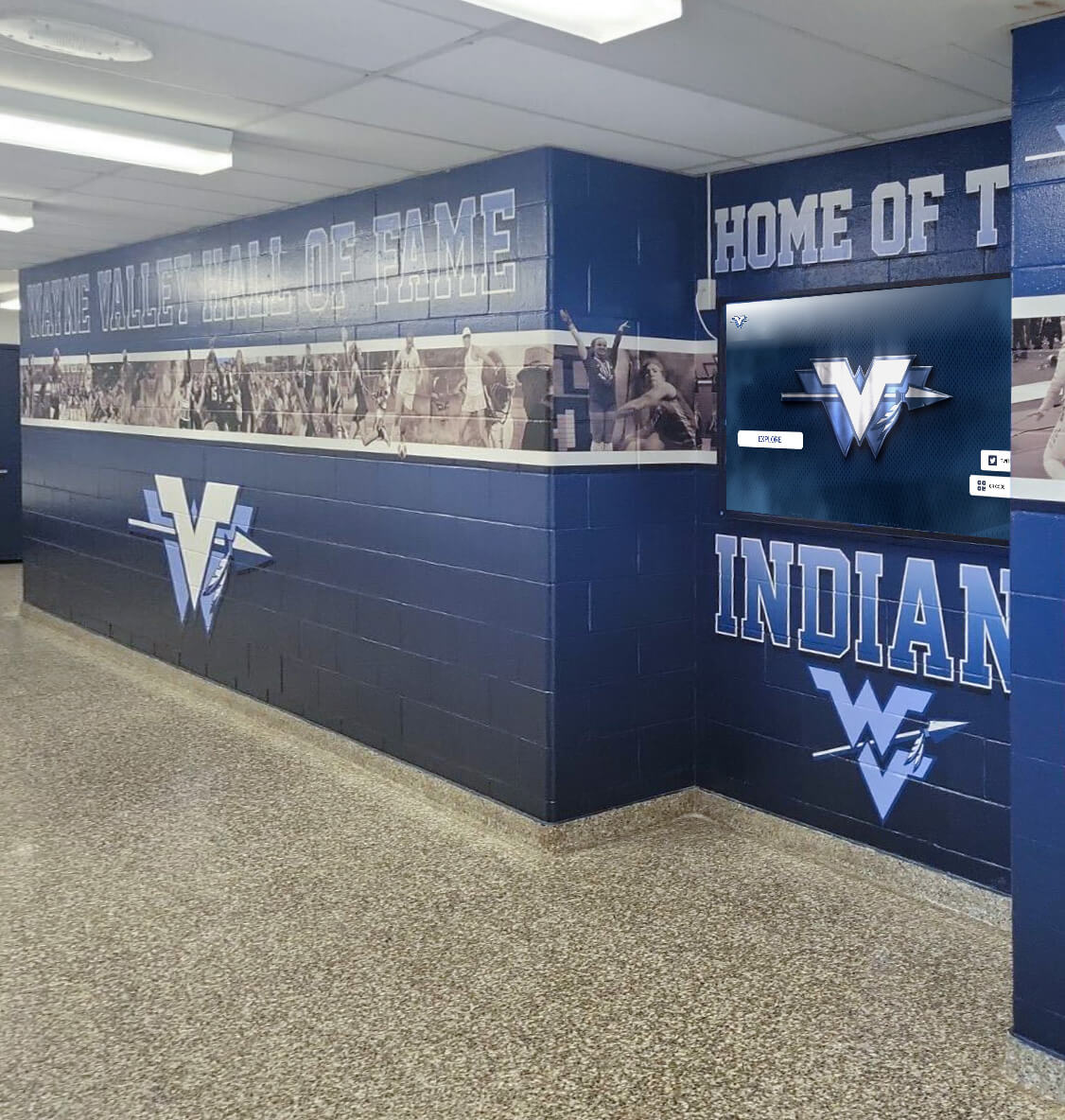
A consistent series of championship recognition across multiple seasons requires standardizing the field set, typography, and color treatment before filling in any blank championship banner template — visual coherence across decades communicates program history more powerfully than any individual banner
Decisions to Make Before Digitizing Championship Titles
A physical blank championship banner template holds limited information — space forces brevity. Digital displays have no such constraint. Before digitizing championship titles, schools need to decide what the expanded digital entry will contain beyond the basic banner fields.
What Additional Context Belongs in the Digital Record
Digital championship records — whether in a touchscreen hall of fame, a corridor display, or an online athletics archive — can carry information that a physical banner cannot:
- Complete season roster: Every player who contributed to the championship, not just the starting lineup
- Season statistics: Key team stats that define the championship season
- Coaching staff: Full coaching staff, not just the head coach
- Game-by-game playoff run: The path to the title — opponents, scores, rounds
- Photography: Team photos, celebration photos, action images from the championship game or meet
- Historical context: First championship in program history, how many years since the last title, records broken during the season
For schools designing gymnasium wall displays that combine championship banners and record boards, planning the physical and digital fields together — before either is designed — prevents content from being trapped in one format when it belongs in both.
Organizing Historical Championships Before Digitizing
Digitizing championship titles is harder than entering current-year data. Historical records may be incomplete: coaches who are no longer at the school, season statistics stored in paper rosters in a storage room, photographs that have never been digitized.
A practical first step before digitizing any historical championship data is a documentation audit — a structured pass through every available source:
- Paper yearbooks from championship years (portraits, team photos, season summaries)
- Athletic department archives and record books
- Local newspaper archives for game coverage and final standings
- Former coaches or players who can confirm roster details and correct errors
School banner ideas for creative designs in halls, gyms, and digital walls of fame covers how other schools have approached the documentation and display challenge when organizing historical athletic achievement for both physical and digital surfaces.
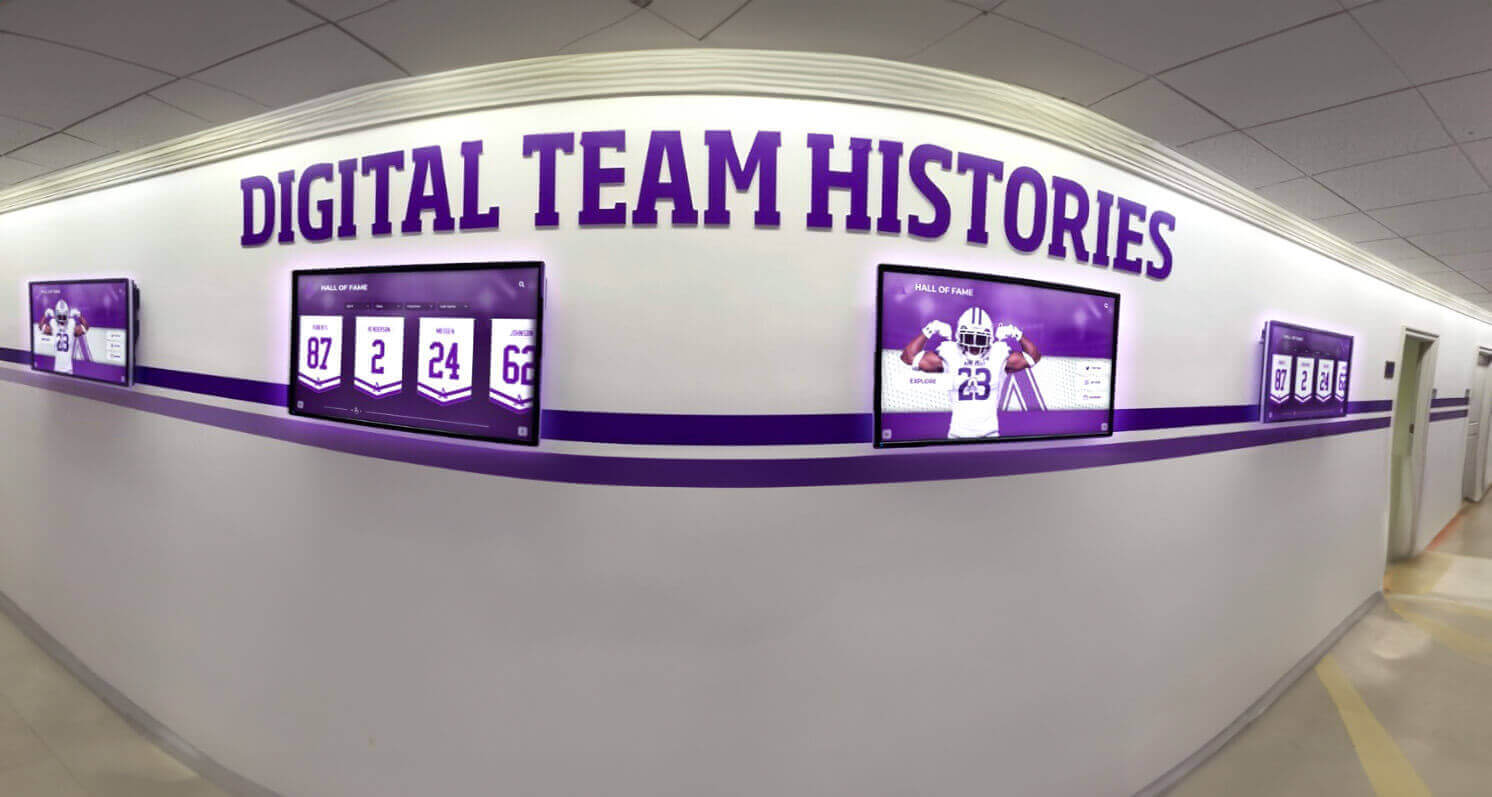
Digital corridor displays can present championship seasons with roster depth, season photography, and historical context that a physical banner cannot accommodate — planning which fields go in each format determines how complete the long-term record becomes
Physical Banner vs. Digital Display: Deciding What Belongs Where
Many schools treat the physical championship banner as the primary record and the digital display as a supplement. A more useful framework is to treat them as complementary formats serving different audiences:
| Information Type | Physical Banner | Digital Display |
|---|---|---|
| Championship year and type | ✓ Required | ✓ Required |
| Sport and team level | ✓ Required | ✓ Required |
| School colors and logo | ✓ Required | ✓ Required |
| Coach name | Optional (once for series) | ✓ Recommended with full staff |
| Final record | Optional | ✓ Recommended |
| Full season roster | — Not feasible | ✓ Core content |
| Season photographs | — Not feasible | ✓ Core content |
| Playoff path / bracket results | — Not feasible | ✓ Valuable context |
| Search and filter by sport/year | — Not feasible | ✓ High value for archives |
| Update without reprinting | — Not possible | ✓ Key advantage |
School gym banners: what to hang, rotate, and move to a digital display addresses one of the most common questions schools face as gym wall space fills: when do physical banners get moved to storage, and how does a digital display take over as the permanent record for older championships?
For schools managing limited gymnasium wall space alongside an expanding championship history, championship banners, gym wall space, and digital solutions covers practical approaches for maintaining physical banner traditions while moving the deep historical archive into a digital environment.
Turn Your Championship Archive Into a Year-Round Recognition Environment
Rocket Alumni Solutions builds touchscreen halls of fame, digital record boards, and corridor recognition displays that hold everything a blank championship banner template cannot — full rosters, season photography, playoff histories, and searchable archives your entire school community can explore.
Get notified when Rocket Graphics opensChampionship Banner Planning Checklist
Use this checklist before ordering a blank championship banner template or beginning a digitization project for historical championship titles.
Before Printing a Physical Championship Banner
Define the field set (apply to the entire series):
- Confirm which championship types earn a physical banner (district, regional, state, national, conference)
- Decide whether coach names are included — and commit to that decision for the full series
- Decide whether season record appears — and commit for the full series
- Confirm whether classification or division is included for state championships
- Document the official field set in writing for future athletic directors
Confirm installation logistics:
- Measure available wall space and confirm banner dimensions that fit
- Identify mounting hardware type (cable system, grommets, wall brackets)
- Confirm mounting height and calculate minimum letter heights accordingly
- Verify material choice is appropriate for gymnasium environment (temperature, humidity, lighting)
Finalize design specifications:
- Pull official school color hex codes from the brand standards document
- Select or match the font used by the existing banner series
- Confirm the logo version to use (athletics wordmark, primary mascot, simplified crest)
- Request a print proof before ordering a full production run
Verify data accuracy:
- Confirm championship year with official league or state athletic association records
- Verify coach name spelling (include assistant coaches if the field is used)
- Cross-check final season record against official athletic association records
- Confirm sport and team level language matches existing banners in the gymnasium
For a broader view of how schools approach digital banner recognition alongside physical championship banners, reviewing how other programs structure the physical-digital pairing can inform decisions before any blank template is filled.
Before Digitizing Championship Titles
Gather source data:
- Pull yearbooks for every championship year to be digitized
- Locate official league or state association records to verify years and classifications
- Identify all available photographs from each championship season
- Contact former coaches or players for seasons where records are incomplete
- Cross-reference local newspaper archives for coverage of championship games
Define the digital record fields:
- Confirm fields that match the physical banner (year, sport, championship type)
- Confirm expanded fields unique to the digital record (roster, statistics, photos, playoff path)
- Set a consistent format for season records (W-L or W-L-T)
- Establish naming conventions for photograph filenames linked to athlete names
Plan the display environment:
- Identify where digital championship records will be displayed (touchscreen kiosk, corridor screen, online archive, or all three)
- Determine whether the digital display will replace or supplement physical banners for older championships
- Plan annual update workflow — who updates the digital record, and when, after each championship season
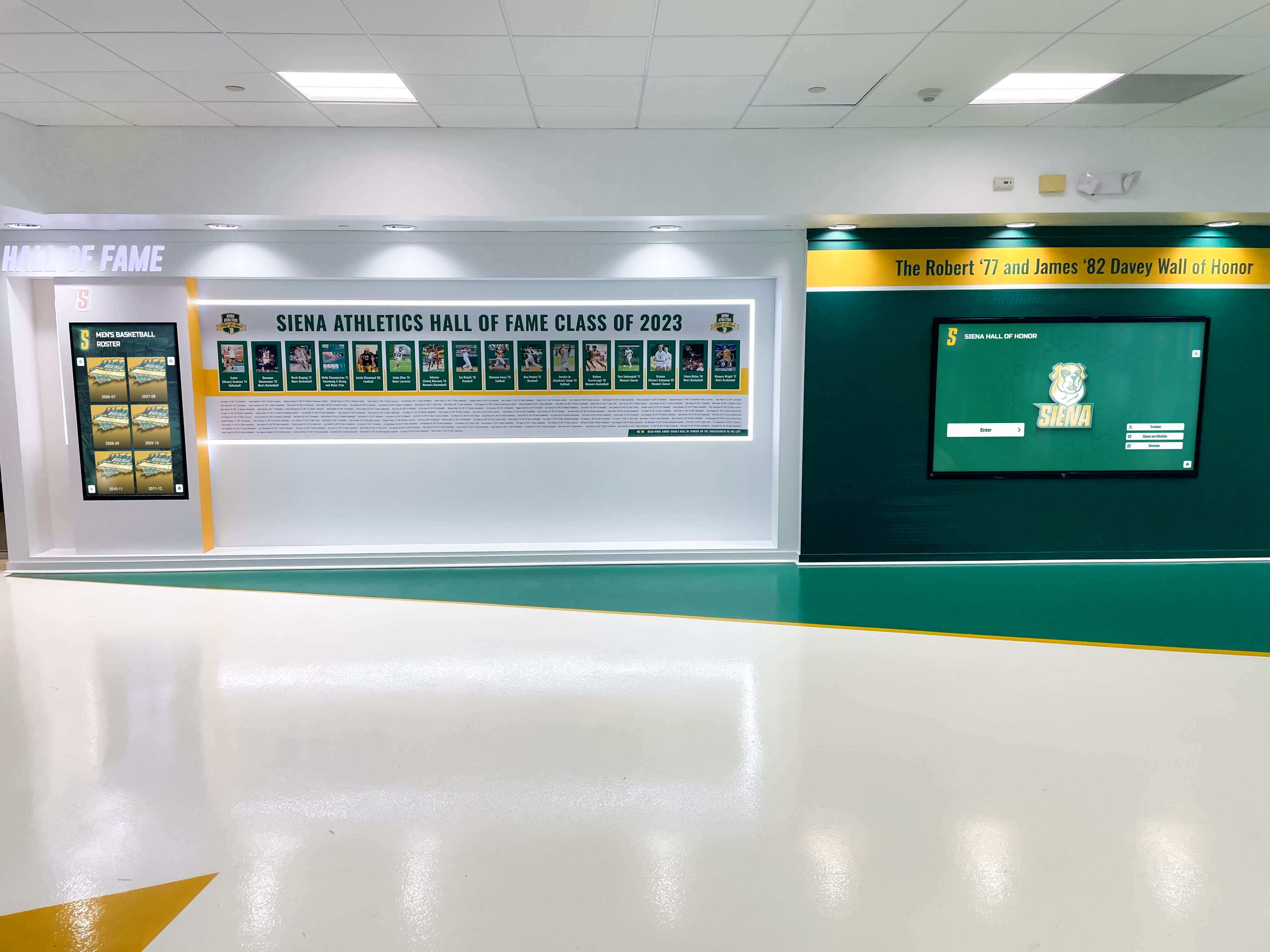
The most effective championship recognition environments combine the permanent visibility of a physical banner series with the contextual depth of a digital display — planning both formats before filling in any blank championship banner template produces a complete, lasting record
Connecting the Physical and Digital Records Over Time
The planning decisions made before filling a blank championship banner template have consequences that extend beyond the current season. A school that documents its field set, establishes its typography standards, and builds a parallel digital record beginning with this year’s championship creates a system that accumulates value over time — each year’s addition strengthens the archive rather than adding a disconnected entry.
Schools that skip this planning phase produce the opposite: a gymnasium where banner formats have changed four times in twenty years, where some sports have three decades of consistent documentation and others have a gap, and where the transition from physical to digital happened reactively rather than as a deliberate extension of the recognition program.
Championship banners and digital recognition solutions covers how other athletic programs have approached the long-term documentation challenge — particularly for schools that are beginning a digitization project for older championships where physical records are the only source.
For schools with touchscreen hall of fame installations already in place, the championship planning checklist above functions as a content inventory — confirming which seasons have complete digital records and which still have gaps to fill before the archive is accurate.
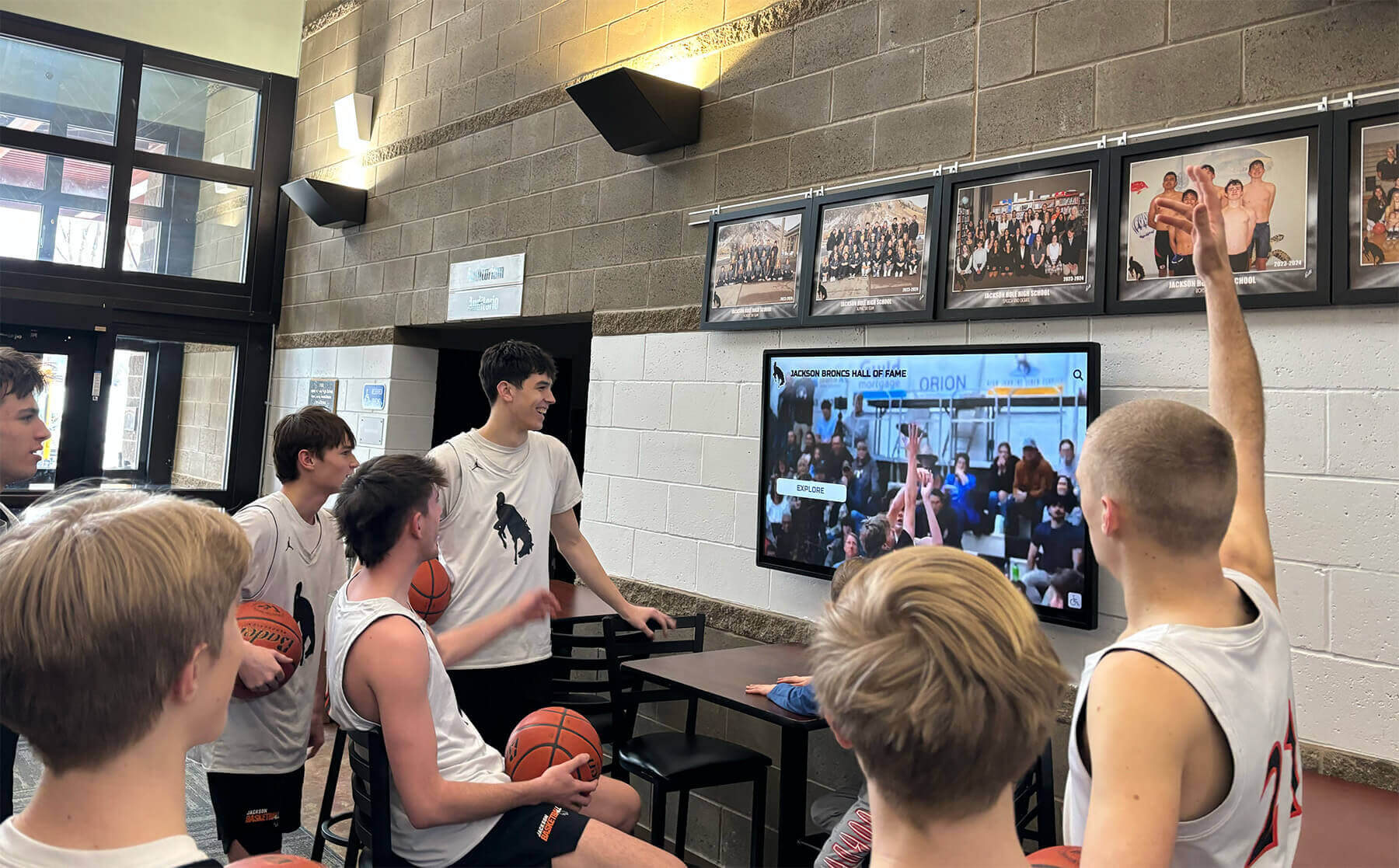
A recognition environment where current athletes can view their program's championship history with full season context — roster, photographs, and records — serves student motivation and institutional memory in ways that the physical blank championship banner template alone cannot achieve
Frequently Asked Questions About Championship Banner Planning
What information should be on a blank championship banner template?
A championship banner template should include fields for sport and team level, championship type, the four-digit championship year, and the school name or mascot logo in official school colors. Optional fields include the coach’s name, final season record, and the governing organization’s name. The key is locking in the same field set for every banner in the series before the first banner is printed — inconsistency across a gymnasium’s banner collection looks unintentional and creates questions about which format is “official.”
What size should a championship banner be for a school gymnasium?
Championship banner size depends on mounting height. The guideline: 1 inch of letter height per 10 feet of viewing distance. A banner at 20 feet needs primary text at least 2 inches tall; at 35 feet near the apex, at least 3.5 inches. Common dimensions are 2’ × 4’ to 3’ × 6’. Always measure available wall space and confirm mounting hardware before finalizing dimensions.
Should championship titles go on physical banners or digital displays?
Physical banners and digital displays serve complementary roles. Physical banners provide permanent gymnasium visibility — readable from the floor at every game and practice. Digital displays carry what a printed banner cannot: full rosters, photographs, playoff results, and searchable archives. Schools with limited wall space often maintain physical banners for recent championships and migrate older titles to digital displays.
How do you verify historical championship data before filling a blank championship banner?
Verify against official state or league athletic association records, school yearbooks from championship years, and local newspaper archives. For older championships, former coaches or players can fill gaps that official records don’t capture. Never print a banner based on informal recollections alone — verify against a documentary source before the order is placed.
What is the difference between a blank championship banner template and a custom championship banner order?
A blank template is a pre-designed layout with fields left empty for the school to fill in. A custom order starts from the school’s own design files and brand specifications. Custom orders match existing gymnasium banner series more precisely, but require the school to own or create the design files. For schools establishing a new series, a custom order that locks in the school’s specific field set and typography is usually worth the additional production cost.
Planning Prevents Permanent Errors
A blank championship banner template is, in practice, a prompt for decisions that most schools have never formally documented. What information belongs on every banner in the series? Who verifies the data before it’s sent to print? Where does information go that doesn’t fit on fabric — the full roster, the photographs, the playoff path that defined the season?
Schools that plan before printing produce a gymnasium that reads as a coherent, authoritative record of program history. Schools that plan before digitizing produce an archive that grows more complete each year rather than accumulating gaps. The blank template is where those decisions get made — or where they get skipped, and the consequences hang on the wall for decades.
Build a Championship Archive That Lasts Beyond the Banner
Rocket Alumni Solutions builds touchscreen halls of fame, digital record boards, and corridor recognition displays that carry the full championship record — rosters, photographs, season context, and searchable archives — alongside the physical banner tradition your gymnasium has maintained for decades.
Get notified when Rocket Graphics opens