Walk the hallways of any high school with a strong athletic culture and you’ll likely spot the same recognition gap: the trophy case honors a handful of champions, the hall of fame plaques celebrate individual standouts, but the team photos—if they exist at all—are crammed onto a bulletin board or stacked in a coach’s office. The best athletic team photo wall ideas close that gap by creating dedicated, well-designed displays that recognize every player on every roster, not just the stars who earned individual accolades.
Team photo walls do something that trophies and records boards can’t: they put faces to the tradition. A student looking at a 2007 state championship banner sees an abstract achievement. The same student looking at the 2007 team photo sees forty teammates who built something together—and sees themselves potentially joining that lineage. That shift from abstraction to recognition is what makes team photo displays one of the most valuable and underutilized tools in high school athletic facilities.
This guide covers the full range of athletic team photo wall ideas—from traditional framed composite galleries to multi-sport hallway timelines to interactive digital walls—along with practical guidance on organization, design, and long-term sustainability.
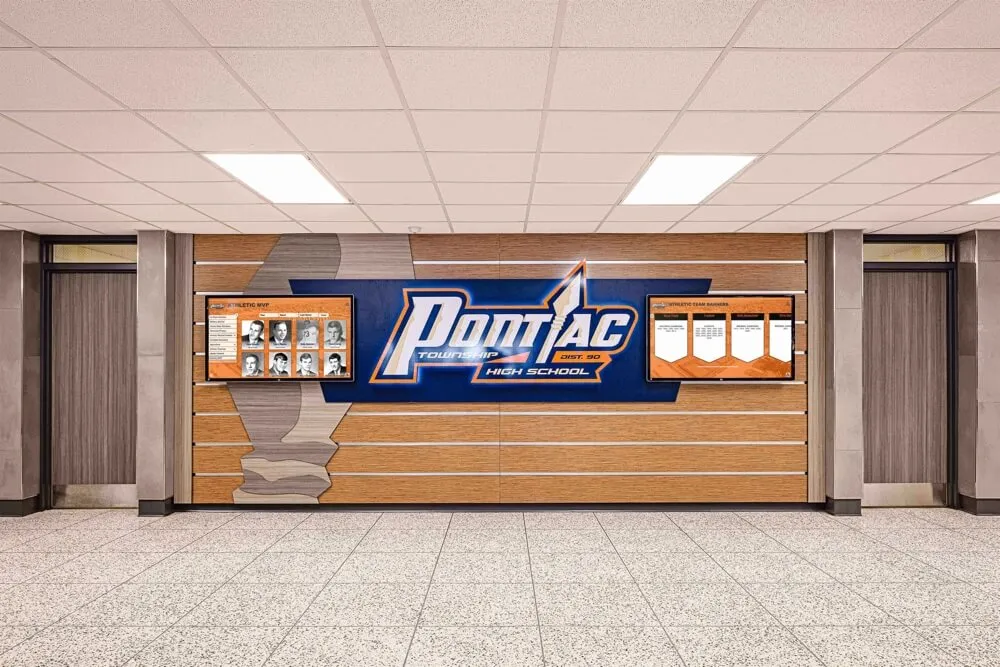
A dedicated athletic honor wall recognizes entire rosters alongside champions and record holders
Why Athletic Team Photo Wall Ideas Matter for School Culture
Recognition investment pays dividends beyond athletics. The National Federation of State High School Associations (NFHS) has published consistent findings showing that high school athletes graduate at significantly higher rates than non-participants—and that schools which visibly recognize athletic participation report stronger student engagement metrics across the full student body, not just among athletes.
The mechanism matters: recognition that scales to include every roster member, rather than exclusively honoring top performers, creates a sense of institutional belonging that motivates continued participation and sustained commitment. According to NFHS participation data spanning multiple decades, the schools with the most robust recognition cultures also tend to sustain the broadest athletic program participation across grade levels and sports.
Team photo walls deliver that visibility at roster scale. Unlike individual trophies or MVP awards, a well-executed team photo display recognizes every person who showed up, practiced hard, and competed. The starting point guard and the JV player who logged two minutes of game time both appear in the team photo. Both names appear on the wall. That inclusivity matters—especially for the significant portion of roster members who will never appear in any other recognition context.
Well-designed indoor sports facility spaces incorporate recognition infrastructure from the planning stage rather than adding it as an afterthought. Schools that think holistically about where team photos will live—and how they’ll be updated, lit, and accessed—create recognition environments that last decades rather than requiring replacement after a few seasons.
What Visitors and Recruits Actually Notice
Beyond current student experience, team photo walls shape how outsiders perceive a program. Prospective student athletes touring facilities see immediately whether the program values its players as people or reduces them to statistics and outcomes. A hallway lined with team photos spanning multiple decades communicates program depth, sustained commitment, and a culture that takes team membership seriously.
The visual environment also matters during alumni events, community gatherings, and homecoming weekends. When former players return to campus and find their team photo still on the wall—accurately labeled, well-maintained, positioned alongside the teams that came before and after—the institution signals that contributions made years ago still have value today.
Format Options: Types of Athletic Team Photo Wall Displays
Different spaces, budgets, and program philosophies call for different display approaches. Understanding the full range of athletic team photo wall ideas helps athletic departments choose formats that fit their specific facilities and culture goals.
Traditional Framed Composite Photo Grids
The most familiar format: individual athlete headshots arranged in a grid with coaching staff, year, and team name. Traditional composite frames remain effective for several reasons:
Advantages of composite photo formats
- Every player appears at equal size and prominence—no hierarchy implied by position or playing time
- Consistent format across years creates visual continuity when rows of composites line a hallway
- Physical frames withstand high-traffic hallway environments without technology maintenance
- Families and alumni immediately recognize the format and engage naturally
Design execution matters significantly. Cheap composite printing with inconsistent backgrounds, poor lighting, or low resolution creates a dated, neglected appearance. Professional composite photography with consistent lighting, school-color backgrounds, and high-quality printing creates a display that feels like genuine recognition rather than an obligation.
Schools choosing composite formats should establish consistent frame dimensions, color standards, and photography specifications from the start. A wall of composites where every frame is a slightly different size or uses a different background color loses the cohesive visual impact that makes these displays powerful.
Sport-Specific Hallway Galleries
Dedicating hallway segments to individual sports allows for richer, more context-specific displays:
What sport-specific galleries can include
- Team composite photos across multiple seasons in sequence
- Championship season action photography as accent pieces
- Coaching staff portraits with tenure markers
- Key records or statistical milestones specific to that program
- Award winner callouts (conference player of the year, all-state selections)
Sport-specific galleries work best in hallways adjacent to the relevant competition venue—swim gallery near the pool, wrestling gallery near the wrestling room, basketball gallery flanking the gym entrance. The spatial connection between display and practice environment reinforces athletic identity in the spaces where athletes spend most of their training hours.
Sport-specific record boards complement team photo galleries effectively, giving viewers the context of program records alongside the faces of the athletes who set them.
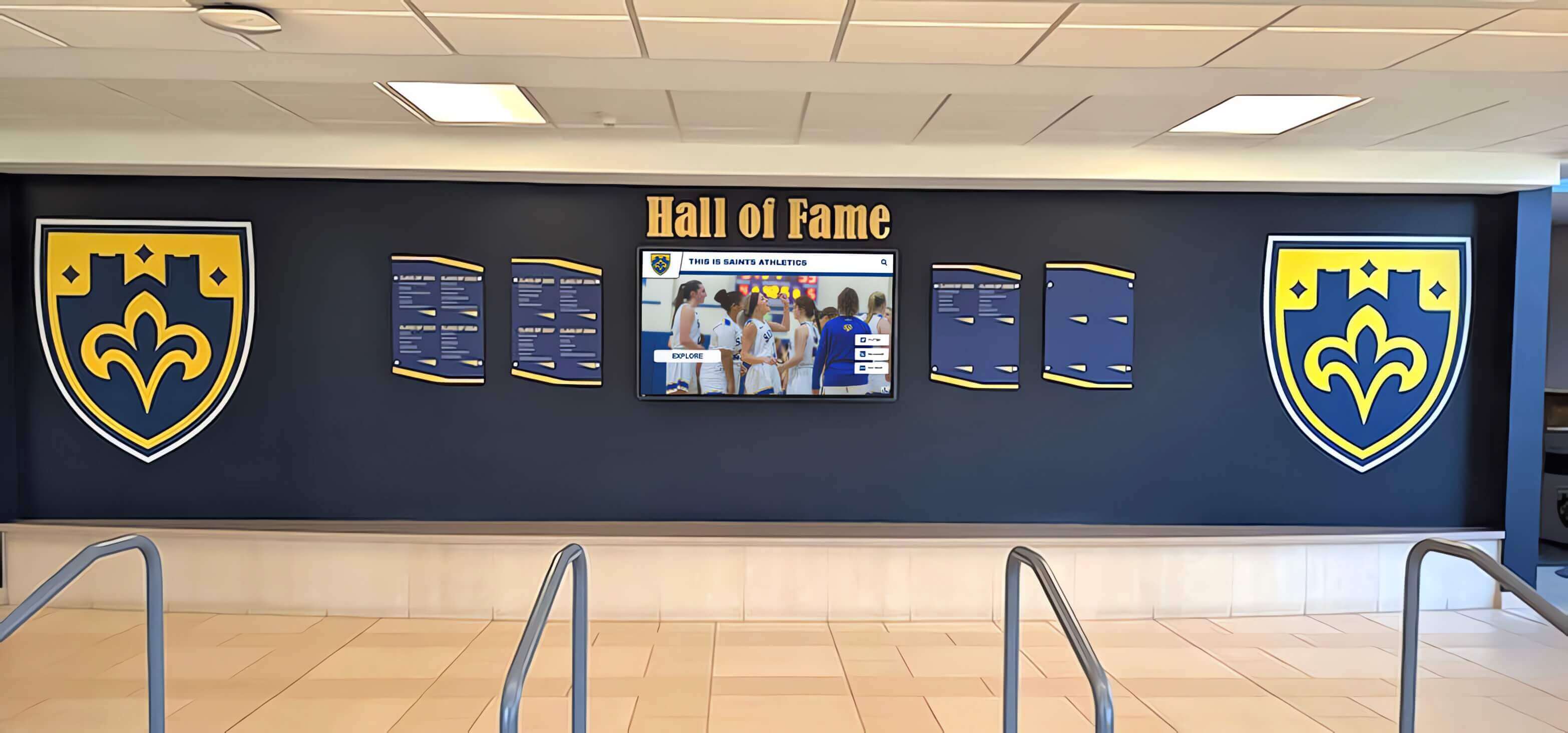
Sport-specific shield and photo displays in lobby spaces create immediate visual identity for the athletic program
Year-by-Year Chronological Walls
A chronological team photo wall tells the story of program evolution from a single vantage point:
Chronological display approaches
- Varsity team photos arranged sequentially from founding year to present
- Decade-organized sections with contextual markers (coaching tenures, facility renovations, title runs)
- Mixed-sport chronological walls showing program activity across all sports by academic year
- Timeline-format displays with photo rows and vertical year markers
Chronological walls create powerful reunion and homecoming anchors. When alumni return to campus, they scan the wall for their year, then stop to show family members their team photo. That engagement moment—a visitor actively participating with the display rather than walking past it—is worth designing for deliberately.
The practical challenge with chronological walls is consistent photography across decades. Early years often lack professional composite photos. Schools frequently close this gap using yearbook scans, local newspaper archives, and alumni-donated copies to fill historical seasons. Even lower-resolution historical images contribute to the timeline’s power when framed appropriately and labeled with clear context.
Multi-Sport Composite Displays
Athletic departments with programs across many sports benefit from integrated displays that give each program visible representation in shared spaces:
Multi-sport display organization strategies
- Seasonal organization (fall, winter, spring sport sections with all rosters represented)
- Alphabetical by sport name for equal-weight presentation
- Consistent physical footprint per sport regardless of roster size
- Central athletic identity element (school seal, mascot) with sport-specific galleries radiating outward
Multi-sport displays are particularly effective in main gym lobbies and athletic wing entrance points where all programs naturally converge. They signal department-wide investment in recognition rather than concentration on a few high-profile sports.
Design consideration: Roster size equity
A challenge unique to multi-sport displays is roster size variation. Football programs may carry 70-80 players; cross country teams may roster 10-15. If display real estate is allocated proportionally to roster size, smaller sports shrink into the background. Effective multi-sport designs use consistent physical footprints per sport—giving equal visible space to cross country and football—with zoom-in detail available for larger rosters through digital supplements or close-viewing composite panels.
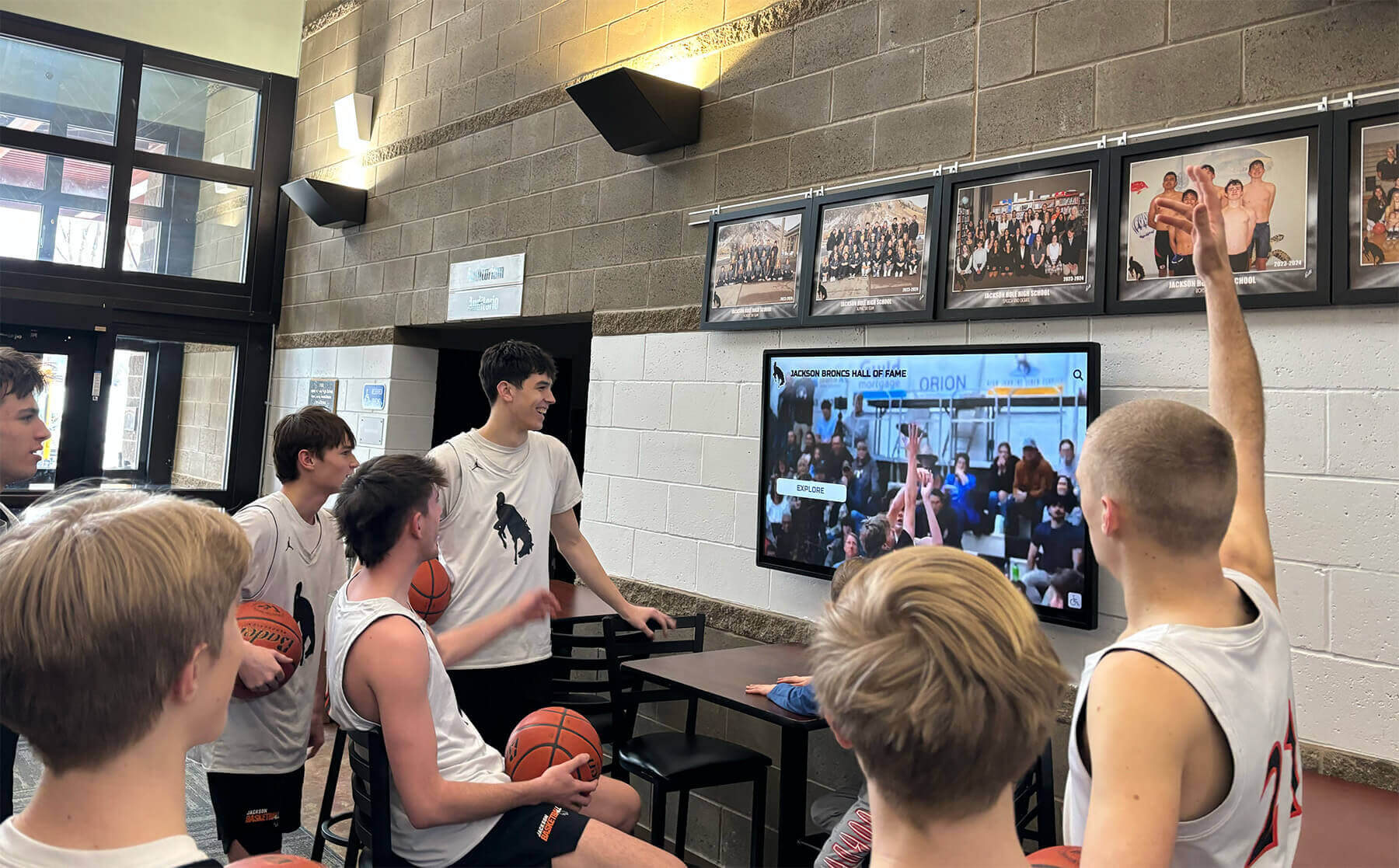
Team displays in lobby common areas create natural gathering points that build program community
Outdoor and Entry-Point Installations
Not all athletic team photo displays need to live in interior hallways:
Exterior and entry installation formats
- Weatherproof composite panels at stadium or field entrances
- Covered entryway display cases combining team photos with season records
- Lobby entrance walls visible to all visitors regardless of school hours
- Entry corridor walls that greet athletes and visitors before they reach competition spaces
Exterior installations require specific materials: UV-resistant printing, weatherproof frames, vandalism-resistant mounting hardware. The increased installation cost is often justified by the visibility these locations offer—community members and parents see the displays without needing to navigate interior hallways during restricted school hours.
Organizing Your Team Photo Wall for Maximum Impact
The best display format fails if the organizational structure makes it hard to navigate. Students, alumni, and visitors should be able to find specific teams and seasons without guidance.
Organizing by Sport
Advantages: Fans of specific programs find their sport’s history immediately. Coaches and athletes feel clear ownership of their section. Recruiting visitors for individual sports navigate directly to relevant content.
Best for: Multi-sport athletic wings, sport-specific hallways, facilities where different sports have dedicated spaces.
Organizing by Year
Advantages: Alumni navigation by graduation year is intuitive and immediately engaging. Chronological storytelling across the full athletic program rewards repeat visitors. Anniversary and milestone celebrations have clear visual anchors.
Best for: Main hallways, lobby entrances, facilities emphasizing program history and tradition over individual sport identity.
Organizing by Achievement Level
Some programs organize displays to give championship seasons additional prominence while still representing every team:
Achievement-organized approaches
- Championship and playoff-run teams featured with larger format or premium positioning
- State qualifier and all-state athlete callouts integrated adjacent to team photos
- Conference title seasons given special design treatment (color accent, larger frame, elevated placement)
- All teams represented, but standout seasons given proportional visual emphasis
All-state athlete recognition can be woven directly into team photo displays—a callout panel adjacent to the team composite identifying which players earned individual state recognition that season creates layered recognition within a single display.
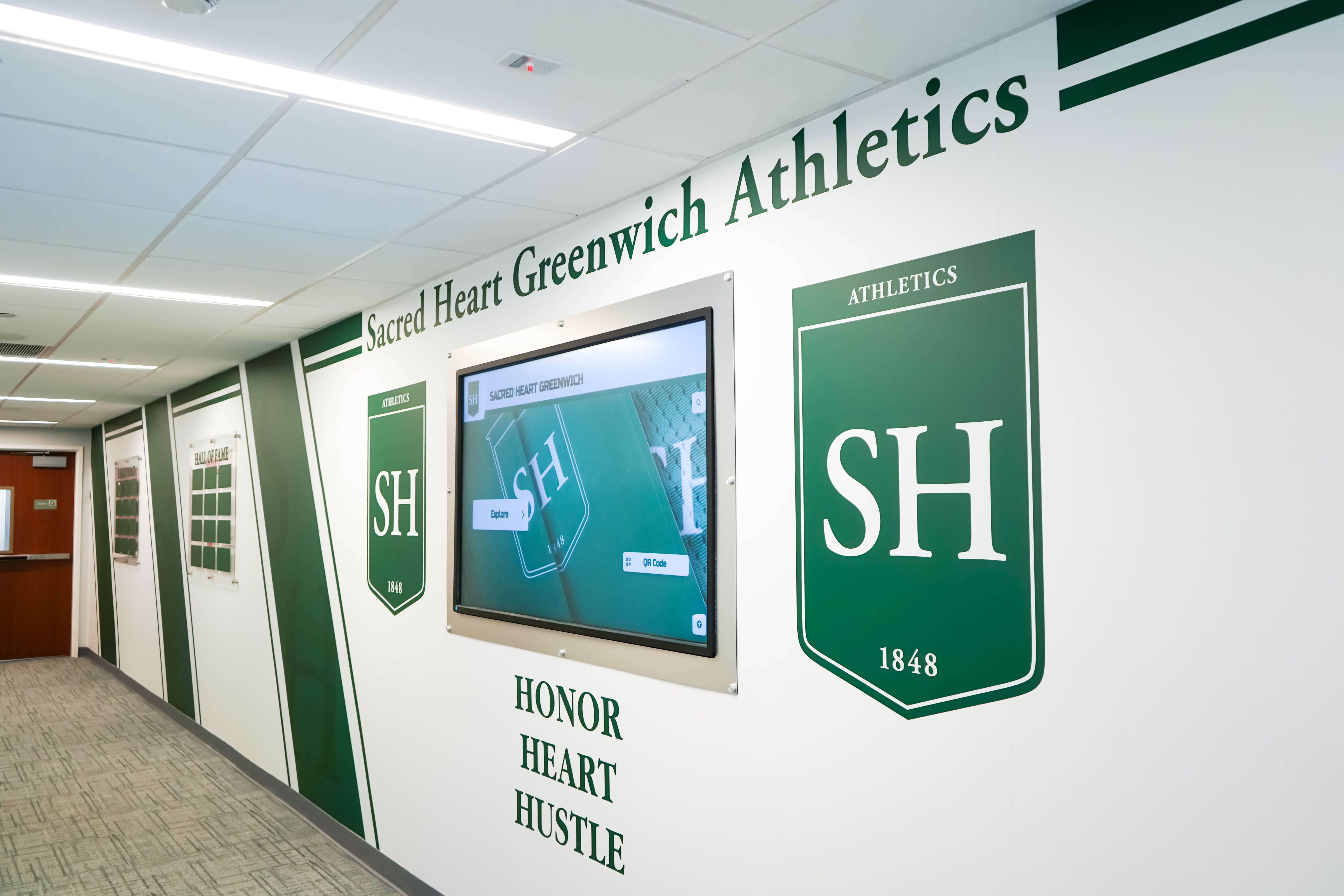
Consistent design language across sport-specific displays creates unified athletic identity throughout hallways
Design Principles for Athletic Team Photo Walls
Execution quality separates displays that look professionally considered from those that undermine the recognition they intend to provide.
Consistent Visual Language
The most effective team photo walls apply consistent design decisions across all elements:
- Frame dimensions: Same frame size for all composite photos within a section prevents the cluttered, improvised appearance of mismatched sizes
- Background and mat colors: Pulling from school color palette maintains brand consistency; a standard two-color scheme (primary color mat, complementary border) creates visual coherence across seasons
- Typography: Consistent font and size for year labels, sport names, and team identifications—matching the school’s official athletic branding whenever possible
- Spacing: Equal margins between frames signal intentional design; irregular gaps suggest afterthought placement
Scale and Placement
Team photo walls should be sized for their viewing distance. Composites showing forty individual headshots need either large-format printing or an alternative approach—small composite frames in wide hallways make it impossible to identify individuals, which defeats the purpose.
Viewing distance guidelines
- Main lobby installations visible from 15+ feet: Large-format team photos (24"×36" minimum) or digital screens capable of zooming individual portraits
- Hallway displays at 6-10 feet: Standard composite frames (16"×20" or larger) with readable name labels beneath each photo
- Close-viewing recognition panels: Smaller individual headshots with detailed career information meant for extended browsing
Lighting
Team photo walls in poorly-lit hallways lose visual impact regardless of printing quality. Thoughtful trophy display case planning includes lighting assessment as a core element, and the same principle applies to team photo walls. Directed track lighting, LED strip accents, or frame-integrated lighting transforms a dim hallway display into a genuinely featured recognition space.
Natural light creates challenges—direct sunlight fades prints and creates glare on glass-fronted frames. UV-filtering glass or acrylic and careful positioning relative to windows extends display longevity significantly.
Making Every Roster Member Visible
The most valuable aspect of team photo wall design is the opportunity to recognize athletes who won’t appear in any other recognition context. Most school recognition systems are inherently hierarchical: varsity over JV, starters over bench players, individual award winners over the teammates who never made all-conference.
Team photo walls can deliberately counteract this hierarchy.
Inclusive recognition approaches
- Display JV and freshman team composites alongside varsity—same frame size, same display prominence, same hallway positioning
- Label every player by name in composite frames, not just captains or award winners
- Include managers, athletic trainers, and team statisticians within team displays
- Multi-year displays showing a player’s progression from JV to varsity honor the full arc of an athletic career
Senior night celebrations create a natural annual moment to ensure seniors see their contributions recognized visibly—team photo displays that incorporate senior-year callouts persist long after the ceremony itself and give families lasting evidence that the school values their student’s participation.
The psychological effect of seeing one’s name on a wall cannot be replicated by a certificate handed out at an end-of-season banquet and put away in a drawer. Permanent, publicly visible recognition is categorically different from private acknowledgment—and team photo walls are one of the most scalable ways schools provide it.
The Digital Dimension: Interactive Team Photo Displays
Traditional printed team photo walls have a fundamental limitation: they fill up. After a few decades of accumulated team composites, hallways run out of wall space. Photos from the 1990s get moved to storage to make room for current seasons. The archive of institutional memory shrinks rather than grows.
Digital display technology solves this problem—and adds capabilities that physical installations cannot match.
What Digital Team Photo Walls Add
The rise of digital wall of fame displays has transformed what team photo walls can accomplish. A digital display installed in the space of a single large frame can cycle through decades of team photos, allow visitors to search by sport or year, and surface individual player profiles with career statistics and highlights.
Digital team photo wall capabilities
- Unlimited storage: Every team from every season accessible without physical space constraints
- Searchable: Students and alumni find their team by year, sport, or player name in seconds
- Instantly updateable: New season photos added without reprinting, reframing, or rehiring installation crews
- Interactive: Touchscreen interfaces allow visitors to explore athlete profiles and browse historical seasons
- Seasonal rotation: Current season teams featured prominently while historical content remains fully accessible
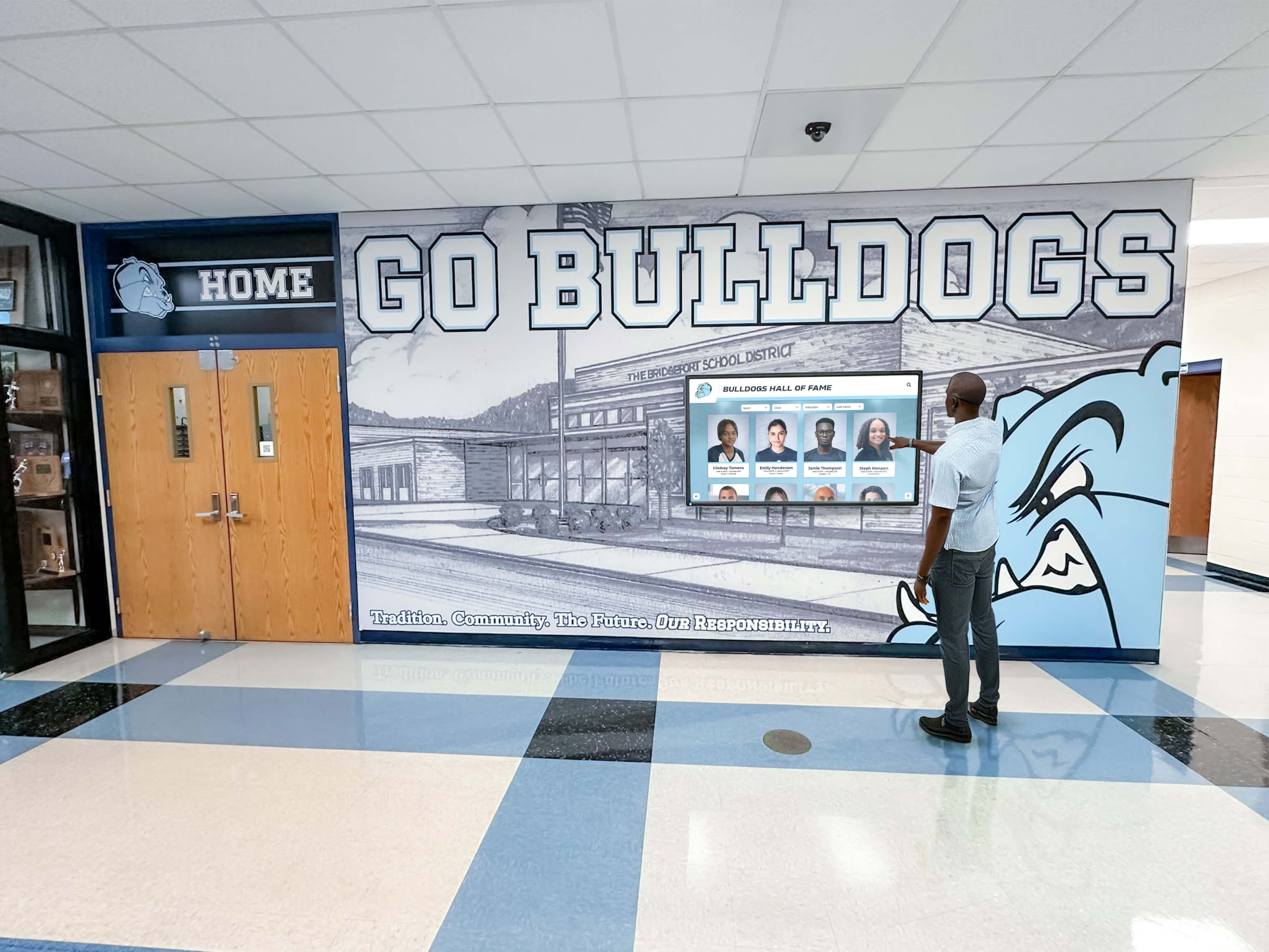
Interactive digital displays allow visitors to actively explore athletic history rather than passively observing static photos
Hybrid Approaches: Physical and Digital Together
The strongest athletic team photo wall installations often combine both approaches rather than choosing one over the other.
Physical elements anchor the display with permanent visual identity—school branding, mascot graphics, and championship-season composites in premium frames that signal tradition and investment. Physical displays carry emotional weight that comes from tangibility: the frame on the wall communicates permanence in ways a screen cannot fully replicate.
Digital elements extend capacity and interactivity—touchscreen kiosks adjacent to physical composites allow visitors to see the full roster, view additional action photography, and access historical seasons that don’t fit on physical walls. A single screen positioned alongside a physical championship display can hold the complete program history for every sport.
Modernizing athletic recognition walls typically follows this hybrid approach: physical composites from recent championship seasons get pride of place, while digital displays surface the historical archive that would otherwise remain invisible in storage.
Content Management for Digital Team Photo Displays
Digital displays require content workflows that physical walls don’t. Establishing these workflows during system setup prevents the backlog that develops when content management is treated as an afterthought:
- Annual team photo uploads at the start or end of each season
- Individual player profile creation (names, positions, class year, notable achievements)
- Metadata tagging enabling search and navigation by year, sport, and player name
- Consistent photography standards ensuring uniform display appearance across seasons
Athletic hall of fame display software platforms purpose-built for school recognition handle these workflows with interfaces designed for athletic directors and sports information staff—not IT specialists. The right platform turns annual content updates into a consistent 30-minute workflow rather than an annual production project.
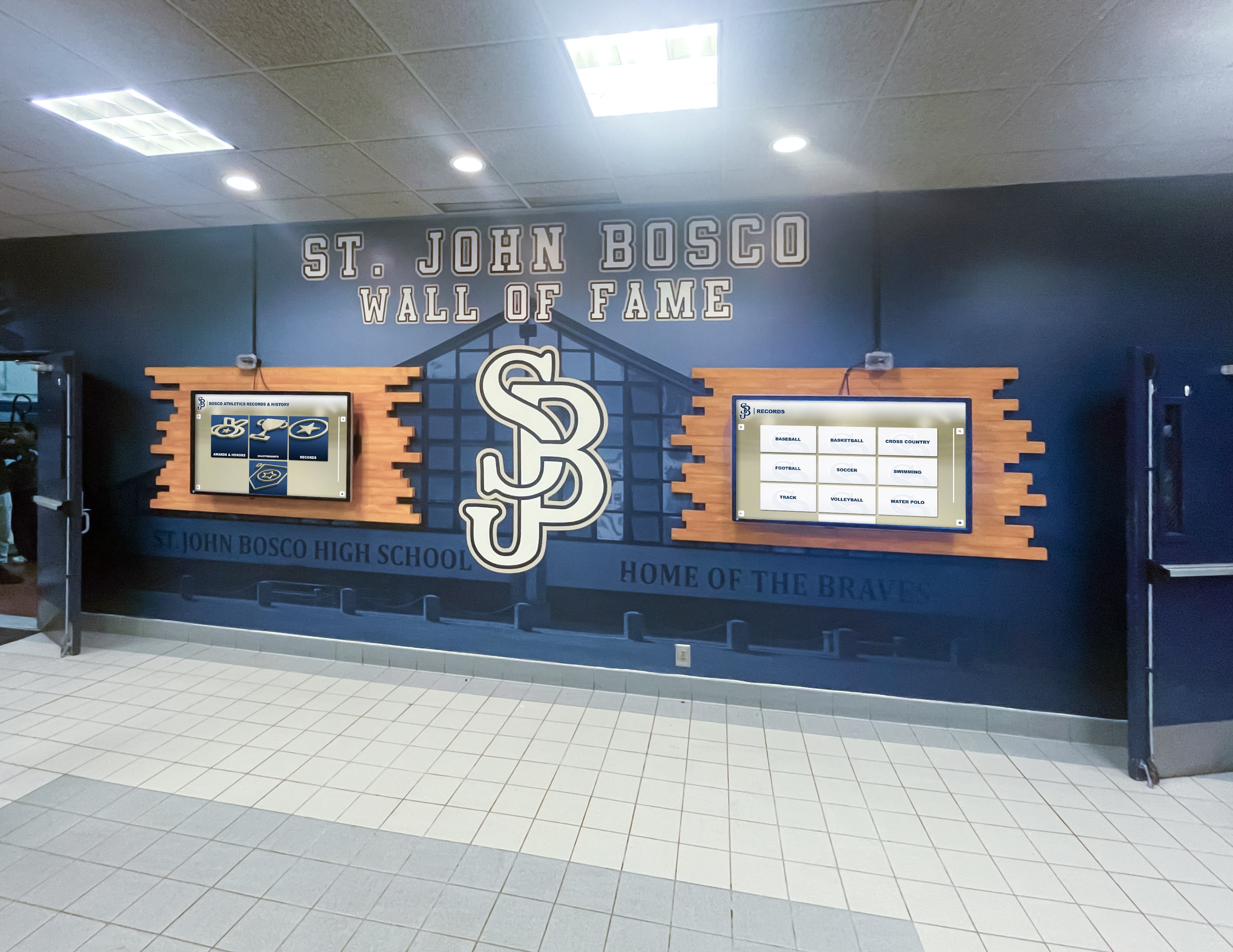
Dual-screen wall of fame installations maximize recognition capacity without requiring extended continuous hallway space
Planning and Implementation
Site Assessment Before Installation
Before purchasing frames, selecting display software, or scheduling photography, assess current state honestly:
Key assessment questions
- Which hallways carry the right traffic for team photo displays to be regularly seen?
- How many years of team photos currently exist, and in what physical or digital format?
- Who will manage annual photography and content updates—and is that realistic with current staffing?
- What budget is available for installation, and what ongoing costs require annual planning?
- Does the facility already have electrical infrastructure where digital displays would be located?
State championship recognition planning provides a useful scoping model—the same questions that determine how to recognize a championship season apply to determining how to build a sustainable team photo display program.
Phased Implementation for Sustainable Projects
Large team photo wall projects often work best in phases rather than attempting a complete historical installation all at once:
Phase 1 — Current seasons: Establish photography standards and display format for the current academic year. Install a consistent system going forward before addressing the historical backlog.
Phase 2 — Recent decade: Work backward 10-15 years, sourcing team photos from yearbooks, department files, and alumni collections. This phase establishes the display as a genuine archive rather than a bulletin board.
Phase 3 — Historical depth: Extend back as far as records allow, filling gaps with yearbook scans and community-sourced photographs. This phase transforms a recognition board into institutional memory infrastructure.
Facility tribute and naming programs often trigger comprehensive recognition installation projects—facility dedications create momentum for broader investment in how schools display their athletic history.
Budget Planning
Team photo wall costs vary widely based on format, scale, and whether physical or digital systems are involved:
Physical installation cost factors
- Professional composite photography: $200–600 per team per season
- Commercial printing and framing: $50–200 per composite frame, with volume pricing available
- Installation hardware and labor: $500–2,000 depending on wall preparation and mounting complexity
- Lighting upgrades: $300–1,500 for directed track lighting or LED accent systems
Digital installation cost factors
- Commercial display hardware (55"–75" screens): $800–3,000 per screen
- Touchscreen overlays or purpose-built touchscreen systems: $2,000–6,000
- Athletic recognition software licensing: $500–3,000 annually
- Content migration and historical archive setup: Varies by volume of material
Booster clubs, alumni capital campaigns, and local business sponsorships frequently fund athletic recognition installations when the proposal clearly articulates the recognition value for the full school community—not just for the athletic program itself.
Frequently Asked Questions About Athletic Team Photo Walls
How often should team photo walls be updated?
At minimum, add the current year’s team composites each season. Athletic programs that photograph all teams—varsity and JV—and install updated composites at the end of each season maintain displays that feel current and actively maintained. Digital systems allow more frequent updates, including mid-season achievement callouts added immediately when earned.
What’s the best way to handle sports with limited historical photo coverage?
Work with available sources rather than waiting for complete records. Yearbook scans, local newspaper archives, and alumni-sourced photos fill historical gaps effectively. Even lower-resolution historical images, clearly labeled with year and team name, contribute to the chronological story. A public note acknowledging that photos from specific years are being sought from the community regularly generates alumni submissions from former athletes who didn’t know the school was interested in their personal collections.
How do you display team photos for sports with very large rosters?
Large rosters—football, marching band—require either large-format composite printing (30"×40" or larger) or split-panel approaches breaking the team into position groups or subsections at a readable individual scale. Digital displays handle this most elegantly: a large-format screen shows the full team as an overview image while allowing touchscreen zoom into individual sections for name-level identification.
Should JV and freshman teams be displayed alongside varsity?
Yes—including all competitive levels is one of the most impactful choices an athletic program makes when building inclusive culture. When a freshman who didn’t make varsity sees their team photo on the wall alongside varsity teams from previous years, the message is clear: participation and commitment are valued, not just the statistical outcomes of the most advanced athletes. Programs that honor every level of competition typically see stronger participation across the full athletic program over time.
How do digital team photo displays compare to physical composites over time?
Physical composites have lower initial installation costs but accumulate ongoing printing and framing expenses each season—and face the space limitation that eventually requires removing historical content. Digital systems require higher upfront investment but eliminate annual printing costs and add capabilities (interactivity, unlimited historical storage, searchability) that physical systems cannot match. Most schools find that a hybrid approach delivers optimal results: physical composites for recent seasons, digital systems for historical depth and interactivity.
Turning Team Photos into Lasting Athletic Identity
The hallways of a school with strong athletic culture do something specific: they make every player feel like part of a tradition larger than any single season. Athletic team photo wall ideas—whether traditional composite galleries, sport-specific hallway timelines, or interactive digital walls—accomplish that goal by putting faces to the tradition, names to the championships, and visual identity to the teams that built a program’s reputation over decades.
The most important design decision is also the simplest: commit to including every roster. Not just varsity. Not just champions. Not just the players who earned individual recognition. Every team photo, every season, every player who showed up.
Rocket Alumni Solutions designs and installs custom touchscreen walls of fame, digital team photo display systems, and interactive athletic recognition installations built to make that inclusive recognition permanent—and to keep it visible, updated, and accessible year after year.
Recognize Every Player on Every Roster
From traditional composite galleries to interactive touchscreen walls that surface decades of team history, Rocket Alumni Solutions creates athletic recognition systems built for the whole team—not just the highlights.
Get notified when Rocket Graphics opens